
The collective IQ of Australasia’s office towers is steadily rising as a growing number of smart building projects is completed. With the accompanying improvement in building’s green credentials, the result is the creation of human- and environment-friendly spaces that tenants are queuing to occupy. The evidence is in the rapidly growing number of green stars awarded to construction projects by each country’s green building advocacy body. It is clear developers are increasingly willing to pay for clever design and smart technology in pursuit of better efficiency.
The Green Building Council of Australia certified 150 Green Star projects last year, 43 percent more than 2013. On the other side of the Tasman, the New Zealand Green Building Council (NZGBC) has certified a total of 70 four-star or better projects.
In the background, architects and engineers are equipping themselves with the IT tools and expertise to enable them to design, construct and operate buildings to exacting certification standards. Vanessa McGrath, the NZGBC’s senior technical co-ordinator, says adoption by the construction industry of building information modelling (BIM) software and building management systems (BMSs) is a positive development.
“IT provides powerful tools to model building performance in terms of response to climate and other conditions at the design stage and to manage buildings efficiently and fine-tune them in response to occupants’ needs,” says McGrath.
BIM, in particular, is having a profound effect, requiring design teams to go beyond “design intent” to “fully co-ordinated and integrated designs”, she says, creating a shift in responsibility within the construction world. A fully implemented information modelling system will tie in with a host of other systems to ensure a smart building design isn’t let down by poor commissioning and operation.
“BIM is used in the design and construction stage and then can be fed into the management system. BIM technology in operation can combine a BMS with energy management systems, integrated work management systems (IWMS) and computerised maintenance management systems (CMMS). BIM systems link drawings, specifications, operation and maintenance manuals, warranties, systems test reports and other project records in one place. This can make a facilities manager’s job easier and more efficient,” says McGrath.
A fully commissioned example of high-level integration is the University of Queensland’s A$30 million Global Change Institute (GCI) facility, designed by global building design agency HASSELL and built by Towoomba-based construction firm McNab. The degree of automation of the six-star-rated building, one of Australia’s first, was recognised with an award for sustainability through innovation last year.
The structure, which is touted as a ‘living building’, features automatic internal and external blinds, louvres, shade-screens, in-slab cooling and audiovisual and lighting systems that interface with a BMS, described by the building’s operators as central to its day-to-day running. Its four levels have no air-conditioning, relying instead on a suntracking shading system and a central ‘thermal chimney’ for temperature regulation.
Solar roof panels connected to storage batteries produce all the electricity the building needs and a storage tank holds 60,000 litres of rainwater for cooling and kitchen and shower use.
A range of touch panels throughout the building connect to one of seven master controllers, which talk directly to the BMS. Building manager David Harris says the ability for users to control room temperature, lighting and airflow locally, while feeding information through to the central controller, was critical to the system’s success.
“The management system enables us to continually monitor the building’s operational status and user preferences, which will allow us to make the building even more comfortable for staff and students in the future,” he says.
Even before the building was standing, McNab implemented BIM systems to help it to manage the construction process and feed vital information to Australia’s green building certification body, opting to use cloud-based conject applications. General manager, environmental services, Mark Jewell says the rigour of the Green Star rating process and the building’s complexity convinced McNab to opt for conject, which can receive, index and store almost any document, communication, report and contract associated with any project.
Instead of two or three people taking up to six weeks to collate the information required for Green-Star certification, software can be expected to cut the duration and headcount needed for the work by more than half.
BMSs such as that in the University of Queensland facility are nothing new, but the NZGBC’s McGrath says they are becoming more capable.
“The use of fuzzy logic allows the BMs to learn how occupiers use the building and can optimize thermal comfort and energy efficiency accordingly.”
“What’s happening is that systems are becoming more adept, more sophisticated and increasingly allowing access to real-time data in a useful format that enables continuous commissioning. The use of fuzzy logic allows the BMS to learn how occupiers use the building and can optimise thermal comfort and energy efficiency accordingly.” McGrath says ASB Bank in Auckland, for example, is making data available to staff so they can play a part in maximising building efficiency.
According to Frans Plugge, however, buildings are often born smart but fail to reach their potential. Plugge, of Wellington’s ECOsystems, says the company’s engineers frequently go into buildings with impressive environmental credentials but the facilities are being mismanaged.
“It’s amazing how much of our work is in fivestar green-rated buildings,” says Plugge. “They have good equipment but the way they’re programmed and commissioned means in the majority of cases our work is still required. That’s because the Green Star rating relates to building design, not operation.
“About five years ago we looked at best practice in the US and UK and concluded that buildings in New Zealand were using about double the amount of energy they should be. We have a pretty temperate climate compared with many parts of the US and UK, which experience greater extremes of cold and heat, so we shouldn’t need to use anything like the energy we do.”
Sometimes energy waste can be put down to lack of intelligence on the part of a building’s operators, such as when heating and cooling are merrily taking place at the same time. An energy audit by a team of ECOsystems’ control, mechanical and electrical engineers, can unlock such savings.
“What we typically do is spend months on-site to get an understanding of how a building functions, how the controls operate, where the energy is being used and what we can do to reduce consumption,” says Plugge.
It’s not that technology isn’t being used for building management but that it’s not being well implemented. Office equipment such as a photocopier, for instance, might be placed beneath a temperature sensor, which then gives an elevated reading and triggers unnecessary cooling.
Or an employee arriving at work on a cold morning might take his place at his desk, feel chilled after the warmth of his car and request that reception have the heating cranked up. The receptionist relays the message to the facilities manager, who calls an off-site control operator who turns up the temperature.
Meanwhile, a late-arriving worker reaches the office after it has been warmed by the sun and wants to be cooled. “There are a number of scenarios like that happening all the time that mean we’re using much more energy in our buildings than we should be.”
 At Dowse Art Museum in Lower Hutt, for instance, cooling of exhibition spaces was an uphill battle because of warm air entering through the gallery’s open restaurant doors on sunny days. The answer was to install doors between the dining and temperature-controlled areas.
Similarly, at McDonald’s outlets it was found airconditioning units in the kitchens and dining rooms were both set to 21 degrees Celsius, without regard to the different uses of each space. In the kitchen, where heat’s being produced by cooking, cooling is constant to provide a comfortable working environment.
In the dining room, however, 21 degrees is unnecessarily warm in winter when customers enter dressed for much lower outdoor temperatures. Conversely it’s cooler than necessary in summer when outside temperatures can be in the 30s. Turning the temperature down by two degrees in the winter and vice versa in summer represents a huge energy saving. “Heating and cooling is where the bulk of energy is used,” says Plugge.
ECOsystems sets out to cut energy use in commercial buildings by half, which Plugge sees the internet of things playing a big part in. “At this stage it’s about putting sensors in the right place and automating controls so that if, say, the temperature is adjusted, it goes back to its original setting after a period of time.”
 The cost-effectiveness of technology such as LED lighting, which uses half the energy of alternatives, keeps improving. Installing equipment and using the information from it correctly is the next stage. If sensors show the outdoor air temperature is lower than indoors, for instance, cooling can be provided by pumping fresh air in rather than the less efficient refrigeration of indoor air.
There’s no shortage of hardware and software for the task. But very often the problem is the ‘wetware’ or the human element. “The big factor is the tenant-landlord conundrum, as we call it.” Landlords aren’t eager to pay the capital cost of energy-efficiency systems. For the tenant, meanwhile, staff overheads dwarf energy savings, and there’s a perception that their comfort might be compromised by sub-optimal environmental settings.
“There’s no shortage of hardware and software for the task. But very often the problem is the ‘wetware’ or the human element.”
But perceptions are changing, says McGrath. “There are some positive models of tenant-landlord collaboration on energy efficiency. For example, IAG is working closely with owners Goodman Property in Christchurch and Newcrest in Auckland to ensure energy-efficient premises.
| Measuring for successA developer might go all out to build a six-star green-rated building, but that doesn’t guarantee it will cost a fraction of the cost of a less smart structure to run.“It’s a bit like being a Toyota Prius owner. Unless you drive it the right way, you’re not going to get the high mileage per litre of fuel out of it that it’s designed for,” says Vanessa McGrath of the New Zealand Green Building Council.
For that matter, throwing every monitoring and automation gadget at a building isn’t going to be much use if the basic principles of sustainable construction –orientation to the sun and how a building responds to the climate – aren’t followed. “IT can be a great boon in modelling and designing for the climate,” says McGrath, pointing to the ‘parametric design’ of Adelaide’s South Australian Health and Medical Research Institute building as an example. It too features shades that change orientation to provide protection from the heat and sun. “It’s about using a lot of data to guide a design that is as low-energy and as responsive as possible. Once a building is operational, smart collection and use of energy and other data is a great tool for efficiency. But it’s not just about having the data – you need to know and understand how to use it and have a plan.” That’s where Nabers – the national Australian built environment rating system – and its New Zealand offshoot Nabersnz come in. Nabers was developed to measure a building’s energy efficiency, water usage, waste management, indoor environment quality and impact on the environment, scored from one (signifying considerable scope for improvement) to a market-leading six stars. Building information modelling (BIM), which the New Zealand Government is promoting in a bid to boost construction industry productivity, goes hand in hand with tools such as Nabers. The Ministry of Business, Innovation and Employment, which is leading a ‘productivity partnership’ initiative with the industry, calls BIM a game-changer. By producing a digital representation of the physical and functional characteristics of a building, BIM gives a reliable basis for decisions concerning the structure throughout its life. The process is being adopted by architects and engineers including Jasmax and Beca. According to research by McGraw Hill, Australia and New Zealand are leaders in BIM use. By the end of this year, nearly threequarters of 435 construction industry professionals surveyed in the two countries expect to be using BIM in 30 percent of their projects, McGraw Hill says. With both Auckland and Christchurch in the middle of construction booms, that has to be a good thing for all. |
“We’re seeing a strong impetus for green building – energy efficiency is only one benefit – albeit an important one. Green buildings have been shown to provide a range of benefits, beyond just energy efficiency, such as healthier and more productive work environments with improved indoor environment quality.”…
Talk IT system usability and, without prompting, one name keeps coming up — Apple. Thirty years ago it began setting the desktop user interface standard with the Macintosh. But when it began selling the iPhone in 2007, the software development world really sat up and took notice.
“Apple’s single advantage is it has always managed to prioritise and focus on what the top task of its devices is, rather than loading them with multitudinous features,” says Dublin-based system usability specialist Gerry McGovern.
Apple raised the usability bar another notch in September with the iPhone 6 and iPhone 6 Plus. The new phones have near-field communications, or NFC capability, adding to the multi-touch control, voice activation and fingerprint recognition of their predecessors. Although hardly a new technology – everyone from Acer to ZTE makes phones with the feature – what Apple promises is to make an NFC-based payment system mainstream. And its record at seeding the app market suggests it will pull it off.
Just to get it started, it has the credit card details of 800 million iTunes customers ready and waiting, and a slick name, Apple Pay. But Apple’s trump card is its fixation with making software as easy to use as possible.
“It has been very selective in how it designs things, which takes a lot of talent, a lot of management, a lot of effort to focus on what is critical,” says McGovern.
He gives Google points for applying the same discipline in the design of its search engine and other online services. And it’s no coincidence, he believes, that both Google and Apple are flourishing.
What works with user interfaces, apps and the web is just as relevant to the world of business applications. But in what McGovern condemns as almost a management conspiracy, ease of use seldom seems to enter into the design of enterprise software.
Instead, using business systems is like “undergoing some form of medieval torture”.
“The vast majority of companies just don’t get it. Even though we have a new model of management that is evidence-based, seeking continuous improvement and focused on functionality, most organisations seem incapable of adapting to it.”
Management professes to be driven by the desire to lift worker productivity, but legacy IT systems have the opposite result, McGovern says. His web design business, Customer Carewords, often works on company intranets and he says it’s common for staff to avoid them because they border on being unusable.
“They are monstrosities that consume huge amounts of productive time and management has got away with it by saying they are mission-critical, which is why they’re impossible to use.
“Managers don’t care if it takes staff 10 minutes or 15 minutes to book a meeting room — they have a view of white-collar employees that their time is elastic and they can always stay at the office longer to get the work done. I’ve spoken to managers in about 40 countries and it’s the same everywhere – a complete contempt for employees’ time.”
Enterprises begin to get it
Cynicism aside, the phenomenal explosion of app development started by Apple and copied by Google, Microsoft and others is, at last, beginning to influence business application designers.
For one thing, the sheer user-friendliness of apps on smartphones and tablets is contagious. If IT departments initially tried to stem the tide, the growing number of organisations with BYOD, or bring your own device, policies shows resistance is futile.
In a September report on the Australian software market, analyst firm IDC listed IT’s consumerisation and the BYOD trend as having a big influence on the way applications are developed and deployed within organisations.
But this is bigger than Australia. In perhaps the clearest sign that the business software world is getting usability’s importance, New York-based Infor, No. 3 in the worldwide ERP market behind Oracle and SAP, has set up a design shop to drive the company’s products “past functionality and into more meaningful experiences”.
Called Hook and Loop, it has a string of catchy slogans — “no fugly software”, “users first”, “device agnostic”. More meaningfully, however, it has brought out its first software, SoHo, aimed at giving a friendlier face to Infor’s suite of business applications.
Marc Scibelli, Infor’s creative chief and head of Hook and Loop, says SoHo’s uniform interface, based on a common set of controls and patterns, is intended to make it easier for a user in a distribution company, for instance, to switch from a financial package to an order-placing application.
If feedback from the company’s September Inforum user conference is anything to go by, customers – about 2000 of whom have adopted SoHo – like the direction Infor is heading in.
“No one is saying ‘God, I wish you’d go back to the old look and feel’,” says Scibelli, who comes from a design rather than software background.
There’s no mistaking that apps, and Apple – September’s iOS 8.0.1 stumble notwithstanding – are driving the usability trend, says Scibelli. The employees being recruited today by Infor’s customers aren’t prepared to endure the business system learning curve of the previous end-user generation.
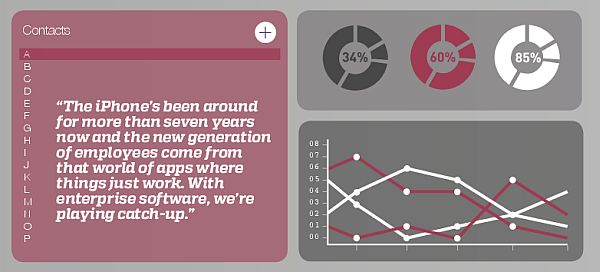
“The iPhone’s been around for more than seven years now and the new generation of employees come from that world of apps where things just work. With enterprise software, we’re playing catch-up.”
Still, corralling Infor’s disparate products with SoHo’s single user interface isn’t the same as reducing their functionality to the simplicity of an app. But that’s what Hook and Loop is working on next in a project called Clearwork.
What the shop’s designers are up to now, says Scibelli, who at 38 is more than 10 years older than his average employee, is rethinking the business processes at the heart of Infor’s enterprise applications. “A lot of these processes – take order buying, for example – haven’t changed in 15 years. We’ve added lots of features to them, but nobody has asked what the best way is of doing them.”
Hook and Loop’s approach is to take those discrete processes and reduce them to app-sized chunks.
“We’re reinventing how someone accomplishes that one task.”
Age of agility
‘Appification’ of feature-rich systems such as Infor LN and Infor M3, which cater for tens of thousands of ERP processes, if users know how to tap all that functionality, would take forever were if not for another increasingly important trend; agile development.
Zach Nies, technology head at agility specialist Rally Software, in Boulder, Colorado, says the company helps big organisations (Telstra is a customer) take advantage of disruptive market influences such as the rise of apps rather than fall victim to them.
“We’ve being helping Telstra launch many agile programmes through its development organisations,” says Nies. Telstra’s Em Campbell-Pretty told Rally’s 2013 user conference in Boulder that after the telco transformed its enterprise data warehouse development group into Agile teams, metrics including delivery cycle time, delivery cost and product defects were all dramatically improved. The first step on the path to agile development, says Nies, is to shift from a data–centric organisational view to one of putting the user or customer at the centre.
“Data is valuable but engagement is critical from a financial or customer value standpoint.” Agility makes possible cross-functional development and rapid, iterative releases of software to enable users to access legacy data in the way that makes sense to them.
“Users interact with great products in a natural and effortless way but that’s extremely hard to get right the first time. Even Apple, which you might think makes that its hallmark, goes through an iterative process – it just doesn’t do it with the outside world.
“You need what I call a high metabolic rate as a development team to quickly understand what users want, deliver it, then rapidly learn whether that’s exactly what they wanted or is there a better way to engage with them.”
Be willing to learn
For McGovern, agility means something else as well: in the world of website design, which he knows best, some outfits will take weeks to make a simple content change that top companies carry out in seconds. “I’ve seen companies that have changed a word, phrase or link 50 or 100 times to optimise it so that it resonates with the customer. The result is they sell more stuff or they have fewer support calls — it unquestionably pays off.
“But with other organisations it’s as though they have arthritis – their bones are stiff and they need to go and do some pilates.”
Those organisations would benefit from coaching by what he sees as a “new wave” of agile designers who spring from the web and app worlds. “These people use the web as an ecosystem for getting software live, then it rapidly evolves. It takes a lot of skill. You have to have a vision and plan and then be flexible and constantly adapt.
“It requires a certain type of personality. People who are adaptive and inquisitive and willing to learn from the customer.”
| Getting the job doneSmartphones, tablets and the millions of apps their owners are leading to consumerisation of the enterprise, says Byoern Schliebitz, of Sydney agile consultancy PanthaCorp.“The start-up companies that are developing these apps understand that the journey begins with the user and user expectations have changed.”A further factor in the transformation of legacy IT is the advent of cloud services, which enable computing capacity to be switched on and off like a tap.The development process itself is undergoing a revolution. Instead of nutting out a ‘golden persona’ or highly detailed software specification, the approach of PanthaCorp and its ilk is to spend a few weeks sketching an application outline before user experience (UX), designer and programming teams work in a ‘scrum’ on a series of iterative releases.“The zeros and ones are not the difficult part, it’s communications and decision-making that counts.” Instead of a swamping ‘waterfall’ method of project delivery, work is broken up into more digestible units. And UX is at the centre.
“There’s general agreement now among our clients that user experience really does matter. As funny as that sounds, this is quite significant. It’s not something we have to sell, our clients are demanding it. McGovern is cynical about “genius designers or genius managers making decisions based on their incredible instincts”, rather than on readily obtained user and usability metrics. “There are certain things people need to do more often than others and those things should be easier to find and easier to do. The thing you do 10 times a day should be easier to find and do than the thing you do once a month.” On the web, function trumps form, he says. “This is what makes money for all the big websites. The successful websites, Facebook, for example, don’t have beautiful designs but rather rigorously tested functional designs.” |
…
The internet of things enables any object that can be represented digitally to be controlled from anywhere. That object might be used to monitor a production process and can help improve operational efficiency and safety. Or it might be used for home security – currently one of the hottest IoT consumer markets – where a rapidly expanding range of devices integrated with cloud services and smartphone apps is designed to alert you to anything untoward on the domestic front, no matter where you are.
But how? Simple: a motion sensor and webcam connect through an internet router to a web server, which sends a message to the property owner based on a set of rules. He or she can then take a look at what’s going on via a web browser or app.
The essential components of these networks are sensors, a communications link over which sensor signals are relayed and a server to translate the signals into a web-friendly format. Although conceptually simple, there are plenty of ‘gotchas’ in patching in to the internet of things, from ensuring equipment can withstand the weather and other environmental hazards to designing resilient power supplies and network links. This guide describes some successful IoT implementations.
Sensors
No one likes to be thought of as a thing. But in IoT terms, humans are potentially just as much things as the billions of other objects that can be connected to the internet.
That’s precisely what Melbourne-based Catapult Sports does. The company, which sprang from the Australian Institute of Sport in the mid-2000s, hooks up thousands of athletes from hundreds of clubs and institutes covering dozens of sporting codes to the internet.
The New York Giants, AC Milan, Brisbane Broncos and Canterbury Crusaders are among its illustrious customers.
Catapult’s early expertise was in sensors, says sports scientist Michael Regan. The monitors it attaches between athletes’ shoulder blades are about half as long and one-and-a-half times as thick as an iPhone.
Yet they carry 11 sensors, including accelerometers, gyroscopes, magnetometers, heart rate and GPS trackers, and they process and store data.
“They measure whole and micro body movement,” Regan says. “The GPS measures when you go from A to B, but at the elite sport level it becomes vitally important how you move, which is measured by the other sensors.”
With the exception of the GPS, which samples data at 10 times a second, the sensors sample at 100Hz, transmitting the data by radio frequency to a receiver up to 200 metres away.
Because sports arenas are often enclosed and partially roofed, a standard GPS chip would not be up to the job, so the monitors communicate with two satellite constellations.
A GPS receiver is about as simple as an IoT sensor gets, but Auckland company Argus Tracking has built an entire business on them.
A typical customer, says managing director Aaron Muir, is the IHC, which has a fleet of 700 three- to 12-seater vehicles.
“The goal is to get data from those vehicles and turn it into meaningful information that customers can use to cut operating costs,” Muir says. In the IHC’s case, simply being able to map drivers’ routes as they ferry service users around has cut the non-profit organisation’s fuel bill by 16 percent, or $800,000 a year.
In truth, Argus Tracking’s vehicle sensors do a little more than just report location. They also record speed, G-forces and driver-inputted data such as vehicle occupant numbers.
Another customer, Ports of Auckland, has cut crash rates by half by using Argus Tracking’s system to disable vehicles ranging from straddle cranes to utes when unauthorised drivers – identified by radio frequency ID, or RFID, tags – attempt to get behind the wheel.
“No one likes to be thought of as a thing. But in IoT terms, humans are potentially just as much things as the billions of other objects that can be connected to the internet.”
Communications
At the heart of the internet of things is the internet protocol, or IP. Network equipment maker Cisco says a common first step for organisations towards the IoT is converting proprietary protocol-based networks to IP.
But the network demands of IoT devices are not typically huge.
Argus Tracking’s GPS sensors rely on Vodafone’s relatively slow 2G network, which Muir has been assured will continue to be supported until 2025. It is perfectly adequate for the job – each SIM-equipped device, the total number of which Muir won’t disclose for competitive reasons, sends a small amount of data.
But it adds up: collectively they transmit 13 million position updates a day, he says.
Catapult, working in either confined indoor or outdoor sports arenas, transmits sensor data via RF links from the athlete-worn monitors to a receiver-equipped laptop.
Regan says each monitor collects about 1000 data points a second, but the actual transmitted data stream is reduced by on-board processing.
“The amount of data we’re producing is extraordinary, which is where the communication and presentation challenge comes in.”
Displaying data
To a greater or lesser extent, extracting useful information from the internet of things depends on standards.
In the world of RFID tags, standards are everything, says Gary Hartley, secretary of New Zealand’s RFID Pathfinder Group, which is driving adoption of the technology. The group is allied to GS1 New Zealand, Hartley’s employer and part of an international supply chain standards organisation.
As proof that there is an infinite variety of things on the internet, GS1 has just completed a trial tracking a shipment of halal meat products from a meat processing plant near Greymouth to Malaysia.
At 11 points along the way, including port of departure Lyttelton and Port Klang in Malaysia, where the edible offal was landed, each carton of the consignment was scanned making detailed information about the contents and their origins accessible online.
Where the IoT is used for freight tracking, standards are crucial, Hartley says. The key to deciphering the RFID meat shipment data was use of electronic product codes, unique numbers that at each scanning point displayed “what, where, why and when” information for each carton.
“Once you get down to that granular level you can start making supply–chain decisions based on whether goods are where they’re supposed to be and that the consignment only contains the items it should.”
If an unrecognised product code appears, that implies a breach of the supply chain and potentially counterfeit goods, with the danger that represents for the supplier’s reputation.
“If you use whatever number you like and I use whichever one suits me, we’ll never agree on what the item is, so the killer app in my view is the sharing of standardised data.”
In the money-driven world of professional sport, however, you can forget standards. Catapult’s competitive edge comes from developing ways to display athlete sensor data just as the customer wants it.
For the coach of an American football team, that might be knowing just how hard to push players during practice so that they can still perform in the next game. The team manager, meanwhile, might be more interested in relating athlete performance to bums on stadium seats.
Regan says he has been asked that very question by a US team official: “I was giving the spiel about how our technology can help with injury prevention and improving performance and he said ‘stop, what in your data equates to a higher number of season ticket holders, higher ratings and more merchandise sales?’.”
Regan says Catapult can’t deliver that yet, but that’s the goal.
“We have to embrace the analytics wave because what we measure does have links and application for a whole football programme or business.”
Catapult’s OpenField software is the first analytics programme designed from the ground up that begins to offer that level of customisability.
“Our industry is trying to take econometrics and that sort of thing and sandwich it into sport. But what we’re aiming to do is build something that is sports-specific in terms of analytics and deep data integration.”
In the end, says Argus Tracking’s Muir, it all comes down to the internet – in the first place to aggregate sensor data, then to provide customers access to the information it represents. The next step is big data analytics.
“As recently as two years ago we couldn’t have contemplated that because the tools were too expensive. Now we could get an open-source tool for nothing and develop what we want to.”
That opens the door to benchmarking of fleet performance and customised reports.
“Once you get down to that granular level you can start making supply–chain decisions based on whether goods are where they’re supposed to be and that the consignment only contains the items it should.”
Gary Hartley, secretary of New Zealand’s RFID Pathfinder Group
…
The Economist Intelligence Unit, which does market research for the Economist magazine, last year asked 800 business executives how often the internet of things (IoT) came up at board meetings. Two-fifths of them said the subject was discussed at least monthly. Three-quarters were using or investigating the IoT and 95 percent expected their company to be using it in three years.
What are they talking about?
Literally, the IoT is a network of physical objects, many of which – cars and medical devices, for instance – already have sensors or microprocessors. Extending the internet to not only connect humans but objects as well will inevitably disrupt business processes.
Kevin Ashton of the Auto-ID Centre at Massachusetts Institute of Technology is credited with coming up with the term. Gary Hartley, secretary of the New Zealand RFID Pathfinder Group, says Ashton and colleagues’ vision a decade and a half ago was of a network of things – freight in transit, for instance – labelled with radio frequency ID tags.
“Cheap, ubiquitous RFID tags would enable the tracking and tracing of these things as their location changed, giving an understanding of the four dimensions – the what, why, where and when,” Hartley says.
“Instead of bits and bytes, they realised that these were things moving through the internet, and therein lay the coining of the term.”
Forecasts of the eventual reach of the IoT give justification to the Economist analysts’ assertion that a revolution is brewing.
IDC predicts growth in IoT solutions from $US1.9 trillion last year to $US7.1 trillion in 2020. Its research looks at the complete ecosystem, including intelligent and embedded systems, connectivity services, infrastructure, purpose-built IoT platforms, applications, security, analytics and professional services.
By the end of last year, IDC estimates 9.1 billion IoT devices were installed and by 2020 it expects the number to have reached more than 28 billion.
The key to such explosive growth is IPv6, the internet addressing scheme that replaces IPv4 enabling 340 billion billion billion billion internet connections. Cisco, a key participant in IoT industry alliances, says devices will extend from manufacturing floors, energy grids and healthcare facilities to transport systems.
Already they are being used for tracking everything from export consignments as they traverse the globe, and tagged personal belongings that are prone to going astray, to friends who are out for a run anywhere in the world.
Wearables – intelligent devices such as Samsung Gear Live and Google Glass – are the internet-connected things that capture the consumer imagination. But they’re also catching on with businesses: Westpac Bank in New Zealand, for example, plans to offer Glass-based services when the spectacles-like device is available here.
Although privacy concerns are common in relation to the IoT in general and Google Glass in particular – the device can record and upload video of anyone and anything the wearer encounters – the incorporation of wearables into the corporate wardrobe is just a matter of time.
Salesforce.com is preparing for that day. Under the name Salesforce Wear, the cloud-based customer relationship management platform provider has released a developer kit to enable integration of wearables’ apps with its enterprise systems.
“IDC estimated there were 9.1 billion IoT devices installed in 2013. By 2020 it expects the number to have reached more than 28 billion.”
Underpinning its bid to lead the enterprise wearable computing market is research from US analyst firm IHS that estimates unit sales this year of wearable devices will be 50 million, rising to 180 million in 2017.
IHS defines wearable technology as devices with advanced circuitry, wireless connectivity and independent processing capability that are worn for an extended time and significantly enhance the user’s experience.
It divides wearable technology applications into five categories: healthcare and medical, fitness and wellness, infotainment, industrial and military.
For the CRM specialist, a big part of the wearables story is closing sales: the devices “will enable salespeople to be more connected to the digital world while being more present in the real world”, runs Salesforce.com’s pitch.
A glance at a smart watch such as Samsung’s Gear Live, which runs on Android Wear, could spare a salesperson the distraction of operating a mobile phone or a laptop during a meeting, allowing him or her to “provide the necessary information without losing focus”.
Salesforce.com’s initiative has the support of a heavyweight of the healthcare information services market, Philips, which makes sensors for use in wearable devices that are integrated with cloud-based services.
The Dutch company’s healthcare informatics business head, Jeroen Tas, says he sees “great promise” for cloud-connected wearable devices and potential for working with Salesforce.com.
Another Salesforce Wear backer is Cambridge based low-power microprocessor maker ARM, which is part of an effort under way in the UK to create a protocol for IoT interoperability.
UK government-funded HyperCat, which also involves IBM, BT and dozens of other companies, universities and local authorities, aims to create an online metadata catalogue that devices of various sorts will be able to automatically interrogate to locate useful data.
HyperCat is the latest of several IoT groupings. The AllSeen Alliance of Qualcomm, Cisco, Symantec and numerous consumer electronics and appliance makers was formed last December and the Industrial Internet Consortium was founded by AT&T, Cisco, General Electric, IBM and Intel in March. Both bodies have more than 50 members.
Similar to HyperCat, the AllSeen Alliance is working on an open-source framework of modular services that enable adjacent devices to discover and pair with each other.
The Industrial Internet Consortium is framing its activities in dramatic terms. We are at the “precipice of a major technological shift at the intersection of the cyber and physical worlds”, says Janos Sztipanovits, a professor of engineering at consortium member Vanderbilt University in Tennessee.
Humanity can gain substantial benefits from the “industrial internet”, Sztipanovits says, with the consortium ensuring frameworks and standards “come together into a cohesive whole”.
Not the least of the challenges will be soothing security concerns. A survey of 250 Australian small businesses in April found vulnerabilities resulting from the IoT were a concern of more than half of the sample.
“We are at the “precipice of a major technological shift at the intersection of the cyber and physical world.”
James Sztipanovits, Professor of engineering, Vanderbilt University
They saw risks from internet-connected phones, closed-circuit TV systems, smart TVs, factory equipment and sensors.
Yet the survey, part of wider research by online security firm AVG Technologies, also found more than 80 percent of respondents consider the IoT an opportunity. The Australian businesses were among a total sample of 2000 in the UK, the US and Canada.
“We as vendors now have a responsibility to demonstrate to them that IoT will give them mobile access to a 21st century world of devices and data that, if managed safely and efficiently, will radically enhance their day-today operations,” says AVG Australia security adviser Michael McKinnon.
There’s a receptive market out there, says IDC.
“Businesses are taking the necessary steps to gain a deeper understanding of IoT and the overall value,” says Vernon Turner, the analyst firm’s head of IoT research.
“Technology vendors are evolving their solutions in a supply-driven market that’s edging towards becoming a more demand driven market.”
All the signs are demand will be insatiable.…
Published on the | Written by
If the customer is king, social media provides high and mighty consumers with powerful new ways to make life miserable for the merchant class. Using Facebook, Twitter, Pinterest and other platforms, shoppers swap notes from consumerism’s frontlines that can make or break business reputations. To prosper in this cut-throat version of the royal court, merchants are having to acquire tools to gauge their status with the king before a cry of ‘off with their heads’ jolts them from complacency. The result is a boom in customer relationship management software sales and an explosion in the number of products, and vendors, vying for a share of the action.
The straightforward – or functional view – of CRM spans an organisation’s customer-related activities including sales, marketing, customer service, master data management and analytics. But there’s another way of looking at CRM, taking a customer experience or customer journey view, that is spawning a confusing mass of tools designed to take advantage of merchant paranoia. These tools’ purpose is to measure customer perception of the organisation before, during and after engagement.
“CRM, as Gartner talks about it, has quite a large scope,” says Gartner’s Sydney analyst Olive Huang with more than a trace of understatement. The CRM software category is so vast that it fills not one but 18 of the firm’s ‘magic quadrants’, its signature method for assessing products’ strengths which divides vendors into leaders, challengers, niche players and visionaries. They range from CRM systems for multichannel campaign management and contact centre infrastructure to sales force automation.
And the sector’s scope is expanding: it is expected to grow at a compound annual rate of almost 15 percent through to 2017, with cloud CRM deployments increasing by nearly a quarter.
IBM, SAP and Oracle each crop up in more than half of the CRM categories Gartner analyses, and Salesforce.com and Microsoft Dynamics CRM are also prominent. But customers should not expect to get their desired functionality from a single vendor. “It is normal for large organisations to have up to seven different products,” Huang says, and they need to interface with each other.
Sense and respond
One way of describing what these products facilitate is a ‘sense and respond’ approach to doing business, which contrasts with the old-school ‘make and sell’ model. Australian pizza chain Eagle Boys is doing it the new way: it has seen the virtue of gaining insight into customer appetites as opposed to trying to feed them what it thinks they might want.
The Queensland-based company’s story also illustrates the diversity of software that today sits on the CRM shelf. Eagle Boys uses cloud-based Google Maps for Business to record delivery addresses for online orders.
Analysis of the mapping software’s geospatial data enables franchisees to see how the popularity of different pizza flavours varies over time and to relate spikes in sales to events such as sports matches, arming it with information to plan for future events.
Sneaky or smart?
Another form of intelligence-gathering is social selling, which Warren Everitt of MarketOne Australia says relies on using channels such as LinkedIn for lines into potential customer organisations.
“We use it heavily not only for our business development purposes but for our customers’, too,” says Everitt, Australian managing director of the US-based marketing consultancy.
It might be as obvious as finding connections between MarketOne’s overseas offices and the target organisation, then using that information to get past the ‘gatekeeper’ who answers the target’s phones.
“We can go in with the pitch that they’re an existing customer. It’s almost sneaky because they’re not an existing customer in the region we’re calling from.”
Sneakiness is the name of the game:
competitors can use the same methods to see who your customers are so they can try to steal them. Everitt concedes that social network noise can be a distraction but says there’s no ducking the fact that the selling methods of the bricks and mortar marketplace are losing relevance.
Truth prevails
“We’re moving to a world where most products and services are being sold online.”
A savvy social media plan is therefore necessary not just for finding opportunities but also for putting out fires.
“We have tools for what’s called social listening, which can scan the web for a customer’s name. Complex algorithms then match the name with any negative or derogatory terms. We can then get reports of the locations of those negative posts so we can attempt to understand their origins.
“Is it someone with a product issue or did they try to get customer support but weren’t happy with the outcome? Or is a competitor trying to defame you and if so, what’s its impact and how do you stop it going viral?”
As in the physical world, Everitt says some people believe any online publicity is good publicity. Gartner’s Huang lends that view some weight with her conviction that sabotage by competitors doesn’t get far in the social media realm because the truth has a way of asserting itself.
Huang says although the customer journey view of client relationships delivers a softer, less definable kind of information, it is as important as the functional view in analysis of CRM systems. The trouble is the sheer volume of products – thousands, according to Everitt – that are trying to squeeze into the customer experience management space.
Indeed, Huang says, “everyone will tell you they’re selling these kinds of products. They range from contact centre telephony solutions and multichannel campaign management to voice recognition analytics.” And much more besides.
Providers want to capitalise on the trend for organisations to use every possible medium to take the customer’s pulse throughout ‘the journey of engagement’ and especially at ‘the moment of truth’ when a sale is closed.

Strategy first
If you are buying a CRM system to differentiate itself from competitors, it makes sense for an organisation to choose one with customisation in mind. But if the system’s role is not competitive, an out-of-the-box solution will probably do. Gartner’s advice is to put business strategy and requirements ahead of vendor selection when shopping for a system. Nor should customers get hung up on choosing a supplier from the ‘leader’ quadrant, since the most suitable and affordable solution might be found with a challenger, visionary or niche provider.
An organisation wanting to get the best reading it can on customer sentiment should study the CRM magic quadrant covering customer engagement centres. Magic quadrants dealing with sales and marketing will guide them to systems for appropriate follow-up actions.
“Organisations need to be able to listen in and understand what customers think about them,” Huang says.
And sensing where they stand, they need to respond. But there’s a line to be walked in avoiding being too intrusive.
“That’s where sensing the pulse is important because you don’t want to annoy your customer. And that’s where there’s a link to using big data analytics to segment your customers.”
Slice and dice
Segmentation’s aim is to understand the frequency and type of communication a customer prefers – not that the outcome is always accurate. A two metre-tall 120kg male colleague of Huang was clearly not the intended target of a misdirected summer marketing campaign.
“It was an advertisement for colourful high-heeled shoes. I asked him if there was something that he thought he should be telling us, and of course, he said it was an excellent example of wrong segmentation.”
The blunder illustrates another fine line between a clever outcome of technology-driven marketing and a damaging one. It also hints at the different origins of such systems.
“One group is traditional email campaign management vendors, which are very smart at personalising messages based on a person’s profile. The second group is new channel vendors that base the ads or promotions they send you on what you browse online and what you do on Facebook, Twitter and Snapchat.”
Gartner estimates only about 15 percent of companies have social media listening platforms and only a small number of those are translating the noise they hear into product support or marketing responses.
Huang says: “The messages your social analytics tool is hearing need to be brought into the marketing, campaign management and service departments, so a number of interfaces need to be built. But the technology is the easy part – what is hard is getting the marketing, sales and service departments to work as one team.”
The pace of adoption for social media listening software looks to be picking up, according to a survey of 330 Australian and New Zealand marketing managers by Sitecore, a UK-based customer experience management platform provider. This year, it says, digital marketing spending – primarily on social media – will eclipse offline spending. The choices aren’t simple, however.
Spoilt for choice
As one surveyed marketing manager said: “I feel overwhelmed at the enormity of creating and implementing a digital marketing plan with very little budget.”
Sitecore Australia and New Zealand managing director Robert Holliday, whose customers include the Australian Army and Statistics New Zealand, sympathises. “Marketers are faced with a diverse and growing range of channels, a consumer journey with multi-channel touch points, different technologies to deliver to each channel and no consistent approach to the measurement of marketing effectiveness.”
Telecommunications company Optus tackled the issue of getting all channels and departments to work together by changing its organisation structure, appointing a consumer group head with end-to-end responsibility for those three functions. Other organisations are creating the role of chief customer officer.
Cloud affinity
CRM, as comparatively lightweight software whose data mostly originates outside the firewall, is eminently suited to cloud delivery. Its coming of- age in the social media era also saves it from data centre capture. A major side benefit of cloud deployment is affordability as it allows much smaller organisations to use solutions they couldn’t have before.
CRM vendors themselves come in many guises. Google, whose Maps for Business software is used by Eagle Boys pizza, is at least recognisable as a software company. But American Express? As a response to the competition posed by internet payment systems and digital wallet providers, the credit card company has become a financial added-value service provider for retailers, making use of the records it has of cardholder transactions.
A programme that it promotes through social media links customer likings for certain products with discount vouchers that are applied at card level. When customers see a promotion for a product they like on American Express’ Facebook page, they can use Amex’s ‘link, like, love’ application to add a voucher to their credit card, which then automatically applies the discount at the checkout.
It’s extremely efficient precision marketing executed in a very smooth loop. In one swoop American Express has moved itself from being a credit card company to being a big data value added service provider, all done in the cloud.
Long live the king
One danger of the drive to probe customer sentiment ever more deeply is that, if mishandled, it could result in the sort of big data backlash that followed disclosures of seemingly unrestrained surveillance of populations by national security agencies. If that happens, it could be a case of déjà vu for some analytics system providers, which also have national security arms.
For a glimpse of what is ahead, Huang points to China. “Although it doesn’t have Facebook or Twitter, it has its own social media. And in terms of commercialisation , it is at least five years ahead of the rest of the world.”
Has that secured or undermined the position of the customer as king? If Huang’s 72-year-old mother in Beijing is typical, it’s the former: “She buys all her groceries online, she orders and pays for taxis on her mobile and she’s not special – every other Beijing grandmother is doing it. “I don’t see anything that will stop the same happening in the rest of the world.”
Technology has proved a lifeline for many manufacturers that could easily have gone under as globalisation – outsourcing to factories in parts of the world where labour is cheap – has swept through the sector. And for those not vulnerable to low-priced knock-offs, the global recession and other market pressures have forced them to seek savings through IT systems.
Now retailers are facing similar challenges. Overseas online shops such as Amazon, with its slick ordering, vast distribution centres and speedy delivery network, are threatening the livelihoods of retailers as distant as Australia and New Zealand. Not even the possibility of applying GST to small overseas purchases might be enough to save local shopkeepers, many of whom are struggling to match the prices and product ranges of their new online competitors.
To have a hope of getting close to the prices Amazon and its ilk can offer shoppers, they need to be looking at fundamental system changes. In other words, they need to be taking a leaf out of manufacturing’s book.
Pet food maker Butch found big cost savings when it began using financial system Greentree, which was implemented to pull together data from the 50-year-old company’s sales and marketing, administration and dispatch departments.
The system has helped the export business slash raw material costs, says office manager Carl Jeffery.
“Raw materials are our biggest single expense,” Jeffery says. “Now we can better measure our input and output, we won’t have to hold so much. Instead of holding $NZ1.5 million worth of raw materials at any time, we might be able to drop that by half. That’s going to be a major saving in running costs.”
Implementation of further Greentree modules will help the company meet its growth ambitions, which have seen it begin shipping its dog and cat food rolls to several Asian and Pacific markets.
Carbon fibre marine components maker C-Tech successfully kept one threat to its business at bay thanks to a modern enterprise resource planning system. Now it is grappling with getting sales online. But it has the advantage of being able to apply lessons learned during the implementation of ERP system SyteLine to its latest challenge.
“Inventory is the cornerstone of a web-shopping solution,” says C-Tech administration manager Lyn Holland. “We put a lot of work into getting our product codes right, including splitting some of our products up into components that can be sold separately. However, we are revisiting some of our processes around bar-coding, serial and lot numbers to make us more web-shop-friendly.”
C-Tech had built up a business that depended for three-quarters of its $NZ5 million annual turnover on sales of sail battens, many of them to America’s Cup teams. SyteLine showed its value when a design-rule change to the world’s richest regatta made battens obsolete, with fixed wings replacing sails.
The ERP system helped C-Tech make the transition to producing a range of tubular composites for applications as diverse as telescopes, guitar necks and gun silencers, as well as control components for the wings of the 2013 regatta’s yachts.
“Without the costing information we gained from having an ERP system we could have gone down some wrong tracks very easily,” says Holland. “We also have a much clearer picture of product cost versus sell price at a time when people are taking a lot more care over what they buy.” It is also proving a useful platform as C-Tech, as a matter of urgency, develops an online selling capability.
“Without the costing information we gained from having an ERP system we could have gone done some wrong tracks very easily. We also have a much clearer picture of product cost versus sell price.””
Lyn Holland, Administration manager, C-Tech
As Amazon demonstrates, once online retailers have the appropriate technology platform, they are limited only by their imaginations and marketing budgets. From starting out as a bookseller 20 years ago, it has become the Harrods of internet shopping, with sales of all manner of things expected to top $US60 billion in 2013.
Google, not to be outdone, is also making its mark in online retail. From what began life as Froogle, a price comparison service developed by Kiwi Google engineering high-flyer Craig Nevill-Manning, Google Shopping is the search giant’s latest e-tail offering, leading shoppers to merchants who buy ads on the site.
Shoppers these days need little persuasion to part with money online with total worldwide e-tail sales counted in the hundreds of billions of dollars a year. As they get used to the internet as a sales channel, they are also asking for access to more and more information electronically, says C-Tech’s Holland.
“For instance, even without a web shopping solution, it is now essential that we send tracking details for each shipment, empowering the customer to track their own order. We are now implementing part of the ERP system to capture and store this information electronically, something that was previously viewed as an unnecessary overhead – our paper-based system worked just fine.
“Full visibility of order stages is already commonplace in web-shopping solutions, but may be less so in the supply of manufactured goods. It is customer-driven expectations driving this business change.”
The last thing a retailer should do, however, is let technology lead them by the nose, says Grant Taylor, chief information officer at outdoor gear chain Kathmandu. But technology as a change-enabler certainly makes sense.
“It’s all about the customer,” he says. About 1 million shoppers belong to Kathmandu’s Summit Club loyalty programme, and like increasing numbers of retail customers, they want to do their buying at stores, online and via mobile devices.
Kathmandu began doing mail-order and web sales in 2008 and last year launched a mobile website and app. Integrating the lot into an “omni-channel” shopping experience is the goal of a $NZ2 million project now under way.
The publicly listed chain is replacing legacy ERP, point of sale and customer loyalty systems with Microsoft Dynamics AX and CRM. The immediate benefit of consolidating records in a single database, Taylor says, is a higher level of customer service.
“Having the data in one source that is updated in real-time means you can achieve things such as sign people up to your loyalty programme and instantly have the discounts available.
“It means that when you buy online you know what your stock level is and where because it is all in one place, so you can actually create a very good omni-channel presence in the market and create a much better customer experience.”
Call centre staff now have a full picture of a customer’s interactions – whether online or at one of the company’s 140-plus stores. “Transaction history and customer details are at their fingertips so they can provide a service through the 0800 number.”…
With the likes of freelancer.com and oDesk, people can work anywhere and, it seems, anyone can hire the right person to do almost anything.
When Melbourne business school graduate Xavier Russo set out to launch his first online venture, he did it on the smell of an oily rag.
But that didn’t mean he had to get his hands dirty.
Russo and his business partner gambled on finding hired help through freelance web service Elance (now named Upwork). The pair of budding entrepreneurs could have built their product comparison website themselves, but they decided to trust the work to developers in India and the Ukraine at rates much lower than Australian programmers would have commanded.
“It was an out-of-hours start-up without much cash,” Russo says. “We liked the idea of being able to focus on what we did best – coming up with the business model and working out what functionality we wanted – and outsourcing the development of the web application we’d decided to build.”
Although the contractors Russo and his partner worked with didn’t come via the usual referral channels such as recruitment agencies or LinkedIn, it turned out to be a happy experience. Their site was built for about a sixth of what they would have had to pay local developers and the venture has subsequently been sold.
Along the way, Russo says, they learnt valuable lessons about using freelance platforms, chief among them being that a special set of management skills is needed to get the most from freelancers and remote workers.
“Part of that is being clear about what you want. When you have someone sitting next to you then you can wave your hands and scribble something on paper, but with communications taking place across time zones via email or Skype, we learnt to be really clear in our expectations.”
Awareness of cultural assumptions is also important. Russo says interactions that are taken for granted when dealing with people who share your background can need spelling out when operating over a cultural divide.
“It helps to say things like ‘if we’re making a dumb suggestion or request or you’re wondering why we’re asking something, tell us — we’re fine with that’.”
There’s every likelihood that using any of the handful of freelance platforms – oDesk and freelancer.com are also prominent – will put you in contact with contractors overseas.
“We probably would have struggled to build our initial web application if we didn’t have access to something like Elance.”
Xavier Russo, entrepreneur and freelance platform fan.
oDesk, which was launched in the US in 2006 and claims its 4.5 million freelancers have done work worth more than US$1 billion – an average of little more than US$200 each – says its guns-forhire are all over the world.
Product vice-president Stephane Kasriel says the California-based company knows from its own experience that geography is not a barrier.
“We do what people in this area call ‘eating our own dog food’ – of our 400 employees, a quarter are full-time staff and the rest are hired through the marketplace.”
Kasriel’s engineering team consists of 40 employees and 200 freelancers.
“They all work for us full-time. One of the awesome things for these people is because they work remotely, they can live wherever they want. We have people in Jakarta; I think there’s one who moved recently to New Zealand. They might live in France for a year, then move somewhere else.”
The US, Europe and India tend to be home to software developer talent while business service providers are frequently from Asia, with the Philippines strong in customer services, Kasriel says.
“The types of work done on oDesk have been exploding. We started out primarily as a web development freelancing marketplace.”
oDesk is cautious about creating new work categories, based on demand projections and on having a supply of suitable freelancers. “It is not very good allowing people to apply for jobs that don’t exist or to post jobs if the freelancers don’t exist,” Kasriel says.
Roughly half of the listed assignments remain various flavours of IT, but other categories – including writing, editing, translating, design, customer service and sales and marketing – are a growing proportion.
“We focus exclusively on work that can be done online. If you can do it on a PC or tablet and you’re connected to the internet – and it’s legal or not subject to some other restriction – then it’s something we want to go after.”
The competition is any organisation that facilitates work between two parties, whether a professional network like LinkedIn, recruitment agencies or other online platforms, Kasriel says. But he says there is plenty of opportunity to go round when the IT outsourcing market alone is worth US$300 billion.
“From that standpoint we are a tiny player in a very big market. However, I think we are very significant for small and medium-sized businesses, for which the traditional IT outsourcing model is fraught with complexities.”
One complexity oDesk does away with is payment: for a 10 percent fee, it connects freelancers and hirers and absorbs international transaction costs.
oDesk claims to be bigger than the rest of the online freelance marketplaces combined, yet Sydney-based freelancer.com proclaims itself the world’s biggest on the basis of its 9 million registered ‘professionals’, made up of freelancers and hirers.
The company, which is pressing ahead with a share float on the Australian stock exchange before the end of the year, has listed more than five million projects with a value of US$1.25 billion.
Freelancer.com’s pitch is that as the largest marketplace for small business, users can hire a freelancer “at a fraction of the cost”. Low cost seems assured: like oDesk, it lists thousands of people prepared to work for significantly less than US$10 an hour.
Yet the platform managers point out it’s not in their interests to foster a pay rate race to the bottom since their fees are based on a percentage of job cost.
Freelancer.com, like Australian competitor 99designs, provides users with another way of getting work done on the cheap. The web services facilitate ‘contests’ so a business wanting a logo, for instance, can pit freelancers against each other with the creator of the winning design collecting a cash ‘prize’.
Freelancer.com’s Australia and New Zealand head Nikki Parker says contests, or ‘crowdsourcing’, are being used for a small but growing number jobs, initially just design, but now in any of the marketplace’s 600-plus work categories.
“A contest allows an employer to draw ideas from some of the best in the industry before ultimately picking the winning piece of work,” Parker says.
If it’s mentoring – or even dating advice – that you are after, another web service and app, Clarity, has more than 20,000 ‘experts’ on its books who can be consulted by the minute at rates of US$1 to US$20.
Matt Cooney, content manager at Auckland marketing and communications company Swaytech, has researched freelance marketplaces with a view to hiring developers and writers.
His impression is that, as when recruiting by more usual channels, it’s ‘buyer beware’, only more so, when using the web services.
“It sounds like it’s the luck of the draw – there are lots of great freelancers out there and lots of turkeys.”
The downsides he sees are dubious feedback systems, lack of responsibility on the part of the platforms for freelancers who don’t measure up and the platforms’ control over the freelance relationship.
“They want to own the relationship, so it’s not as though you can then simply engage that freelancer in future.”
Russo used 99designs for his venture’s logo, although he has misgivings about freelancers working for nothing. His experience of Elance, and later oDesk, was a revelation, however.
“We probably would have struggled to build our initial web application if we didn’t have access to something like Elance.”
Russo is currently working in an allied field at Envato, a Melbourne company that uses the web to deliver know-how and resources – including themes, templates and typefaces – to a creative community of three million registered users.
“It sounds like it’s the luck of the draw – there are lots of great freelancers out there and lots of turkeys.”
Matt Cooney, content manager, Swaytech
In April, Envato launched Microlancer, which “flips the marketplace model”: rather than a platform for hirers to solicit bids on jobs, it is a shopfront for freelancers to post their services at fixed prices, says Envato chief executive Collis Ta’eed.
Examples include creation of custom lettering (available for US$250 in four days with two revisions) and app icon design (delivered in three days with five revisions for US$135).
“Hopefully there is a bit of a candy-store effect with the customer discovering things they didn’t even know they could get done – having old photographs colourised, for instance, or getting hand-doodled illustrations done.”
More than 3000 services have been bought through the marketplace, which takes a 30 percent fee. Services are confined to graphics and web development but will be expanded.
“Our mission is to help people earn and learn online and Microlancer extends the opportunities within the Envato ecosystem.”
Ta’eed says a key element of Microlancer is a vetting process that ensures freelancers can provide the services being listed. “It’s a quality assurance step for the buyer.”
Far from being a saturated market, he believes freelance platforms have a long way to go.
“It makes sense that the marketplace model, which works so well online, coupled with a general shift in the world towards thought workers, would yield a fast-growing sizeable future in this space.
“Even though it’s been going for years, I almost feel it’s a green field,” he says.…
In a marketing world in which tools and tricks of the trade typically have a brief shelf life, it would be no surprise to find Google Glass had already been adapted to help businesses sell more stuff.
That’s certainly the way it appeared on 1 April on the website of marketing software company HubSpot.
Anyone landing on hubspot.com was exhorted to open their eyes to a revolutionary new tool with more than a passing resemblance to Google’s high-tech spectacles.
Video featuring HubSpot’s marketing and product development chiefs revealed SprocketVision, a gadget whose wearers were apparently able to identify sales prospects by a virtual sprocket — HubSpot’s logo — hovering above them. Based on real-time analysis of the interaction with the prospect, SprocketVision then prompted the wearer with a winning sales pitch.
As April Fools’ jokes go, it was a slick stunt. And as it turns out, the video is just one of hundreds of online HubSpot promotional clips, many of them playing off YouTube phenomena such the Harlem Shake and Gangnam Style dance crazes.
Six-year-old HubSpot, based in Boston, is a prime example of a company that eats its own dog food. As founder and chief executive Brian Halligan says in yet another video, the company was set up to rewrite the classic marketing playbook that consists of buying a list of prospective customers, doing endless emailing and cold calling, advertising and going to trade shows.
Although – or perhaps because – it was widely used, the classic model was broken, Halligan concluded; namely, people were sick of being marketed at. His answer: show companies how to turn the marketing flow around using techniques such as HubSpot’s attention-getting videos.
No more menial marketing
HubSpot is mentioned in the same breath as marketing automation software providers Marketo, Eloqua and Pardot. But Halligan maintains that his company’s inbound marketing platform puts it in a separate category.
 Hair-splitting aside, the distinguishing feature of all four companies’ products, and of a host of less wellknown ones such as InfusionSoft, is that they take much of the menial work out of marketing.
At a basic level, that means automatic segmenting of data lists so marketers can better target prospects, and providing ready analysis of campaign results. As social media proliferate, marketing automation also gives marketers the tools to manage the various channels by which they communicate with prospects.
Marketing automation is not to be confused with customer relationship management (CRM). If a CRM system is thought of as a database of sales leads, marketing automation provides a platform for communicating with prospects based on rules set by marketers.
Except in HubSpot’s case, Halligan says: instead of mass communication driven by the marketer, HubSpot’s inbound marketing model gives the customer the information he or she seeks through data-driven, personalised communication. Inbound marketing delivers leads at less than half the cost of outbound marketing, he contends.
HubSpot is racking up customers, with nearly 8500 in 46 countries — including Australia and New Zealand. According to Halligan, more than 90 percent of them had increased website traffic and leads within a year of using the software.“HubSpot has been developed to make it easy for customers to practise effective, personalised marketing,” Halligan says, trotting out the company mantra that “1+1=3”, where content and context go hand-in-hand.
Although mostly separate (not, however, in the case of InfusionSoft), CRM and marketing automation systems work in tandem. HubSpot uses Salesforce.com, as do Marketo and Oracle-owned Eloqua, to create a closed-loop ‘smarketing’ tool that aligns sales and marketing.
The relationship between the two makes it easy for marketers to “convert, close and delight” customers, Halligan says, by showing them which of their marketing efforts work and for whom.
Salesforce.com, meantime, is not confining itself to CRM. It can justifiably claim to have led CRM into the cloud and is continuing its pioneering ways with cloud-based tools for companies to connect to customers via social media and mobile devices.
Salesforce.com’s Marketing Cloud “seamlessly” connects marketing with sales and service, the company says.
“Marketing is undergoing its biggest shift in decades, as brands move from traditional strategies to connecting with customers and fans globally through social media.
“Gartner has said that by 2017 chief marketing officers are going to spend more on technology than chief information officers. The Marketing Cloud empowers brands to take advantage of this shift, turning insight into action and connections into customers for life.”“As the lines between marketing, sales and service blur, we’re seeing that the CMO is a strategic and critical part of how every company operates,” says Sydney-based public relations manager Katie Dufficy.
HubSpot’s Halligan also sees social media as an increasingly important piece of the puzzle in attracting new customers. HubSpot’s experience is that two thirds of business-to-consumer and between a third and a half of business-to-business companies that use Facebook for marketing have gained customers through that channel.
Functionality that alerts users to the best times of day to make social media postings and gives them one-click analysis of social campaigns are therefore important features of marketing automation systems.
Join the sales and tech loops
Marketo and Eloqua were listed as Gartner’s CRM lead management “magic quadrant” market leaders last June. The way such products work, the analyst firm says, is to integrate business processes and technology: they take in unqualified leads from a variety of sources – web registration pages, direct mail campaigns, digital marketing channels, email marketing, multichannel campaigns, database marketing and third-party leased lists, social networking sites, tradeshows and events such as webinars – turning them into “qualified, scored, nurtured, augmented and prioritised selling opportunities”.
Warren Everitt, the Melbourne-based managing director of Eloqua partner MarketOne, says the systems’ early adopters were big B2B outfits.
“The large technology companies pioneered using automated processes for end-to-end lead lifecycle management in the mid-2000s,” says Everitt, naming Intel and Google as examples.
With marketing budgets to match their size, they could afford the $100,000 – $200,000 annual cost of implementing the systems.
“Sales and marketing automation doesn’t come cheap. If you really want to do things properly and get more than just an email marketing platform you need an end-to-end process that includes lots of mediums and messages to communicate with and touch customers.
“Many of the companies we work with in the B2B technology space have money to spend to implement that process and the success they’ve had has driven the buzz around these systems.”
Everitt says the marketing automation trend began in the United States, spread to the UK, where he worked for four years, and is now being seen in the Asia-Pacific region.
“I remember in 2005, when there were one or two marketing automation platforms available, if you talked to people about them they had no idea what you were on about. But by the end of 2007 everyone in the UK wanted one.”
Everitt says word has filtered down to the APAC branch offices of companies with northern hemisphere headquarters where marketing automation has been a hit.
“Everyone now seems to know a bit about it and we’re seeing a real increase in people wanting to adopt it.”
 An organisation with about 50,000 customer contacts might spend about $30,000 on the platform, but that’s just the beginning.
“Then you need to implement it. You need to have nurturing programmes in place, you need to have content, you need to have all of the associated elements of an end-to-end lifecycle management process and plugging all of that in is quite costly.”
For companies with six-figure marketing budgets, the expense is no obstacle, Everitt says. “The B2B technology companies we work with have those sorts of budgets and it’s not a big deal because we’re able to prove the return on the marketing investment is there.”
If there is a single ingredient for success across the range of organisations MarketOne works with, Everitt says, it is ensuring the customer’s marketing and sales functions work together.
“The biggest challenge in most businesses is that marketing is seen as one department and sales is another and they don’t communicate. One of our KPIs is around how aligned marketing is with sales after we’ve implemented a marketing automation campaign.
“Are the marketing messages or the trigger points pushing the prospect to sales? And if the sales department follows up with them and they’re not yet ready to buy, is that information communicated to the marketing team so they know when they need to have further contact with the prospect?” If a sale eventuates, the marketing team needs to know so it can attribute the revenue to whatever campaign spurred the customer to action.
The human factor
As attested to by the amount of energy HubSpot puts into online videos, marketing automation would be nothing without the human touch.
“It is a combination of digital marketing and human touch,” Everitt says. “The best players follow a methodology called ‘serious decisions’. The serious decision waterfall model is an end-to-end process.
“Many marketers think there is a defined mode and path that people take from first understanding what your product is through to the end sales process, when it fact it is completely different to that. Someone might take a few steps forward then a few steps back.
“Being able to manage people at the different phases of the buying cycle is important to make sure people don’t fall out of the loop. If the salesman picks up the phone and the prospect isn’t immediately interested, we need to make sure that person is continually communicated with.”
Crucially, that communication should not be a general email but should be based on what is known about the individual and should contain targeted, relevant and timely information.
According to Sean McDonald, head of New Zealand InfusionSoft reseller Sales Systems, ‘marketing automation’ is a bit of a misnomer because it implies the process is automated and doesn’t need human intervention.
“But I always say to clients that software is great, but it’s just software – without human touch it doesn’t do anything. Without the content – the stories and the messaging – it’s just a useless software system that on its own does nothing.”
Not every marketing automation user is of Intel or Google’s scale, and nor do they all have a CRM. InfusionSoft is aimed at smaller organisations and comes with integrated CRM functionality.
McDonald says small and large outfits have the same goals — they want more leads and more business and they don’t want to have to spend a fortune obtaining them.
“Marketing automation really fits the small to medium-sized business market because it’s an incredibly cost-effective way of marketing, generating leads, getting repeat business and more sales.”
Whereas products catering to the big end of town might cost about $1000 a month, InfusionSoft is about a fifth as much, and it’s possible to fully implement a system – including CRM, e-commerce, content marketing and campaign nurturing – for about $3000, as has been done for small home-based tanning business Brownallyear.com.
McDonald is an avowed fan of CRM (“I’ve run scores of sales teams in New Zealand and throughout the Asia-Pacific”) but doesn’t believe the technology, which he likens to a car’s rear-view mirror, has delivered on its promise.
 “A rear vision mirror gives you a view behind you; it tells you who your customers are, it does reporting, shows you how many calls you’re making, but it doesn’t give much else. What it doesn’t do is generate leads for you.
“Marketing automation is different. It unlocks CRM’s potential. It is like the headlights on a car at night; it allows you to see where you’re going and pinpoint the targets that you want to acquire.
“We are interested in seeing what’s behind us but it’s more important to see what’s ahead.”
Get the message out
Organisations looking to adopt marketing automation would do well to send their sales and marketing teams off for a couple of days’ training before beginning implementation.
That’s the advice of Bryn Thomas, marketing manager at Melbourne-based MessageMedia, which provides text messaging services to more than 10,000 customers. Since 2010, MessageMedia has used Eloqua, the marketing automation platform bought by Oracle last December.
“Eloqua captures lead nurturing data from our online lead forms and pushes the data through to our content management system,” Thomas says. “It also serves as our electronic direct mail system and automates customer emails for such purposes as new sign-ups and account additions.
”Thomas says the system has been successfully used to run campaigns, such as offering free trials of MessageMedia’s email and webbased SMS products, from which sales prospects are gleaned. “We have automated campaigns in the past and the process was relatively straightforward.”
Eloqua not only functions as an integral part of the company’s lead-capture process but also acts as a fall back in the event of data corruption within the company’s main customer relationship management system.
A key to successful imple-mentation is integrating the user organisation’s sales and marketing functions, which Thomas says is helped by committed training ahead of system adoption. “Under-standing Eloqua processes from the beginning will allow an organisation to take full advantage of the software,” he says.
Kit up
When Auckland entrepreneur Brett Herkt began selling a cloud based management tool kit for business leaders, he looked to the cloud for the answer to his marketing needs. His last role was running Maxnet, an ISP and data centre business, which he concedes was no great shakes at marketing. “We had a massive sales team that was selling direct, so I never really had any experience of email marketing before setting up my own business.”
In the early days of his new venture, LeaderKit, Herkt and his salesperson did cold calling. Then he signed up for marketing automation system InfusionSoft.
“This is way more cost-effective. For less than $15,000, we’ve bought a data list of 1000 New Zealand organisations, we’ve telemarketed them, 600 gave us permission to send them email; we did a little campaign and no more than one percent dropped off and I’ve now got 99 percent of those 600 on my database and I send them a bi monthly newsletter.”
The newsletter is read by nearly a third of recipients and a campaign last year that pushed readers to LeaderKit’s website resulted in an average of 15 to 16 pages opened and a typical 15 to 20 minutes spent on the site.
“You run a campaign and between InfusionSoft and Google Analytics it gives you very detailed views. I can see CEOs of major corporates clicking into the emails we send.”
The marketing donkey-work is automatic, Herkt says, but success isn’t.
“You have to have really good content and you have to learn how to use the system — there’s quite an overhead to getting going with it.” Campaigns and content could cost up to $30,000, but LeaderKit is rolling out its own.
“If you’re prepared to invest hours to set it up yourself, the cost is a few hundred US dollars a month.” For that sum, LeaderKit’s CRM, ordering, e-commerce, marketing automation and content marketing are all taken care of.…
For good or ill, big data is getting bigger. From President Obama’s re-election campaign and US retailer Target’s identification of pregnant shoppers to whistleblower Edward Snowden disclosing that the National Security Agency has been bugging our communications, examples of big data collection and analytics are everywhere.
IT vendors that until now hadn’t been known as purveyors of big data products are joining the bandwagon. In June Hewlett-Packard announced a newly minted big data consulting practice and at Microsoft’s July Worldwide Partner Conference in Houston boss Steve Ballmer said big data was one of four focuses of a reorganised company.
The drip-fed revelations by Snowden, an ex-NSA contractor, haven’t made him popular with Obama and have angered US allies such as Germany whose citizens have been caught in the NSA net. As noted by a columnist in The Guardian newspaper, which was one of the first to report Snowden’s disclosures, the leaks also highlight the role of algorithms — or analytical software — for finding gold among the dross.
To IT practitioners who’ve been bombarded by big data hype for years already, none of this will be news. If uncovering a terrorist plot is the nugget sought by the NSA, in the world of business intelligence the payoff comes in the form of intersecting lines on a chart that might reveal a previously unsuspected customer appetite or the solution to a population or health problem.
The question, said Radio New Zealand broadcaster Kim Hill during a series on big data earlier this year, is whether the phenomenon represents manipulation or empowerment. Target, perhaps spooked by that line of enquiry – it was once confronted by a man whose school-aged daughter was being mailed baby-related bumf by the chain; he had no idea she was expecting – stopped co-operating with the New York Times reporter who broke the story about the company’s use of data analysis to identify pregnant customers.
Hill pointed out that big data analytics has completely taken over: in 1986, only six percent of the sum total of world data was digital; today, nearly all the written word, music, images and data is in binary form.
She’s in good company with that observation: according to Gartner principal research analyst Dan Sommer, it’s fast becoming a world of “analytics everywhere”. Speaking ahead of a Gartner business intelligence summit in Mumbai in June, Sommer said that by next year analytics will be in the hands of half of potential users, rising to three-quarters by 2020.
“Post 2020 we’ll be heading toward 100 percent of potential users and into the realms of the internet of everything.”
Cutting through the hype
Yet there are other voices – and research – suggesting big data is just big noise. Although the Obama campaign’s use of big data in getting him re-elected last year has been widely trumpeted – campaign workers were apparently able to identify all 69,456,897 Americans who voted for him in 2008 – campaign CTO Harper Reed told a CeBIT audience in Sydney in May that big data was “bullshit”.
He wasn’t totally dismissive, however. ITWire reported Reed qualified his remark by saying data itself is less important than what you do with it.
Analyst IDC and customer behaviour researcher Fifth Quadrant have also come out with findings that temper the big data story. An IDC survey this year of 300 Australian organisations found big data analytics is certainly “getting SMB’s tongues wagging”, (Vern Hue, senior market analyst for Australia and New Zealand, commenting on the survey result).
But his colleague and head of big data research in the two countries, Shayum Rahim, says although Australian enterprises are well on their way in the “big data journey”, they are still at a relatively early phase in resolving many of its issues.
In a smaller survey of 64 Australian organisations Fifth Quadrant found customers of less than half the sample were enjoying improved experiences as a result of big data analytics. The author of the Sydney researcher’s ‘Big Data or Big Hype’ report, Chris Kirby, says only an eighth of the sample rate their analytics activities as “extremely successful”, yet three-quarters use big data analytics.
“The greatest success appears to come when organisations adopt an integrated customer analytics strategy that puts quality data in the hands of decision-makers and leadership from executive teams is critical,” Kirby says.
IDC found more than 80 percent of organisations have either deployed or have plans to launch big data analytics in the next 12 months, which Rahim says illustrates that Australian organisations’ efforts range in maturity from ad hoc and experimental discovery to advanced analytical capability that drives decision-making.
“Technology vendors and service providers will really need to think about where in this maturity model they will engage customers. Do they go with the low-hanging fruit and target customers with budgeted projects, or do they expand their pipeline and work with those customers who have just begun their business analytics journey?”
What’s more, he says, organisations are being very strategic in the use of data analytics to deliver specific line-of business outcomes. “We spoke to senior IT executives who acknowledged a shift in focus from IT priorities to LOB requirements when it came to big data initiatives.”
He sees a warning there for CIOs: they will need to be more closely linked to lines of business and their specific goals to remain relevant “in rapidly changing organisational landscapes”.
Entering the mainstream
If there are obstacles to the adoption of business intelligence and analytics, ethical questions such as Hill hints at seemingly aren’t one of them. Gartner’s Sommer said ease of use, performance and relevance are the sticking points, but disruptive technologies such as Facebook and web browsers are helping overcome them.
And usability is being pushed to new levels by what Gartner calls interactive visualisation or data discovery, the tools which enable data mash-ups. This segment is growing three times faster than traditional business intelligence front-ends, with Gartner expecting the market to be worth US$1 billion by the end of next year, dominated by vendors such as QlikTech, Spotfire and Tableau.
“However, MicroStrategy, IBM, Microsoft and SAS have all launched rivalling products in the past year, propelling that entire segment into a newer, much more competitive phase,” Sommer said. “What this means is that data discovery has arrived as a mainstream architecture.”
Cynics might say the subject is being over-hyped but one thing is irrefutable: data is piling up at an enormous rate.
Gems amongst the dross
Big data is classified as structured or unstructured, the former representing about 20 percent of the total. The unstructured 80 percent, which encompasses everything from machine and sensor data to contact centre logs, is growing three times faster than structured data. Lurking amongst the vast amounts of unstructured data is what is known as dark data – data organisations might not even know they have.
Every enterprise action from a tweet to a customer paying an invoice or making a purchase makes the pile bigger. Much of it goes unexamined, yet it can have real value. A customer transaction that might not immediately result in a purchase, for instance, could be an opportunity to create awareness of a product they might ultimately buy.
Or, as cosmetics company Elizabeth Arden discovered, there could be significant savings hidden in the heap waiting to be revealed by big data analytics’ all-seeing eye. Using QlikView data visualisation software, the New Zealand subsidiary of the US cosmetics maker found that a couple of its retailers were chewing through product testers at a much greater rate than others.
Visibility of business data went “from night to day” when Elizabeth Arden began using QlikView in place of manually entering figures from a green-screen ERP system into a spreadsheet, says finance chief Tony Goddard.
“It was hopeless,” says Goddard of the company’s pre-QlikView business intelligence efforts. “If we noticed a particular sales trend it was very slow trying to go back to the original data to try to interpret it.”
QlikView, in contrast, makes it easy for users to analyse sales results for particular products and customers over any period.
“We can see how much we sold to the customer at what discount, the cost of goods and the gross margin. We can get into profitability by customer, by brand and by SKU.”
Goddard says the marketing team love it because it gives them an answer when he presses them on where their budget goes.
“They’re able to say, ‘we got this result from that spending’,” he explains.
The sheer volume of data, however, is holding organisations back from making sense of it. By 2015, says HP, organisations with more than 1000 employees in industries such as banking, manufacturing and communications will have an average of 14.6 petabytes (million gigabytes) of data.
Coping with your data
The pioneer users of business intelligence tools were financial services organisations and Fifth Quadrant’ study suggests they are also the leaders in big data analytics – more than a quarter of respondents to its survey were banks, insurance companies or finance firms. But HP says interest in analytics is spiking among business-to-consumer and particularly telecommunications companies and airlines.
Aside from drowning in large volumes of data, other words starting with ‘v’ – velocity and variety – neatly sum up additional challenges faced by big data newbies. When it is considered that data comes from sources as diverse as the web, social media, partners, customers and the factory floor, arriving at a rate of a terabyte an hour from a single industrial machine, the potential difficulties can be glimpsed.
The first step in helping customers grapple with their mounting data stores is to understand what problem the customer is trying to solve or the objective he is trying to achieve.
Glen Rabie, head of Melbourne-based data visualisation tool company Yellowfin, says the ideal is that customers will have worked out how to store and manage their data before contemplating how to slice and dice it. But the reality is many come at the problem the other way around.
“Often people buy backwards. They’ll look at what we do and say ‘that’s fantastic — I want those lovely shiny charts’, but they don’t really think about the structure their data is in. They’re not necessarily ready yet to put a presentation layer in front of it.”
Rabie says Yellowfin will offer advice about the plethora of possibilities, but the choices aren’t simple, either for large or small to medium-sized operations.
“When thinking about SME solutions, the market is actually quite complex. There are a lot of different products and solutions so it can be difficult for people to work out what’s appropriate in terms of infrastructure.”
Standards in the big data world are ill-defined, in contrast to the traditional database market in which SQL and relational databases won the day, and it can be hard to validate the claims made for particular products, he says.
“Every product will tell you it does all things, as opposed to understanding what your needs are and easily being able to find the right match.”
From a visualisation perspective, the key is that data access not be a bottleneck.
“If you have to wait 30 minutes for a query to run then no tool on the planet is going to be appropriate because you’re going to get very frustrated every time you want to change a chart,” Rabie says.
“So we help our customers to think about what is the most appropriate place to put their data, should it be SQL Server, or an analytical database like Vectorwise or Netezza, or should it be a Hadoop or MongoDB solution. If they’ve already solved those issues, that’s fantastic.”
Studies in success
“An even more fundamental question for an organisation undertaking a big data or business intelligence project is ‘what are its objectives?’. It can’t expect a return on the investment, for instance, if it is not prepared to act based on what the analytics brings to light, if necessary changing the way it operates,” says Rabie.
At Elizabeth Arden, that was easy. When it found some of its 130 retailers were using unjustifiably large quantities of testers, which represent a significant cost to the company, it asked the sales reps looking after those accounts to find out what was going on. “Once they knew we had this visibility, suddenly their demand on our testers went down and we’re saving money,” says Goddard.
At Yellowfin customer Macquarie University in Sydney, data visualisation led to big, and financially beneficial, changes to grant applications and its supply chain, Rabie says.
“A fundamental question for an organisation undertaking a big data or business intelligence project is ‘what are its objectives?’. It can’t expect a return on the investment, for instance, if it is not prepared to act based on what the analytics brings to light, if necessary changing the way it operates.”
Glen Rabie, head of Yellowfin
Savings aside, an intimate understanding of their data can be the only advantage available to organisations in highly competitive markets. If it helps them keep customers close, that’s much cheaper than acquiring new ones.
How else than by poring over sales data, for instance, might Australia’s largest department store group Myer have found that customers at certain rural department stores who bought beds also bought chainsaws?
Mark Fazackerley, Australia and New Zealand head of MicroStrategy, says when the unlikely association between the two product lines was discovered, Myer rearranged its store layout accordingly. The theory was that holiday-home owners were trimming trees and replacing beds on the same cycle.
“When you consider the millions of point of sale transactions Myer handles, to sift through and find that correlation is quite an achievement,” Fazackerley says.
Similarly, New Zealand electrical goods wholesaler JA Russell used MicroStrategy to uncover slow-moving stock in its warehouse. “It was able to adjust its forward ordering and pricing to try to alleviate that.”
The trend among business intelligence users is towards “democratising” data collection and analysis, says Fazackerley, away from “guys in lab coats” who generated reports only they understood to giving staff the ability to find “information that matters in a time-frame that allows them to act on it and generate results”.
The trouble is democracy, as Obama might say, can be messy: putting BI in the hands of the masses could be a potential IT management nightmare. However, that’s not how it worked out at real estate agent Ray White.
Brisbane Tableau consultant and former Ray White analyst Nathan Krisanski says the firm opened up its data to 1000 franchise owners and 10,000 sales people without them even knowing what tool they were using.
“Tableau gave us the ability to push data to our people in a format that made sense to them and required little interaction to obtain basic information. But it also provided end users with transparency and deep-dive analysis if they wanted to understand more.”
And it was done in a controlled environment, Krisanski says.
First things first, though, says Yellowfin’s Rabie, who warns that big data advocates shouldn’t go off half-cocked.
“They need to know why they’re doing it and if they find out interesting things be in a position to do something about it.
“If they don’t have their ducks in a row, they’re just wasting money.”…
Retailers’ IT focus is shifting from front-of-house cash-collection to integrated systems with stock management and accounting capabilities, says New Zealand Retailers Association chief executive John Albertson.
“Point of sale systems used to be standalone and front-end only but we are seeing far more integration across the whole business because of demand for information and the ability that gives people to make better decisions.”
The change is being driven by competitive pressure on retailers, Albertson says, and technology development. The upshot for shopkeepers is that their job description is no longer what it used to be.
“You need broader knowledge of a lot more things than perhaps you would have in the past.
“The old days of buying and selling have become more complex because you’re trying to match what customers want with what’s available, figure out how to sell at a competitive price and still make a quid at the other end.”
Profit remains the goal but the currency has changed, Albertson says.
“Our belief is that information is the new currency. Information is what retailers badly need to supplement what has traditionally been a high degree of gut feeling, of acting on intuition.”
Helping hand
The first port of call for advice about how to get their hands on the new currency is likely to be the retailer’s accountant, who will explain that front- and back-office integration can help with everything from reducing inventory to giving slow moving stock a hurry-up.
When POS, inventory management and financial systems are linked, each sale subtracts the relevant stock items from the retailer’s inventory, triggering other activities, such as reordering, as required.
“The major chains have been committed to system integration for some time because their issue is making sure they have the right stock at the right place,” Albertson says.
“But even for the small retailer it has become more important because the volume of stock held and the cash it ties up has become a critical component of running the business.”
A further bottom-line benefit is being able to identify where shrinkage — or stock loss — is occurring. But that is the low-hanging fruit of integration.
There are other gains to be made by subjecting sales information to close scrutiny. For supermarkets and other purveyors of high-volume fast-moving consumer goods, the wealth of data they are collecting has led to the rise of the business analyst.
“For the national chains, the business analyst is becoming a critical role,” Albertson says.
Armed with real-time information, timely decisions can be made about discounting of slow-moving goods, for example, as a means of clearing shop shelves for product lines in greater demand.
“Managing down to that level becomes more and more important. If you’ve bought 14 new lines to go into the new season and 10 of them aren’t working, if you get rid of those 10 right away, even if you do it at cost, you have the rest of the season to reinvest in the stuff that is working for you.
“As a general principle one should always price to the market. The norm in years gone by has been that you almost priced to a formula — you took your buy price and put a percentage on and sold.
“But now there’s a lot more pricing to the market — what will the market stand, and if I have to discount, will I still be making a margin.
“So the number of decisions being made are rather greater than they used to be and the only way to make good decisions is to have good data.”

All together now
If retail integration is well executed, it has the potential to deliver functionality that is greater than the sum of the parts. But with many disparate systems involved, there’s also a risk that component incompatibility delivers less than the promise.
To compound matters, says Jeff Fletcher, operations director at Acumen Consulting in Auckland, there are numerous vendors vying for retailers’ attention.
“It’s a bit of a pig’s breakfast out there with lots of vendors doing lots of things,” says Fletcher. What a retailer won’t find is a tidy off-the-shelf product that does everything.
“They tend to be partial solutions that fill in a bit of the picture, which is why so much integration is going on.”
An integrated retail system generally has three components: a POS front-end, an inventory or stock management system in the middle and a back-office accounting system.
Also in the mix will be an electronic payment gateway, which could be integral with the POS system, perhaps an interface with an online shop and, for large outfits, an optional data warehouse for sophisticated analysis of sales and supply records.
Depending on scale, a retailer might also have links with supply chain partners.
“Of the triumvirate of back office, stock and POS, you get some independent POS systems, some independent stock/retail management systems and some independent accounting systems.
You then have some that cover two areas.
“So there can be overlap. But I’m yet to see a truly convincing decent-priced system that covers the whole range of capabilities.”
Fletcher, an accountant, says Acumen comes at the puzzle from the ERP system end.
“You can use an ERP at the point of sale but it won’t have a touch screen or out-of-the-box integration with Eftpos… it’s a bit like putting a skirt on some mutton and calling it lamb.
“It’s not what I would call a proper POS system, although for some businesses it’s perfectly fine. Others, though, have different requirements.”
At a minimum, Fletcher believes, a POS system should have a touch screen, Eftpos integration and online-offline functionality.
Retail management systems, for their part, typically act as a central repository for everything related to stock and merchandising.
And a back-office system, such as Microsoft Dynamics NAV, which Acumen sells, handles all accounting functions, including fixed-asset and cash management.
If well put together, they should deliver the retail holy grail: figures for sales, stock on hand and the bottom line that tally at each tier — a single version of the truth, in other words.
According to Fletcher, that involves integrating transactional data at source with the accounting system, eliminating manual processes. Failure to get it right leads to poor cash reconciliation, the consequence of which is late and weak financial reporting.
“In my experience most people don’t get it quite right and they fudge it with a bit of creative accounting. But if you do a proper integration you don’t have those issues.”
Have data, use it
The one thing worse than not having access to an integrated system’s wealth of data is not putting it to use.
“That’s where retailing has to head,” says Albertson. “If you have information available, you have to be using it.”
Owen McCall, CIO for more than seven years at leading New Zealand retailer The Warehouse, couldn’t agree more. At The Warehouse, which began supplying sales data in real-time to its head office a number of years ago, the information serves two purposes.
“For us it was about supporting on-the-floor staff in answering the question ‘have we got stock’. If the answer comes back that the item is in stock, they can go with the customer to find it. That’s the main benefit.
“The other is driving supply chain decisions. Fireworks is the best example of that, where we’re moving stock hourly, in some cases, because of restrictions in how the product is handled.”
The Warehouse’s system architecture wouldn’t be untypical of many New Zealand retailers, says McCall, who left the general merchandiser in April this year to start a consulting business.
The POS tills in each of the chain’s 88 stores are standalone, so a failure in one won’t stop the rest from functioning.
“In my view there is only one mission-critical retail system,” McCall says, “and that is your point of sale system, which gives you the ability to transact sales and collect money. We spent a lot of time thinking about how to keep that up and running.
“The others, although it’s inconvenient if they’re down for a while, it’s not truly crippling.”
Each morning Warehouse head office pricing data is pushed to the stores’ back office systems, which transmit it to the tills.
During trading hours, sales data makes its way from the tills to the store back office, from where it is uploaded in real-time to head office. There, it is distributed to a variety of systems, but two main ones.
“One is the Tui inventory management system, from where it goes to the general ledger, and the other is the data warehouse, to support daily sales reports,” McCall says.
Until a couple of years ago, sales data was only uploaded at the end of the trading day.
“When we were relying on the overnight data feed, it was very easy for a team member to say we were out of stock if numbers were low, rather than risk the item not being available.”
The upgrade to a real-time sales data feed also sped the preparation of sales reports.
“By integrating right through, we got a company-wide daily reporting by the time people start work in the morning.
“For highly seasonal products such as fireworks, real-time inventory gave buyers and supply chain partners excellent information about when they needed to replenish stock.”
Outside of that, not a lot of real-time decisions were being made, McCall says. The Warehouse wasn’t doing intra-day pricing, for instance.
“That’s not because technically it couldn’t be done, because from a systems point of view it could be. The reason was that physically changing prices in 88 stores in a robust manner for an hour so is an incredibly cumbersome and expensive exercise.
“On a daily basis, however, the buyers look through the sell-throughs to understand what that means in terms of positioning stock and understanding what promotions they need to run or not run as the case may be.”
Stock replenishment was largely automated, relying on daily system “sweeps” to check on availability of fast-moving products, and weekly checks for slower-selling goods.
“That’s a relatively simple process of comparing stock on hand with stock maximums,” McCall says.
If certain thresholds were met, orders to restock stores would then be automatically placed either with The Warehouse’s distribution centres or external suppliers.
You, too, could have one
The Warehouse system’s origins go back to the mid-1990s and, although refinement is always possible, it does a good job, believes McCall.
Most of the components were custom-built, but today a retailer could buy the equivalent off-the-shelf. For a retailer of The Warehouse’s size, he says that comes down to a head-office choice between Oracle Retail and SAP.
 At the mid-size POS and store system level, McCall says there are several good options, including Triquestra and Advance Retail.
“There is quite a good ecosystem.”
His impression is that Australian retailers have a similar range of options to choose from.
“I don’t think the Australian scene is much different — not at the major end of town, anyway.”
If there’s a difference between the retail shopper’s experience here and across the ditch, he puts it down to size.
“I think you get a wider variety of experiences in Australia than in New Zealand and I would attribute most of that to market size.
Because Australia is bigger, retailers can afford to have a wider selection of viable formats.
“From a systems perspective, at the corporate end of town I would say we’re probably slightly ahead of Australia, but I think a lot of that has to do with implementation cycle times.”
It stands to reason that a billion-dollar New Zealand retailer, which would be big by local standards, would make quicker work of rolling out SAP, say, than a multibillion-dollar Australian chain such as Coles.
“Bigger businesses just take longer. But I don’t think there’s a lot in it, really.”
Paul Bickerstaff, sales and marketing director at Commerce Vision in Brisbane, says selling online is an increasing pre-occupation of Australian retailers.
“One customer said to us recently this is no longer something we can ignore,” Bickerstaff says.
Just to what extent online retail is catching on can be seen by a recent change of heart by Harvey Norman chairman Gerry Harvey.
“It’s now got to the point where he’s even saying he has to get on board.
“What we say to our bricks and mortar customers is that they really need to be thinking about a multi-channel strategy.”
Many have already gone beyond thinking about it: Commerce Vision’s Customer Self Service product handles about 150,000 monthly online orders worth tens of millions of dollars for 75 customers.
Online into the future
What is the future of retail systems? To a great extent, online stores — and the million or more Kiwi shoppers flocking to them — are already answering that question.
As in Australia, Albertson says there is a growing expectation that retailers will have an online presence, if not for making sales, at least to enable window shopping.
“If a shopper is looking at any significant purchase then it’s quite commonplace to go online, look at who’s got what, what the differences are between the brands and retailers, and they’ve almost made their decision before leaving home.
“In that regard it’s critical that whatever presence online a retailer has is integrated across the business.”
That has implications for pricing. When Albertson was in the market for a car a couple of years ago, he found a vehicle he had seen at a sales yard available on the dealer’s website for $1000 less.
“When I went back to conclude the deal I suggested the online price was the one I would like to pay and he had no alternative but to agree.”
The new sales and marketing medium requires a retailer to keep online and shop-floor pricing in sync, unless a discount is being offered through one or other channel.
“So the more you can automate that the better.”
In the online world the shopping basket and payment gateway take the place of the POS and Eftpos functionality of the bricks and mortar retailer, McCall says. The complication is the need to maintain consistent pricing, particularly when offering bundled deals, such as a discount on the second of a couple of items bought.
Failure to get it right can undermine customer trust.
“At an industry-wide level the approach to this is around having a robust master data management system that can feed all channels.
Architecturally, that’s the right way to go.
“The problem with master data management system projects is that they’re complex and expensive and there is no direct payback that you can see from it.”
Combining that with electronic shelf pricing could be the key to convincing retailers it’s an investment worth making.
“Some of the new supermarkets have electronic shelf pricing and online pricing and you change the amount in the master file and everything changes automatically.
“That level of integration is going to be important going forward,” Albertson says.
AU: 1800 462 388 · +61 401 189 448