
In one of his books the Victorian-era novelist Anthony Trollope warned against considering questions involving great change: “The best carriage horses are those which can most steadily hold back against the coach as it trundles down the hill.” He was writing about parliament rather than commerce, and it would be a foolish 21st Century CEO who took his advice to heart, but he articulated the natural human response to change: to resist it.
Disregarding their internal culture – including employee values, beliefs and habits – can cause organisations to fail spectacularly when they attempt to change by deploying technology. Barry Carruth, managing director of Probity Consulting, specialises in improving the infrastructure supporting corporate services. An accountant by trade, he’s seen technology projects initiated for reasons of political agenda rather than a grounding in good business sense. But since the economic downturn he’s noticed a more prudent approach to technology implementations. “Organisations are putting in more robust processes to evaluate whether a project will deliver change,” he says.
Carruth draws a distinction between cultural change and change management, however. “A lot of people set off with the idea of cultural change but with no end-state in mind. As a result the cultural change tends to waver and without an objective it’s like an unguided missile.” And there’s not necessarily a need to change an organisation’s culture merely to deploy a new technology, he reckons. “There is a need to put in really good change management processes and bring people along on the journey but the fundamental underlying culture of the business can remain the same.”
Probity helped the New Zealand Fire Service to introduce a paperless accounts payable system. “We removed all paper based purchase orders and invoices and a result of that change was a change in the policies and behaviours of the people in the organisation. This one small piece of technology had an impact on the whole business.” But it was change made in the context of its existing business processes. “If you don’t look at an application from a process perspective, looking for improvement, all you’re going to do is take a round peg out of a round hole and put another round peg back in,” Carruth cautions.
“People set off with the idea of cultural change but with no end-state in mind. As a result the cultural change tends to waver and without an objective it’s like an unguided missile.”
Barry Carruth, managing director, Probity Consulting
There are numerous examples of organisations automating manual processes, many of them dating back to the earliest days of IT. But fundamentally changing a business to anticipate or react to external disruption is what consultants and analysts are warning 21st Century organisations they must prepare for, and this requires an entirely different approach to working, not merely a refining of processes.
Robert Hillard is managing partner of the technology agenda at Deloitte Consulting in Australia. “The evidence that culture matters is as simple as looking at a software product that in one company is lauded as a case study globally and in another company is thrown out and the stakeholders describe as a complete failure. Some of them might be technical issues where it’s implemented badly but the primary difference is that one suits the culture of the organisation well and the other doesn’t.”
In its paper ‘Digital disruption: Short fuse, big bang?’, Deloitte claims “one-third of the Australian economy faces imminent and major digital disruption”. Deloitte ranked industries and businesses according to how soon they’re likely to experience significant digital disruption. Those who’ll encounter it within the next three years it considers to be on a ‘short fuse’; those that can expect it in four to 10 years are on a ‘long fuse’. Having the human resources to address this disruption is essential, says Deloitte: “This might be achieved through training and good management or, where the pace of change is great, sourcing staff who can contribute the skills required to remain competitive.” Our interviewees unequivocally agree the latter is where many organisations fall short.
Technology as change agent
David Guazzarotto, CEO of Future Knowledge, is a Sydney-based specialist in HR, talent management and social collaboration technologies. He says technology adoption must be driven by behavioural change. “If it’s not underpinned by an alignment with a strategic imperative there’s a higher likelihood of failure. It’s about driving the people side of things.”
CEOs and senior executives must ask themselves whether technology is driving change or vice versa, says Guazzarotto. “You should look at the opportunity for change and the need for a better way of working and then report back with a technology that’s appropriate. But if the leaders in an organisation are not capable of supporting people effectively, no amount of technology is going to get you across the line.”
Organisations trying to out-manoeuvre competitors through innovation – rather than through market-dominance or lower pricing, for example – face a bigger challenge than those merely pedalling water. But knowing your industry and maintaining intelligence about your competitors may be just as effective as being the first mover, Deloitte’s Hillard claims. “Trying to identify where the change is going to come is more important than trying to come up with the disruptive technology.”
He provides an example from an industry using more efficient platforms and emerging technology to differentiate its offerings. “The car insurance industry is creating telematics: telemetry for motor vehicles. That could mean different packaging of insurance by the kilometre – you pay more insurance if you choose to drive faster, and so on. Customers get frustrated if they’re paying a higher premium than their driving habits dictate.”
Add agility, not complexity
IBM’s global C-Suite study incorporates everyone from CEO, CFO and CIO respondents to human resources, supply chain and marketing chiefs, and IBM says it’s based on face-to-face conversations with more than 4000 executives worldwide. Concurring with the findings in Deloitte’s paper, these CxOs foresee major changes in the business landscape within the next three to five years. Most of them regard technology factors as among most important external forces shaping business. The fact every business is today suffused with technology means CEOs – many of whom once wore IT scepticism like a badge of honour – must now embrace it.
“Even the most old-school CEO can’t ignore the realities of technology driving change in a macroeconomic sense in their own organisation,” says Guazzarotto. One example is in cloud services adoption, which may have the side-effect for many organisations of having to align business processes with what are, effectively, hardcoded IT systems. That contrasts with the commissioning of bespoke or highly customisable applications in the past. For such organisations, competitive advantage will be a question of how good they are at making best use of such commoditised systems, Guazzarotto says. “I come from an ERP background, and in the SAP, PeopleSoft and Oracle days we always talked about best practice. What we’re moving to in the cloud era is perhaps ‘most common practice’ rather than best practice.”
Meaningful change comes not from building a cool office, deploying an app then sitting back and waiting for the phones to ring. “Change is thinking about where you are as an organisation, what your strategy is and what the bigger picture threats and opportunities are,” says technology evangelist, investor, commentator and business adviser Ben Kepes, who cautions against deploying technology without first considering the underlying organisational culture. “There’s nothing worse than implementing an agile product without having an agile organisation.”
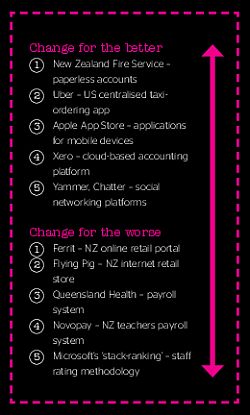 Deloitte describes agility as “a willingness to make decisions and mobilise quickly. It’s about fostering an organisational culture that values innovation and in which people are responsive to change”. In software development a number of methods, tools and principles fall under the agile definition and they tend to be based on iterative and incremental development, where products and services evolve through collaboration between self-organising, cross-functional teams.
“Traditionally, change had to start bottomup, had to be cultural,” says Kepes. “What we’re seeing now is a fundamental shift. The days of the massive, multi-hundred-person organisation are drawing to a close. Those organisations just can’t be sufficiently nimble. We’re going to see the rise of project-based, team-based distributed organisations.”
Adding complexity – which happens as new technologies and capabilities are clipped onto existing practices and systems – causes more problems than the additional functionality solves. “We’re happy to add sophistication and complexity,” says Hillard. “But it’s hard to also remove something every time you add a capability so that your organisation doesn’t become too complex; when somebody wants to implement a new system, everybody wants to hang scope off it like ornaments off a Christmas tree.”
One problem with viewing the business from the standpoint of its existing processes is that it’s akin to analysing an artist’s brush-stroke without considering her source of inspiration, let alone the effect the finished painting has on the eye. Creativity, as Kepes points out, is more than the sum of its parts. “You can’t systematise innovation,” he says. “It just doesn’t work that way.” For this reason, forward-thinking industrial-scale organisations are getting creative: “They’re setting up skunkworks-type operations, where they ring-fence some budget and let people get creative because corporate structures and rigid IT systems don’t lend themselves well to that ambition.”
All just a game…
An Economist report, ‘Agent of Change: The future of technology disruption in business’, predicts new technologies will result in a general flattening of business hierarchies, “with one victim possibly being the ‘middle manager’ role”.
Hillard, who advises every organisation to look at change through the lens of economic fundamentals, agrees. “The middle-manager whose role was simply to facilitate bureaucracy, to interpret orders from above and execute from below, is enormously at risk. The challenge is to find career paths where people can contribute to the greatest possible degree across the widest possible footprint their ability allows.”
Social media, so-called gamification and virtual teams are set to help companies find new ways of defying disruption. Hillard says large bureaucratic organisations are seeing their staff create self-organised teams on various internal social media products. But companies have to change their culture before people can use them effectively; legacy performance management structures and unimaginative team incentives dissuade potentially talented new recruits.
“By enabling social technologies in your organisation and allowing your employees to engage externally via social platforms you amplify your culture.”
David Guazzarotto, CEO, Future Knowledge
“They don’t want to sit inside a deep hierarchy and receive orders from above,” says Hillard. “If you can harness 10 people looking at a difficult strategic problem rather than one person having to make the decision you’re going to get a better outcome. It’s crowdsourcing decision-making in organisations, using social media or gamification. It’s about trying to engage large numbers of people by making our day-to-day jobs into the form of a game and getting people excited and engaged.”
Gamification is being integrated into help desk software and used to help increase employee productivity. It’s also being introduced as a tool for customer engagement, for encouraging good behaviour on website forums and increasing social network engagement. Some critics dismiss it as another marketing fad; others say it offers achievement only in its most artificial sense. But Hillard maintains gamification has the potential to assist adaptive, information-driven organisations. “Rather than creating a chain of command and coding that into an approval process, you need a score level in order to be confident that this expenditure or investment has appropriate approval, watching through social media how people choose to get that score.”
Guazzarotto agrees social media can support rapid cultural change, but it’s still enemy territory for many of the organisations he works with. “By enabling social technologies in your organisation and allowing your employees to engage externally via social platforms you amplify your culture.” Conversely, a toxic culture can quickly be exposed for that – negative viral campaigns on social media can do immense harm in a short time; as in the case of English gastro-pub The Plough that laid-off its head chef before Christmas but neglected to regain control of the business’s Twitter logon. His subsequent series of damaging tweets suggesting questionable ethics has since been retweeted multiple times.
Carruth agrees a skill-upgrade is underway, with fewer people engaged in mundane processing-type work, but foresees a less catastrophic evolution for middle-managers. “They possibly require less management in those roles than previously, which means there are fewer middle-management roles, but they’re declining not disappearing.”
Guazzarotto predicts our working methods are fundamentally changing. “I’m advocating the end of the job; in other words, we’re not going to be hired to do a particular job, we’re going to become part of collaborative structures that are centred on activities instead of jobs and responsibilities and we’ll be collaborating with people from all over the world: employees, contractors, industry influencers. Social media is the glue binding all that together.”
It’s sobering that nearly four in 10 respondents in the Economist’s survey worry their organisations won’t keep pace with technology change and thus lose their competitive edge. Successful change isn’t trivial; but then, neither is wasting your energy holding back a carriage horse while your competitors are overtaking you in high-powered motor vehicles.…
It seems self-evident that information technology makes us more productive.
However, academics and technology sceptics know all about the productivity paradox. It was popularised in a 1993 article by Professor Erik Brynjolfsson, who noted an apparent contradiction between advances in computing power and the slow growth of productivity.
Let’s face it; technology’s transformative effect on business isn’t always apparent. Be brutally honest, even with all of your new devices and mobile working capabilities, how much more productive are you today than you were 10-15 years ago? Enough to justify every dollar you’ve spent on technology in the interim?
More likely your productivity is being spread more thinly over what was previously your leisure or commuting time. This is corroborated, in part at least, by responses to a Clarian Human Resources study completed in conjunction with Massey University this year, the Great New Zealand Employment Survey 2013 (a nationwide online survey based on 334 responses). For example, one comment read: “Constantly accessible. People expect faster responses. Too easy to keep checking in on emails at home and on leave”. Respondents cited “excess workload” as a barrier to performance and nearly two-thirds of respondents felt IT led to spending more time on work.
It’s partly a perceptual problem, of course; just because you’re at work doesn’t mean you’re working. As the Economist’s contributor Buttonwood wryly noted, the ability to watch funny cat videos doesn’t count as increased productivity, and the same publication has been saying new technologies don’t automatically lift productivity since at least 2003: “Firms need to work out how to reorganise their business to make best use of any important new technologies before they can reap the full rewards.”
Back in 2000 Professor Robert Gordon at Northwestern University in the US wrote a paper (Interpreting the ‘One Big Wave’ in US Long Term Productivity Growth) in which he asked whether the computer and internet revolutions are as important as the first industrial (steam) and second industrial (electrical and internal combustion) revolutions. He contended many of the inventions that initially led to the deployment of computers occurred in the 1970s and 1980s and since then the majority of notable developments had been in communications and entertainment.
“But that was before the effects of the internet,” you reasonably respond. “Now we have the cloud, cheap storage, reliable web search and robust, free email!” So why aren’t these innovations unambiguously reflected in our productivity figures? Well, for one thing, says Oxford University economist Paul David, by comparison there was no notable productivity growth until at least 40 years after the introduction of electric power. It took until around 1920 for US machinery to be connected and for organisations to re-engineer themselves for the benefits of electricity. David also calculates that a technology only begins to significantly affect productivity when it has reached a 50 percent penetration rate. US computer use, for example, only reached this mark in around 2000.
More input, less output
The Australian government’s Productivity Commission is studying the problem of manufacturing’s contribution to the decline in productivity growth and undertaking work to identify its causes. Its findings aren’t expected until after this edition goes to print. But in its June 2013 National CEO Survey, the Australian Industry Group says the fact Australian businesses have been keen technology adopters over the past two decades has had a positive impact on productivity at a company level. To maintain this momentum, it concludes, significant new policy initiatives are required, including the development of a national workforce skills strategy for the digital economy.
Meanwhile, a September 2012 paper by the New Zealand Productivity Commission, Productivity by the numbers: The New Zealand experience, finds New Zealanders working more hours but producing less than workers in other countries: “New Zealanders work about 15 percent longer than the OECD average to produce about 20 percent less output per person,” the paper says. New Zealand’s labour productivity has been falling behind other OECD countries for decades, it seems. Productivity commissioner Murray Sherwin has also said that even though the country has invested heavily in ICT technology, many organisations have failed to turn their investment into meaningful productivity growth.
Healthy scepticism
Some digital commentators are sceptical about the metrics traditionally used to measure productivity. Geof Heydon is director of business development for the information sciences group at the Commonwealth Scientific and Industrial Research Organisation (CSIRO) in Sydney. “If you take something that’s been happening for 100 years and try and work out how much it’s improved, there’s a fairly good chance that you won’t find massive improvement,” Heydon cautions.
However, he is dubious about research findings suggesting technology isn’t increasing productivity. “More often than not those research programmes are run by various big consulting companies, and quite often the outcomes are very much dependent on who’s funding the research. The research required to get proper answers on these things is extensive and mathematically complex.”
Underscoring the difficulty of measuring productivity in the digital age, Heydon says it’s challenging to analyse an entire economy and understand what’s happening to it from a computing perspective. “It’s easy to miss critical aspects of what’s digital and hard to be completely thorough and detailed about it.”
Technology timeline
Pinpointing the source of productivity gains when new forms of power were introduced was relatively straightforward but seems to have become more elusive with each progressive innovation. For example, from the mid-1880s, electrification dramatically increased the productivity of factories. Also, the centralisation of electricity generation meant more businesses could afford electricity because they paid only for the power they used.
“If you take something that’s been happening for 100 years and try and work out how much it’s improved, there’s a fairly good chance that you won’t find massive improvement.”
Geof Heydon, director of business development, information sciences group, CSIRO
The earliest information technology hardware took the form of adding machines and unit recording equipment, which processed data by running punched cards through tabulating machines. Comparable human calculations required more manpower and were subject to greater levels of human error. The first completely transistorised calculator dates back to 1955 when IBM introduced its 608 machine (those punched cards weren’t fully superseded until the 1980s).
The lack of portability of early electric typewriters in the early 1900s is one reason why they took time to realise sizable productivity gains and they didn’t wholly supplant manual machines before the very first word processors began to sweep both typewriter variants aside in the late 1970s and early 1980s.…
Just 70 years ago, politicians claimed to know more about what was good for our health than we did ourselves. These days it seems Google is more likely to be consulted than the family doctor.
To Dr Sarah Dods, research leader of health services at CSIRO (the Commonwealth Scientific and Industrial Research Organisation) in Victoria, health is the last bastion of a pre-industrial world: people making local decisions and doing things their own way because they believe that’s best.
“There’s a centuries-old culture around the art-form of diagnosis and the intuition a doctor is required to have to do their job. The way they’ve been trained is a very different model from quality assurance and industrialised principles.”
One means of evolving from that arguably outdated culture is through better technology use. Another is by getting patients more involved in their healthcare decisions. The terms eHealth and tele-health are often used inter-changeably, but each presents an opportunity to address what Dods refers to as the sector’s “strong, cultural challenges”.
Correctly used, eHealth is the use of information and communication technology in delivering services, including the operational use of database tools and personally controlled electronic health records (PCEHRs) of the kind being introduced by Australia’s National eHealth Transition Authority (NEHTA). Tele-health is the delivery of health services and related processes from a distance; everything from patient-care in the home and providing an emergency capability to monitoring chronic diseases and consulting patients via video conference.
Seeing a plan come together
NEHTA’s introduction of electronic health records to capture and maintain Australian patients’ medical records will be harnessed by brand new healthcare facilities, offering a glimpse of what the future of the sector might hold.
Western Australia’s Fiona Stanley ‘digital hospital’ project will be based on an information technology platform that the Government of Western Australia Department of Health predicts “will enable unparalleled levels of accessible, integrated and evidence-based patient-centric care”.
The Department says the technology will improve safety and quality of care for patients, improve coordination and delivery of healthcare services and improve privacy and security of their information.
In New Zealand, too, state-of-the-art facilities will be among the beneficiaries of an eHealth vision of the future.
Waitemata District Health Board is building a $39 million Elective Surgery Centre on its North Shore Hospital site. It says the centre will be one of the most medically advanced in New Zealand and will be dedicated solely to providing elective (non-urgent) procedures, such as joint replacements. “It will significantly reduce patient waiting times for elective surgery, ensure a more efficient service for patients, and increase the number of procedures performed each year by 1500,” says Waitemata DHB. The Centre is due to be completed by mid-2013.
Graeme Osborne is director of New Zealand’s National Health IT Board. He’s taking a realistic approach to executing his National Health IT Plan.
You’d expect it to be based on a mature strategy, especially since it’s already well underway. But although there have been two high-quality reports on health sector reform so far this century – 2001’s Working to Add Value through E-information (WAVE) report and the 2005 Health Information Strategy – neither was fully realised.
Writing strategy is one thing, executing it entirely another.
Osborne says the National Health IT plan is an action plan with enough strategy in it to make it useful. “We’d already seen the other two strategies had some wonderful people developing them and the right ideas but they weren’t able to turn them into something people delivered against.”
Although New Zealand was an early adopter of systems for GPs, Osborne acknowledges it’s been slow in areas that haven’t directly benefited clinicians – clear business cases and clinician demand are needed for technology investment to low. “The major investments that need to be made in core IT solutions have not been prioritised as highly as they should have.”
People, data and supply chain
Healthcare vendor Oracle’s vice president of healthcare and life sciences, responsible for Japan and Asia-Pacific, is Mehdi Khaled. He warns of the dangers of trying to compare and contrast the needs of the Australian and New Zealand health sectors. “New Zealand is a small country with a very limited budget. Politics in Australia also play a much bigger role than in New Zealand and the scale of implementation is different.”
He says New Zealand and Australia diverge on their approaches because their health priorities differ.
“Australia, being a very large country, has rural health challenges and remote populations. For New Zealand it’s a problem of capacity, of harmonising the delivery of care across the DHBs.”
The ‘eHealth vision’ enshrined in New Zealand’s National Health IT plan is that “each patient will have a virtual health record, with information stored electronically and accessible regardless of location by linking to existing systems run by healthcare organisations”. And yet Osborne has been dismissive of electronic health records; most notably in Australian magazine PulseIT (‘New Zealand’s eHealth Agenda’, Kate McDonald) in which he describes PCEHRs of the kind being introduced by NEHTA in Australia as “pretty boring”.
PCEHR proponents say they bring important health information from different systems together and present it in a single view, much as described in Osborne’s plan, so how does he reconcile that with his published comments? “Electronic health records, as well as being complex, don’t give you any sense of what your clinician’s trying to do with you. They’re quite static. That’s why I say they’re boring. You need an action plan, everyone to be on the same wavelength. You need more of a Facebook-type concept where people are able to network and work out how they’re going to work together to get you recovered.”
Others in the industry see more scope for savings and gains from better use of systems already in place. For Tranzsoft Group’s CEO, Rod Hall, the biggest need in the health sector relates to supply chain integration. “On the one side you’ve got the supply chain – getting stock and requirements to the patient for treatment – and the patient management side.
Both have had difficulties addressing integration. If you don’t have good data to begin with, how do you populate patient management records, clinical records and implant registers? If it’s done manually, that’s a risk.”
While technologies such as RFID (radio frequency identification) tags are being deployed in the New Zealand supply chain, Hall says it’s been a slow process. “In theatre, medical devices and implants, most of the leading orthopaedic suppliers in New Zealand use Magellan, the RFID tunnels we’re agents for. All of the big orthopaedic suppliers in Australia use RFID in their warehouses and they’re then adopted in New Zealand.”
However, whereas in Australia hospital stock passes through warehouse RFID tunnels, is checked off and that’s replicated in hospitals, reaching a decision to roll out that dual functionality in New Zealand has been beset by delays.
“Each installation would be less than $80,000,” says Hall. “When you think of the high cost for a lot of items around health, that’s minor. NEHTA has released reports, not only about ROI but also the accuracy and risk mitigation they’ve discovered using RFID tunnels. If an initiative is proven to be good, shouldn’t hospitals adopt it as a small, discrete project?”
Transforming the patient experience
As founder and CEO of Orion Health, vendor of Concerto, the clinical workstation product chosen by the National Health IT Board (and also the clinical data repository used by some DHBs), Ian McRae can afford to sound upbeat. He says the sector is about to enter a phase of fundamental change, driven in part by patient empowerment. “A lot of people have iPhones or Androids and want to see their lab results. Ultimately, there are going to be devices whereby you can continually monitor the chronically ill and thereby improve their healthcare, make people live longer and keep people out of hospitals. That’s going to be the trend over the next 10 years, in my opinion.” He says the incremental approach to technology improvement taken in the sector over the past 20 years will no longer deliver the required returns. “It’s wrong to think we’re going to take the current health systems and tweak and add to them. We’re about to go through a period of internet-style rapid change based around new technology and patients demanding access to information.”
The DHBs in the four regions (Northern, Midland, Central and Southern) are “turning off” their local versions of clinical workstation – the system that displays patient information and provides decision support – and moving to a single, regional instance of Orion Health’s Concerto. As a result they’re faced with varying degrees of complexity, depending on how far their local versions of the clinical workstation are integrated into their local systems. “It’s about getting the right champions who’ll see the value of the regional instance, rather than their local instance,” says Osborne. “The South Island is our ‘poster child’, they’ve taken South Canterbury and West Coast onto the Canterbury version. They have a great relationship with Orion in the way they do support and keep updated with the latest versions of software.”
Thanks to the internet, patients today have more medical information at their disposal than GPs had 50 years ago: the “I Googled it” factor. But change for patients isn’t exclusively technology driven; some of it stems from them becoming less trusting of the medical profession, according to Orion’s McRae. “We’ve spent a couple of decades squeezing efficiencies out of the health system, making doctors and nurses work harder, taking all sorts of costs out of the hospitals – and there are still some gains to be had – but you’re into diminishing returns and you’ve got to do some things that haven’t been done before.”
That may include exploiting scientific discoveries that demand a higher degree of trust in the medical profession by patients than is presently there.
Oracle’s Translational Research Center has created a platform to support what it calls ‘the biomarker lifecycle’, from discovery to clinical use, based on a databank designed to enable scientists and clinicians to identify and explore patient sub-populations.
It’s working with pharmaceuticals companies to store that information and compare benchmarks for genetic profiles against specific diseases, says Khaled. “Instead of making every patient in cancer therapy become a new clinical trial – which was the case up to ive years ago – we can say, ‘What’s the likelihood that this patient with this genetic profile and this cancer will respond to this treatment?’ And you have more evidence to do so. We’re moving the boundaries of personalised care.”
The idea of using your genetic profile to improve your health may evoke Aldous Huxley’s Brave New World, but it’s no closer to sci-fi than a story on The Economist website, ‘The dream of the medical tricorder’. These hand-held diagnostic devices are similar to the scanner-like gizmos used to deliver healthcare on the USS Enterprise on TV’s Star Trek.
There are some thought-provoking reader comments from doctors, including one about software company Visensia, which has developed a calculator that can predict cardiac arrest 15 hours ahead of the event. By combining patients’ vital sign data it produces a real-time risk measure to warn patients and specialists.
The idea that patients will more actively be able to prevent health events is enticing; although, as another reader comments on The Economist article, it’s one thing collecting data and another knowing what to do with it.…
Published on the | Written by
“A sceptic might argue you can achieve more efficiencies by having better trained, more well-informed customer services staff rather than through the implementation of IT, but you still need the means to make them better-informed in the first place,” says Murray Foster, CIO at Thames Coromandel District Council (TCDC). “Almost 100 per cent of our data is electronic, all of our processes are electronic. There isn’t a way to be better informed without using systems to find it.”
Foster is a technology convert in a smaller council, but understands that good IT does not necessarily result in better service, nor reduced costs. “I’d like to say that by using technology effectively you can be more efficient and keep rates down but I don’t think there’s a group manager around who’d say, ‘Because of IT we’ve been able to reduce rates.’”
What ratepayers get for their dollar might come down to personal experience. Good customer service may come from someone bright on the other end of the phone, not necessarily use of the latest technology. Likewise, outdated business practices might be to blame for a bad experience rather than poorly operated IT systems.
Around half of the 1,000 business respondents to an MYOB Business Monitor survey of perceptions of council services last year said they were dissatisfied with local government. Bad customer service and lack of responsiveness to the urgency of business needs were frequently cited concerns.
The cost of delivering IT systems to support council services has been in the spotlight since the early stages of the Auckland Supercity amalgamation. The Royal Commission on Auckland Governance first recommended a unified local governance structure and amalgamated councils as recently as 2009.
Government only announced an Auckland Supercity would be set up in time for the 2010 local body elections.
A high level of ICT duplication in the region was noted in the Commission’s report, which continued: “The Commission does not contemplate the Auckland Council’s ICT infrastructure will be built from scratch. The objective will be to ensure smooth transfer of the eight current councils’ ICT systems to the Auckland Council and to plan the migration of the numerous duplicated council business systems to a single ICT infrastructure platform.”
Cost comparisons
Following murmurings of an IT budget blowout and a price hike to more than NZ$500 million, Auckland ratepayers as well as those involved in the transition process are asking questions about the necessity of a brand new IT system and about senior management governance.
Auckland CIO Mike Foley was once headhunted by Deloitte. He became CIO of Watercare before being appointed information services manager of Auckland Council in 2010. Recently he’s been under fire for not insisting on a more rigorous evaluation of the legacy councils’ systems. But Foley is adamant new IT systems will improve ratepayers’ ability to interact with Auckland Council through multiple channels. “We’re looking at online processing of resource consents, dog licences, online payments, more interaction through the call centre if you need it.”
“WHERE WE HAVE TO, WE BRING IN A SPECIALIST BECAUSE WE DON’T MERGE SYSTEMS EVERY DAY. WHEN YOU’RE TRYING TO MERGE EIGHT INTO ONE, YOU HAVE TO BRING IN THE PEOPLE WHO UNDERSTAND THEM”
Mike Foley, CIO, Auckland Council
SAP implementation specialist Deloitte provides consultancy services to Auckland Council. Since the New Zealand Herald obtained a confidential Deloitte proposal showing it charging daily net rates of between $1200 for an analyst and $3400 for a senior manager, the minister of local government has been asked before Parliament if he has confidence in the Council’s financial management.
An IS Capital Plan presented to Auckland Council in May 2011 shows a correction in its forecasted “Enterprise Capability Development” investment of around $230 million in the years between 2011 and 2015. But Auckland Council chief financial officer Andrew McKenzie says this considerable variance is attributable to the eight legacy councils halting their investing in systems. “When we came in, the proposed investment levels were well under $20 million a year for the eight councils, about $2.5 million each, so they weren’t realistic. We’ve just done a long-term plan and we’ve flattened out our investment profile. We’re still refining it at the moment but it won’t be as peaked as we’ve suggested for 2012-2014.”
Beyond the pain barrier
Malcolm Fraser is CEO of the Future Cities Institute, a nonprofit organisation focused on empowering citizens. “If central government says it’s going to amalgamate a city because there’s too much duplication and they don’t communicate that there will be a period of pain, they’re setting the wrong expectation.”
It seems Aucklanders are going to need a high pain threshold.
“IF CENTRAL GOVERNMENT SAYS IT’S GOING TO AMALGAMATE A CITY BECAUSE THERE’S TOO MUCH DUPLICATION AND THEY DON’T COMMUNICATE THAT THERE WILL BE A PERIOD OF PAIN, THEY’RE SETTING THE WRONG EXPECTATION”
Malcolm Fraser, CEO, Future Cities Institute
Bernard Orsman reported in the Herald in May last year that the cost of building a new SAP computer system over the next eight years would be NZ$506 million. Already spent during the transition was $54 million to set up the bare minimum for day-to-day functions, including payroll, email, telephone and recruitment, which the Council’s 16 December strategy and finance meeting agenda says was within budget.
Comments on the Public Address blog after Russell Brown published a post titled ‘Someone has to be accountable for this’ last May were largely connected with the ballooning cost of systems and a lack of transparency about decision-making.
“If it transpires that knew that the costs would be far in excess of what we were told, then there is only one way of characterising what happened,” Brown concludes: “We were lied to.”
Auckland City CEO Doug McKay admitted to “poor communication” on the part of the Council in a Computerworld article in June last year. But he told iStart media portrayals of the Council signing off on a $500 million IT spend are inaccurate.
“In practice it’s nothing like that. It’s broken down into all these individual projects. I’ve met with a number of our critics over the past few weeks and I’ve got a better idea of where they’re coming from. But in a lot of cases they’re out of date on their information, they’re still poring over the ATA investment cases.
In many of these situations we’ve moved on.”
The Auckland Council senior executives remain unable to provide a total cost for the new system because, they say, they have yet to decide to what extent SAP will be used.
“We’re seeing how much extra we want to put onto as opposed to other technologies,” McKenzie says.
Starting from scratch
Former Auckland Regional Council (ARC) CIO John Holley questions the SAP project’s governance. He’d like to know why Auckland Council didn’t follow best practice by having its vendor migrate data onto the existing systems at a fixed price.
The admittedly much smaller council-controlled organisation Auckland Transport did just that when it ‘cloned’ the existing Auckland Regional Transport Authority (ARTA) SAP system for $2.2 million. Transport started its implementation after the Council’s and had it fully operational in time for the Council’s ‘day one’, 1 November 2010, including functions yet to be fully deployed at the Council.
Foley counters that since Auckland Transport only had to replicate the functions of the legacy Auckland Regional Transport Authority from 1 November 2010, its migration was simpler. “We were merging eight separate businesses into a new entity. It was felt better to put it under the umbrella of the overall programme and do the data migration within that programme.”
CFO McKenzie adds that Transport also didn’t have so many financial applications: “We have five different systems and a multiplicity of brands.”
Questions remain over why ATA chose a new SAP install for Auckland over one built on an existing implementation as had originally been planned. Holley says the Council’s December agenda document – in which it states a fresh installation was “a better fit for the scale and longer term needs of Auckland Council” – is full of misdirection and inaccuracies. Among these, says Holley, is a worrying knowledge gap about ARC’s ERP system.
“At the ARC and ARTA we had SAP asset management. It had two components: plant maintenance and a module called real estate.” The strategy and finance agenda document claims “ARC’s system did not include the real estate solution” when in fact it was incorporated in asset management.
Foley, on the other hand, remains convinced the existing ACC and ARC SAP systems were unsuitable. “They were way behind in terms of support and the versions they sat on and didn’t have some of the modules we needed. So we’d have had to do significant upgrades. Starting from scratch gave us a more robust platform. It gave us the version compatibility that we wanted so we don’t now have to do another significant upgrade for another 12 or 18 months, which is a huge task to undertake. You always want to go back to a vanilla implementation, which is where we started from. The other systems had some kind of customisation buried somewhere and the majority wouldn’t have worked.”
Holley defends ATA’s selection of SAP, as well as that of Deloitte as implementation partner. However, he maintains there was no consultation with the council CIOs on the implementation approach. “After Deloitte was selected it was effectively given free reign with the ERP implementation steering group, which had no real SAP implementation experience, no CIO representation and no one from the councils with experience in dealing with SAP implementations and external consultants.
This meant the key advisor to the steering group was Deloitte.”
The Council document contradicts this: “The decisions, assumptions, costs and implementation approach were tested and validated by a numbers of parties throughout the life of the project including … chief information officers of the legacy Auckland local government organisations.”
McKay has said it was preferable not to have legacy council CIOs on the steering group because they lacked objectivity but Holley contends anyone with significant council experience of implementing SAP would have recommended a clone of an existing environment. “The consultants, with the most to gain from a green-fields implementation, were taken at their word that none of the environments was suitable.”
Foley says Auckland Council follows accepted project management standards and all large investments have to be ratified by councillors. “There are two internal checkpoints for every project: an IS governance review that makes sure it technically fits with what we want, and then it goes up to the executive prioritisation group to ratify the solution and in terms of the investment and whether the business case stacks up. Once we get into an inflight project there are the usual committee meetings around scope, budget, quality, timelines and milestones.”
McKay is also sensitive about governance, given his CEO responsibilities. “We have to put up a 10-year plan for our IT investment, which we’ve done, but we don’t consider that an approved budget. Every single project within that overall 10-year timeframe, we put them all in front of the politicians, either for an approval or an FYI. They’ll have somewhere between 80 and 100 opportunities over that 10 years to make comment on any of those investment proposals.”
Sour grapes?
Richard Hunter is director of Origen, a vendor whose product was squeezed out during the amalgamation. Origen’s ERP suite Ozone was installed at Franklin District Council. Hunter is disappointed ATA didn’t evaluate any of the Auckland councils’ legacy software. “No one ever came to see Origen or Ozone.
The decision-making was based on prejudice and not robust evaluation. None of them was ever evaluated, a cost-benefit analysis looked at or a strategic fit for the longer-term view.”
A neutral observer might dismiss these as the sour grapes of a vendor whose products weren’t chosen but Hunter dismisses that. “Irrespective of the system it’s the process I’m talking about. They’d never select Ozone – it’s a New Zealand product. I’m not talking about what’s happened to Origen. I’m talking about the entire process and decision-making.”
Mike Wanden is both CIO of Otorohanga District Council and president of the Association of Local Government Information Managers (ALGIM). Wanden saw Foley’s presentation at ALGIM’s annual conference last year. Foley is on the ALGIM executive. For the CIO of a small council like Otorohanga, Wanden says, it’s hard to comprehend the IT task faced by Auckland. “I don’t think they’re going to realise the potential of Auckland Supercity until the next generation – you’re talking 20 or thirty years down the track before any benefits will be realised.”
“I DON’T THINK THEY’RE GOING TO REALISE THE POTENTIAL OF AUCKLAND SUPERCITY UNTIL THE NEXT GENERATION – YOU’RE TALKING 20 OR 30 YEARS DOWN THE TRACK”
Mike Wanden, CIO, Otorohanga District Council: president, ALGIM
Origen’s Hunter was also at the ALGIM conference for Foley’s presentation. “Everyone just listened to this guy talk and their jaws dropped – they’d never heard anything like it. He was coming out with some very big generalisations and rationalisations.”
What about my rates bill?
Auckland Council’s current programme of work is part of a wider organisational transformation to assess which applications are best suited for council-specific functions such as managing consents, field services, licensing, property records, websites, document management. The legacy Papakura and Franklin rates systems are currently being migrated to the old Auckland City Council rates system, Pathway. In October, says Foley, the Council will probably migrate the regulatory systems, but this will only be an interim fix. In the longer term the Council will need to evaluate a permanent replacement.
Foley says the Council has yet to select suppliers for licensing, compliance, regulatory and rates functions. However, iStart understands from one industry source that the decision to implement SAP’s regulatory modules has already been made, although the Council will still issue a request for proposal later in the year.
Ratepayers around the country may be wondering whose interests their council serves. Foster from the TCDC says the fact IT is still considered a “black art” by the public increases the difficulty of communicating IT project costs.
“I’d like to say that by using technology effectively you can be more efficient and keep rates down but I don’t think there’s a group manager around who’d say, ‘Because of IT we’ve been able to reduce rates.’”
Auckland Council’s CEO says the fact its new systems will make the Supercity a more efficient council will ultimately cut costs, but rate increases are beyond the control of council executives: “Politicians make the rating decisions, we make the cost and savings decisions,” says Mackay. “We saved $81 million in our first eight months – not all of it was related to IT but a lot of it was enabled by new processes and systems – and that couldn’t have been achieved under the legacy councils. It was the equivalent of 6 per cent of rates we didn’t have to ask the people of Auckland for – 1 per cent of rates is about $14-16 million.”
McKenzie says ratepayers ought to view IT costs relative to total Council spending. “In the technology area you’re talking about a $0.5 billion investment and about $300 million of that is in new IT infrastructure and systems.
Across Council we’ll spend about $13.5 billion on transport, wastewater, storm water, new buildings, libraries, and of that $13.5 billion around $9 billion is on buying new assets.
In spite of that massive investment in the city, we’ve got rates increases of 3.6-4.9 per cent over the next 10 years.”
Passing the ‘Dom Post test’
Citizens want to see their council operating efficiently to reduce rates, says Julian Moore, director of organisational services at Wellington City Council (WCC). “What ratepayers want is evidence that we’re not spending money we don’t need to spend.”
So who’s accountable for ensuring that? Foster of TCDC’s take on that is straightforward: “The guy who signs the cheque.”
“WHAT RATEPAYERS WANT IS EVIDENCE THAT WE’RE NOT SPENDING MONEY WE DON’T NEED TO SPEND”
Julian Moore, director of organisational services, Wellington City Council
Moore sees it as a standard chain of command with the CIO accountable to the CEO who’s accountable to the mayor and councillors. “I’d be accountable for the effectiveness and efficiency of our IT operation but these things are not just IT decisions – the decisions you make around systems need to be driven by business.”
Hunter of Origen is sceptical ratepayers will notice benefits from Auckland City’s new system. “They keep talking about improved customer service but I don’t really see any value in it at all. It’s got more consistent but it’s not actually lifting the bar in any way.”
Moore of WCC says his council places the interests of ratepayers above those of suppliers. “Most people on councils want to be sure they can defend their procurement. That can lead to us having undue process around it. In Wellington we call it the Dominion Post test – any decision you make, you have to defend it to the public.”
It’s always challenging for councils to justify expenditure to ratepayers. Foster of TCDC reckons the public sector should hire more CIOs who’ve worked for suppliers. “It’s always good to go and work for a vendor and have some P&L responsibility – that sharpens your focus.” Ratepayers are more likely to appreciate sharpened focus if the picture makes sense. That calls for a more business-like attitude on all sides of the debate.
|
AUCKLAND COUNCIL BEHIND THE SCENES Since ‘Day One’, 1 November 2010, the following applications have been merged and are live: > SAP (core finance functions, asset register, procurement, HR, payroll) > Hyperion (budgetary planning – monthly, yearly, 10-year plans) > Telephony (common platform across most legacy councils) > Website (currently an overlay – legacy websites are still operating where online payments were in place) |
iStart: What improvements can ratepayers expect to see from the new IT systems?
Mike Foley, CIO, Auckland Council (MF): “The ability to interact with council through multiple channels. In the long-term we’re looking to do online processing of resource consents, dog licences, pay online, more interaction through the call centre if you need it. Better information about the customer, from our perspective, major service improvement that we need to make collectively.”
iStart: The IS Capital Plan presentation, May 2011, shows a $230 million correction to the “Enterprise Capability Development” figure between 2011 and 2015. This must have been a surprise to all – how did it come about?
Andrew McKenzie, chief financial officer, Auckland Council (AMK): “The previous Councils’ budgets were all much lower because the Councils had stopped investing in their systems. They also had systems that were scaled to their own particular needs and investment programmes that aligned with that – if there was an investment programme. When we came in, the proposed investment levels were well under $20 million a year for the eight councils. If you think about three of them using SAP, divide 20 by 8 and you get about $2.5 million each whether they were getting anything out of it, so they weren’t realistic.”
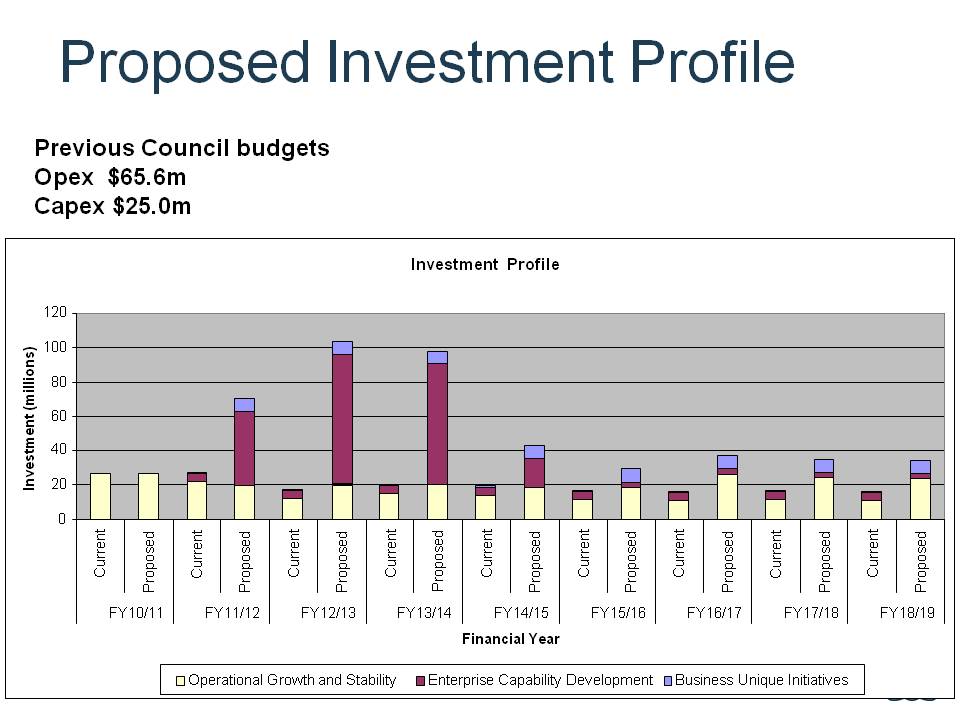
iStart: So ‘Current’ refers to the previous councils?
AMK: “That’s right.”
Doug McKay, chief executive, Auckland Council (DM): “That wasn’t an overspend, that additional money. From our perspective, it’s not; that’s transparently what we believe we’ve got to do over the next three to four years and we’ve just been very honest and very transparent about that.”
AMK: “That was the previous councils. Papakura had stopped investing in their systems at least three years ago.”
DM: “And those are 10-year plan numbers. If you look at those bar charts, from memory, they’re a pretty flat line across the board for 10 years. Whereas we’ve tried to reflect the actual work that’s needed to be done and the investment required to migrate to the new systems that we need to get to.”
AMK: “We’ve just done a long-term plan and we’ve flattened out our investment profile. We’re still refining it at the moment but it won’t be as peaked as we’ve suggested for 2012, 2013, 2014. The number of things that need to be done and the ability to do them all in a very short period of time, we’ll still have an initial peak but it will be more spread out over the following 10 years.”
iStart: What is the total cost of the SAP implementation expected to be?
AMK: “That’s kind of like ‘How long’s a piece of string?’, because we don’t know how much SAP will be used across Council. At the moment we’ve got it used for our ERP system, including HR and IS, and we’re looking at how it expands from there and if it’s the right system to use. With the way technology’s developing you don’t need to just have one brand, you can have a number. But SAP at the moment is the pivotal financial system but we’re seeing how much extra we want to put onto it, as opposed to other technologies.
iStart: How much is being spent on top of SAP on council-specific functions (i.e. those managing consents, field services, licensing, property records etc)?
MF: “At the present we’re working through a programme of work, as part of a wider organisational transformation, to look at what solutions would be appropriate to run those functions. We’re in the process of migrating what are known as the southern systems, which is Papakura and Franklin, from a rates perspective onto the old Auckland City Council rates system, which is Pathway. October time, we’ll probably move the regulatory systems across. Dog licensing, just from a timing perspective it interacts with their current schedule to get dog licences out and confirmed. Longer-term we have to look at what is the appropriate solution to use. We’ve yet to get to that point, we’ve got to work through the interactions with that and that has a direct impact on our property information. It also has a huge impact on how we manage customers from a ratepayers’ perspective. There’s a tripartite piece of work that we need to do, in how we bring these three things together as one – whether it’s in one solution or three, we haven’t decided yet and we haven’t decided the brands.”
AMK: “We don’t really ‘do SAP’. We’re looking at the actual business need and that’s what we’re doing a project based on.”
MF: “If you look at our footprint there’s over 3500 applications, probably more towards 5000, that we’ve got to bring down. At a minimum we’ve got eight of each one, up to a maximum of 297 in the asset management space. We’ve got to bring those down to one answer at some point. How we do it, in what sequence we do it, we have to work that through. We’ve already started in the back office, we’re now doing some of the asset work. Obviously we’ve done the email system because obviously that’s a core one for the whole council but as we rationalise the back office stuff and the footprint they have, we can then start to look at how we bring the customer solutions together. We’re still running the old eight – we have to – and even when we do merge we still have to maintain the usual legislative requirements around financial history for seven years. In some instances around property it may go out to 40 years history that we have to keep, which is significant.
AMK: “We have some obligations in the property records area where we must provide people with information on their property. That adds a lot of complexity because whoever’s accessing our information, first of all it was converting paper-based systems into digital, now it’s about merging the digital together so we can access easily those records right across the region.”
iStart: Can you explain briefly what SAP will do for the council that an application designed for council use can’t do?
AMK: “With SAP currently we have a footprint across the core finance, procurement, HR and asset management. Beyond that, like all of the major brands – whether it’s SAP or Oracle – they have industry specific verticals, and one component they have is around what they call public sector. They have a set of templates built around the functions and processes used in national and local government to deal at a customer level or an activity level interactions with those authorities. Whether it’s SAP, Oracle, Pathway or whatever else, we haven’t chosen a brand for the areas of licensing, compliance, regulatory and rating. We have to look at what we have in the current footprints, whether they’re appropriate or not to scale up to what we want to do in the future and whether we can actually migrate to whichever one we choose and how they all interrelate to one another. A key component from a technical aspect is can things actually talk to each other, and nowadays most of them can but there are some constraints in some of the footprints that we have now.”
iStart: Transport had SAP manage its data migration at a fixed price. Why did ATA recommend not doing that at Auckland Council?
MF: “If you look at Transport from where it came to where it went, it was almost a mirror copy. So Auckland Regional Transport Authority became Auckland Transport, so what they did before 1 November 2010 they did on 1 November 2010, where we had to take eight legacy environments from different structures and processes into a completely new environment. We were merging eight separate businesses, basically, into a new entity. All of the processes they did in Transport were held on other systems and they just flipped over and changed the brand name, basically. All their road asset maintenance was done in a completely different system.”
AMK: “And all councils had to use the same system because of NZTA requirements. You didn’t have the diversity that you do in the financial area. For example, we have five different systems – you’ve seen the multiplicity of brands that we have, FinanceOne, all the rest of it.”
MF: “Because it was felt better to put it under the umbrella of the overall programme and do the data migration within that programme itself.”
iStart: Which parts of the new council systems are already live?
MF: “Email, which is now merged completely; SAP we have core finance, accounts payable, asset register, procurement, HR, payroll, Hyperion from a budgetary planning point of view – monthly, yearly and 10-year plans, a number of the telephony systems are now merged, so we’re using a common platform across a large proportion of the ex-councils. The website is an overlay – we still have to operate the ex-council, local ones for various reasons because some of them had payments online to the back office, others didn’t. The common standards we have are mainly in the back office around infrastructure but we’ve still got a lot of work to do there. We run now 12 different data centres of every size and flavour you can think of, so there’s a large consolidation we’ve still got to do. Our network’s consolidated, we have a full network across all regions and every location. Mobile provisioning is all through one vendor, telco provisioning is through two main vendors, in assets we’ve done property–”
AMK: “and parks next and storm water the following year.”
MF: “They’re the big ones we’ve done so far.”
iStart: Why was neither the existing Auckland City Council nor the Auckland Regional Council SAP system suitable?
MF: “It was an option we looked at. It wasn’t feasible, for a number of reasons. They were way behind in terms of support and the versions they sat on and didn’t have some of the modules we needed. So we’d have had to do significant upgrades. Starting from scratch gave us a more robust platform. It gave us the version compatibility that we wanted so we don’t now have to do another significant upgrade for another 12 or 18 months, which is a huge task to undertake. You always want to go back to a vanilla implementation, which is where we started from. The other systems had some kind of customisation buried somewhere and the majority wouldn’t have worked.”
iStart: How big is your project team?
MF: “We’re running 94 or 95 projects at the moment. The number of people working on projects is close to 200 or 250, including internal resources. There’s a mix, obviously you bring in specialists where you need them. There are people we bring in on a short contract, but we swap in and out where we need to. A lot of the IP we want to keep inhouse, so it’s staffed mainly where appropriate by internal resources. It’s probably 35 percent contractors, 65 percent inhouse. But it depends on the project – where there’s a real specialist we have to bring in a specialist because we don’t do this every day, we don’t merge systems every day. We maintain them and keep them up to date but when you’re trying to merge a minimum of eight into one, you have to bring in the people who understand those systems, and when you start to merge them into one brand, then you bring in the specialists because they’ve done it before.”
iStart: How many other New Zealand councils use SAP?
MF: “In New Zealand alone there’s Christchurch City Council, Greater Wellington Regional Council, two of the large CCOs – both Transport and Watercare use SAP – ourselves, obviously. If you look around the wider government footprint, Defence, Police, Corrections, IRD, Kiwirail, Conservation. If you go across the ditch, all of the state-level entities use SAP in some form or another, and at a local level you’ve got Bankstown , Gold Coast… so we’re not alone. I have ongoing discussions with Christchurch and Gold Coast and some of the local authorities in Australia, as well, around what they’re doing and whether we can leverage what they’ve done because we’re all doing kind of the same thing at the moment.”
iStart: How do you ensure effective governance of SAP projects?
MF: “We go through the normal project frameworks using the industry standards where we have defined scope, cost appropriately, once it gets into business case – depending on the level – it either goes to Andrew, Doug, or in most cases it goes up to Council for ratification. But also, even when it’s below the threshold we go to council and FYI them, anyway, so they understand what we’re doing. There are two internal checkpoints for every project, an IS governance review that makes sure it technically fits with what we want, and then it goes up to what’s known as the executive prioritisation group, to ratify the solution and in terms of the investment whether the business case stacks up. Once we get into an inflight project there are the usual committee meetings around scope, budget, quality, timelines, milestones, just as a standard structure.”
DM: “I’m sensitive around the governance aspect, given my responsibility. But in a council environment, as well, just to give a bit of context, we’ve got to put up a 10-year plan for our IT investment, which we’ve done, but we don’t consider that to be an approved budget. As Mike and Andrew have said, we make a habit of, every single project within that overall 10-year timeframe, which is the number that’s captured a lot of the media interest over the last few months, we break that down into projects of $2 or $3 or $8 or $9 million and we put them all in front of the politicians, either for an approval, as Mike said, or an FYI. So I imagine they’ll have somewhere between 80 and 100 opportunities, over that 10 years, to make comment on any of those particular investment proposals.”
MF: “This week we’ve got two that are presented to Council around HR, compensation management and performance management, and then two that we’re in the process of presenting to council that’ll lead to some kind of competitive tender in the marketplace, around IT infrastructure and standardisation of the back office, from my perspective.”
iStart: What about summarising very complex projects to people who are not technology savvy?
DM: “It is an ongoing challenge, given the technical overlays here, and that’s why we present a $2 million or a $3 million case and we keep going over the basic strategy behind it. That document you referred to in May 2011, we ran all the councillors through that and they found that extremely helpful to orient themselves. Of course, we do use some external consultants to give us best practice feedback. It’s not an easy one, but it has been portrayed as if the Council signed off on a $500 million budget. In theory that’s true but in practice it’s nothing like that. It’s broken down into all these individual projects and we give them the opportunity to debate it with us. We have a lot of people, clearly, talking to the media and others about our IT strategy. It’s quite an opinionated area, is what I’m finding. I’ve met with a number of our critics over the past few weeks and I’ve got a better idea of where they’re coming from. But in a lot of cases they’re just not across the latest thinking and they’re out of date on their information. They’re still poring over the ATA investment cases and in many of these situations we’ve moved on.”
iStart: What’s your total annual IT operating budget and how does it compare with earlier forecasts?
DM: “For the current financial year we’re running a budget of roughly $112 million, which is where we knew it would sit, given we were bringing on the old legacy investments, all the contractual arrangements they had. We’re actually running nine councils now instead of eight because as we merge systems we stand things up and then we turn things off. Where we can turn things off we reduce our costs completely. So it’s a bit of a peak and then it drops off significantly.”
AMK: “It’s a little bit hard to compare with the previous councils because some councils didn’t allocate depreciation directly to different IT groups. So Mike’s given you $112, which includes depreciation–”
MF: “But it also includes… in my group I ran the mail and courier services, the print shops. Other councils may have given them to another organisation. I have a consolidated view of services that before you probably couldn’t link together. But compared to where we should be we’re where we should be.”
iStart: Will the Supercity deliver on its promise of a more efficient council for Auckland?
DM: “For sure. I see three key areas: enabling people to do their jobs better. Currently people are working across, in some cases, nine systems. In their legacy environments they were working in outdated systems, in some cases with systems that weren’t supported any more. I get good feedback from our staff who’ve made a migration, they’re finding they can do their jobs a lot better. Secondly, customer service. Building control, becoming an accredited building authority, which meant in October last year we had to disband the eight previous councils’ authorities. They weren’t enacted any more, and we wouldn’t have been operating, issuing building consents. So we had to devise a completely new business process right across the system and Mike had supported that. I haven’t had a complaint on a building consent for three-and-a-half months, since we’ve put that system in place. And thirdly, we’re getting efficiency and reduced cost. We’ve made it public that we saved $81 million in our first eight months – not all of it was related to IT but a lot of it was enabled by new processes and systems – and that $81 million in savings could not have been achieved under the legacy councils and it meant it was the equivalent of 6 percent of rates that we didn’t have to ask the people of Auckland for. Every 1 percent of rates is about $14-16 million. So there’s been significant benefits already and it doesn’t take much to understand that if you’ve got 3500 going on 5000 separate, dedicated systems, Mike’s talked about the hundreds of people that we’ve got in the IT function, we know by any benchmarking best practice that that’s way over the top, but that’s about managing the complexity we’ve got at the moment. As we progress our way through that, I see some significant further savings comings.”
iStart: So it is possible to keep rates down?
DM: “Yes.”
iStart: But even having great systems doesn’t automatically translate into low rates rises, right?
DM: “Yes, but there’s a key reason for that: politicians make the rating decision. We make the cost and savings decisions. There’s a political overlay there that we don’t control. Our new LTP that we’ve just put out has 3.6 percent rates for the next year, and then between 4.5 and 4.9 percent for the next nine years. The average rate increase for the legacy councils for the last 10 years was 6.9, and that ranged between 5.4 and 8.1. So we are significantly below and my view is that we’ll probably do better than what our LTP says.”
AMK: “If you look at what’s driving rates, in the technology area you’re talking about a $0.5 billion investment and about $300 million of that is in new IT infrastructure and systems. Across Council we’ll spend about $13.5 billion, ignoring the IT, on transport, wastewater, storm water, new buildings, libraries, et cetera, and of that $13.5 billion around $9 billion is on buying new assets. Every time you buy something new you’ve obviously got to pay the interest on it and the other associated costs. In spite of that massive investment in the city, as Doug said, we’ve got rates increases of 4.9, 4.5, 3.6 percent over the next 10 years. The IT investment is a very small drop in the bucket of money that we’re going to spend, and it’s not driving rates increases, it’s reducing costs.”
The Canterbury earthquake recovery operations are driving home to New Zealand businesses that no amount of preparation guarantees the safety of data and applications in the event of a force majeure – the “superior forces” usually exempted from insurance policies. But working in the cloud, at least theoretically, separates your data and applications from your physical infrastructure and places them on a remote platform.
As discussed in previous iStart features, there are multiple definitions for cloud computing. We’ll simplify matters here by giving cloud services the umbrella definition of any model of computing where services and applications are hosted securely and accessed through the internet.
New Zealand organisations weren’t among the respondents to the Acronis Global Disaster Recovery Index, but our Australian neighbours emerged as laggards, ranking poorly on their ability to avoid downtime in the event of a serious incident, suggesting we’d have fared little better. However, if stated intentions are anything to go by, the ability to quickly recover IT and systems following a disaster is of growing concern. More than two-thirds (71 per cent) of all businesses surveyed by Acronis expect to include cloud computing as part of their backup and disaster recovery (DR) strategy by the end of the year.
Many onshore providers offer infrastructure as a service (including but not limited to Datacom, Entrada, Gen-i, IBM, ICONZ, OneNet and Revera), and even more of them offer hosting in the cloud, including Appserv, Datacom, Fronde, Fujitisu, Gen-i, IBM, ICONZ, Intergen, Maxnet, OneNet and Revera. Before you even begin to evaluate your provider’s resiliency in the event of the unexpected, you need to ask yourself how quickly you really need to be able to recover your data in the event of a disaster – the answer will have a direct impact on the cost of the service.
Business (almost) as usual
For some Christchurch businesses, having cloud services as part of a DR strategy pre-earthquake meant being able to continue operating uninterrupted, lessening the impact on their earnings. Brett Roberts, a partner in BusinessIQ, knows of at least one such example. “We’ve got two people in Christchurch working out of a small serviced office in the CBD. They haven’t been able to get in there for weeks and they’re still working. They don’t have a server down there; it’s all in the cloud.”
The Christchurch earthquakes shunted businesses around the country to think more carefully about data recovery and backup. CEOs are evaluating risks that are normally obscured by the day-to-day minutiae of running a business. As a result, at least one of our interviewees predicts a boom-time for disaster recovery experts.
It’s worth bearing in mind that a cloud provider’s scale and existing infrastructure can potentially offer resilience of a kind you could never afford to provide yourself. Gen-i’s 12 data centres are co-located in Telecom’s exchange buildings, which were built to withstand natural disasters. Due to the vital contribution telecommunications make to recovering from a civil defence emergency, telcos receive priority assistance at government level.
Neil Osmond, strategy manager, technology, is on the team developing Gen-i’s cloud strategy. He says the emphasis of conversations with customers, particularly since the Christchurch events, isn’t so much on technical features as it is on trust, reliability and availability. He underscores the importance of infrastructure resilience: “Our data centres have seismic bracing and a lot of backup systems, batteries and diesel generators. In a large event like Christchurch, diesel is immediately rationed. Some areas are zoned-off and you can’t get people in. But being a telco, and being part of the civil defence response, we have access to the buildings and diesel, and we’re escorted into the buildings immediately to keep communications for the emergency services open. In thinking about resilience, you’re obviously going to rely on providers who are able to act in extreme circumstances.”
Seismic mindshift
Steve Matheson, chief operating officer of Datacom New Zealand, says the earthquakes highlighted an eventuality people hadn’t fully recognised. “People have always thought that if the power went off, they’d just move their computer somewhere else. This has also rammed home, from a vendor’s perspective, a force majeure situation on a customer.”
Datacom had fortunately invested in strengthening its capabilities prior to the earthquake. Its new Christchurch data centre had been seismically engineered, and even though it’s situated inside what became the red zone, it ran continuously without customer outages. “We had the power go off on us and all the facilities and the bracing on the racks all worked.”
The provider also had a dual fibre link; one half of which was lost during the earthquake when a building it passed through collapsed. Matheson says network resilience proved its worth: “We were still able to access all the systems in Christchurch from Auckland. In fact, we used staff in Auckland to manage the systems for some time during the earthquake.”
Cameron McNaught, executive general manager solutions, Fujitsu Australia and New Zealand, says plans for a New Zealand data centre have firmed up since we last spoke to him in October 2010, when he predicted it would open one this year, subject to customer demand. “We now have internal approval. We’re doing some work with our current facilities to be able to offer services out of Wellington.”
Fujitsu views this as “a starter service”, but it’s also seeing interest from its New Zealand customers in having their data and applications hosted on Australia-based cloud platforms. McNaught says one New Zealand government department is already using a Fujitsu platform for its development test services, as a pilot to evaluate the cloud for larger scale projects. McNaught says he hopes expansion of Fujitsu’s Wellington facility on Taranaki Street will allow it to offer cloud-based services from August or September.
Download the full pdf article:
Cloud resilience at what price?
…
AU: 1800 462 388 · +61 401 189 448