
If there’s any silver lining to be found subsequent to global economic disruption, it’s the catalyst it’s created for business innovation. Organisations and AP teams across the globe have been faced with both a major challenge and an opportunity to rethink their processes to promote both short- and long-term success.
The global economic disruption has provided an opportunity to rethink processes to promote both short- and long-term success.
This new and insightful eBook explores the outlook of the ‘New AP Department’: what’s changed, what changes will stick and how to promote business continuity with an AP automation solution with benefits such as:
- Ability for AP staff to competently do their jobs from any location, without compromising quality
- Optimised cash flow thanks to electronic payments & greater visibility into spend-related activities
- Improved collaboration & relationships with key suppliers by providing a vendor self-service portal
What’s on the docket:
- Business disruption prompting business innovation
- Enabling remote work
- Eliminating manual processes
- Optimising cash flow
- Improving supplier management & supplier relations
- Enhancing visibility
- Creating a more strategic AP with automation

Download the ebook: The new AP department
…
…
What’s in the e-book?
There’s no doubt about it: Efficient order-to-cash (O2C) processes are important to company success. Nonetheless, they can be a challenge to attain. As different teams pursue their own goals and self-interests – utilising separate systems and applications in the process – what’s best for the organisation as a whole is often put on the backburner. Which is exactly why companies need to rethink traditional O2C processes and focus on the strategic end-goal for all: an improved customer experience.
Addressing the root causes of inefficiency makes future initiatives much easier to implement.
Why now? Because expectations have changed. Today’s customers care more about their experience and the ease of which they can do business with a company. In other words, customer service tactics from even 5-10 years ago simply don’t cut it anymore. Organisations that fail to adapt and evolve their service strategies are at risk of gaining and retaining business.
Table of contents:
- Introduction
- O2C Automation
- Automation outcomes
- Five teams
- Order management
- E-Commerce
- Logistics and distribution
- Accounts receivable
- Sales
- Delivering a superior customer experience
- Conclusion
- Get to know Esker
Download the ebook: Improving the customer experience
…
Cash is king and automated order-to-cash solutions have proven to be an effective way of getting cash flow moving in the right direction.
Order-to-cash solutions bridge the chasm between receiving orders and applying cash, automating all the processes required to receive and process sales, from order management and fulfillment to invoicing and payment processing.
This whitepaper will show you the cash-flow benefits of automating the O2C process:
- Reduce DSO
- Fewer customer deductions
- Lower write-offs
- Better financial control
- More accurate cash forecasting
Each of these benefits of an automated O2C solution is impressive. Together, they can significantly accelerate a company’s cash flow.
The technology eliminates the friction that impacts cash flow.
Contents:
- Sales order processing remains a manual affair
- The problem with manual 02C processes
- The ramifications of imperfect orders
- An end-to-end solution to slow cash flow
- The power of 02C automation
- Why automate 02C now
- About Esker
- About the Institute of Finance and Management
Download the whitepaper: Order-to-cash automation
…
Now more than ever, businesses are realising the importance of having an optimised cash conversion cycle and tools that provide full visibility into the day-to-day payables and receivables processes that have a big impact on cash flow. If your operations are still inundated with inflexible, manual practices, you’re likely missing out on heaps of cash caught up in inefficient processes.
Read the white paper to discover how a cloud-based automation solution can accelerate your cash conversion cycle, free up ‘unproductive’ cash and bring new levels of visibility and flexibility to your organisation.
Day-to-day payables and receivables processes have a big cash impact on a business
Table of content:
- Introduction
- Why the cash conversion cycle matters
- Best practices for accelerating cash conversion
- Empowering the business through cash conversion
- Start transforming your cash conversion cycle

Download the whitepaper: How to make your cash work harder for you
 ABOUT MARK BROUSSEAU //
Mark Brousseau is a noted analyst, speaker, writer and marketer, with over 21 years of experience in advising leading providers of financial operations solutions and services.
Brousseau is president of Brousseau & Associates, a full-service strategic marketing and business development consultancy with the largest client base of any firm of its kind. Brousseau & Associates counts among its clients many top solutions and services providers in the payables, receivables, payments, document management and healthcare verticals.
…
Background
Husqvarna, a global leading producer of outdoor power products, was looking to optimise its order management process, as it was struggling to manually process a monthly volume of 3,000 orders, received in different formats (predominately fax, but paper, email and e-commerce as well). Husqvarna lacked visibility into its order processes, users faced difficulties in easily retrieving information and completing an order was very time consuming. To address these problems, the company selected Esker to automate its order management process to achieve multiple objectives.
We are able to process orders in any format, giving us the visibility to fulfil all orders in a timely and correct manner.
“Today, delivering an order is all about speed and accuracy. With the help of Esker, we are able to process orders in any format, giving us the visibility to fulfil all orders in a timely and correct manner.” says Kanae Ohtsuka, Global information services, Husqvarna Japan.
Solution
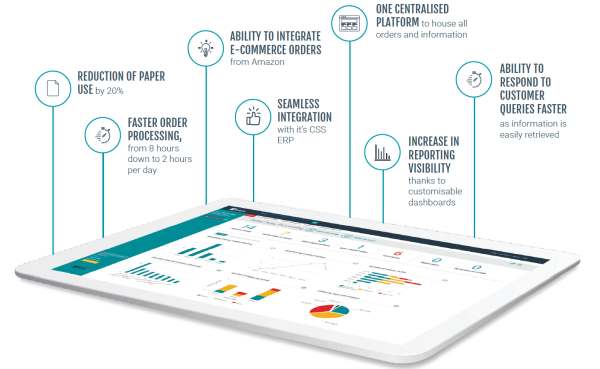
Fax continues to be widely used in Japan, however it remains very challenging to retrieve accurate information due to poor quality and content. Thanks to Esker’s Order Management solution, Husqvarna is now able to process all orders received via email, e-commerce platforms like Amazon and fax all on one platform. This has resulted in significant time savings as they no longer need to process orders on two separate platforms.
Particularly beneficial to Husqvarna was the fact that Esker’s solution interface is translated in more than six languages, including Japanese, which has
facilitated solution use internally and increased adoption rates among their customers.
Benefits
Husqvarna has enjoyed numerous benefits from implementing Esker’s automated Order Management solution, including:
Source: This article was originally sourced from Esker
During times of significant disruption and uncertainty, it’s essential for organisations to maintain business process efficiency as well as communication with customers and team members. With more companies making the necessary transition to a remote workforce, it’s changing the way accounts receivable (AR) teams work.
Today’s unprecedented situation has had a direct impact on businesses and their ability to manage their AR process and collect cash. As a credit and collections manager, your job is to preserve cash flow and provide the same service level to customers.
In today’s current climate, your strategy may need to be adjusted to continue to bring efficiency.
We’ve compiled seven tips to help you adapt your collections strategy, continue collecting cash, take care of your customers, empower your team, and come out on top (without being impacted too severely).
Based on our research, here are seventips to help you adapt your collections strategy, continue collecting cash, take care of your customers, empower your team, and come out on top (without being impacted too severely).
- Reassess your receivables situation
- Adjust your collections strategy
- Digitalise documents
- Facilitate customer payments
- Manage customer relationships
- Ensure visibility and collaboration
- Ensure staff wellbeing
Download the eBook: 7 tips for effectively managing your accounts receivable process in challenging times
…
Blogs and articles about digital transformation today frequently address the fact that even though the benefits of process automation are glaringly obvious, a vast majority of businesses have yet to digitise. So if business leaders are well aware of the ways automation can lead to lower operational costs, higher staff productivity and job satisfaction, and stronger relationships with customers and suppliers, why aren’t they making the switch?
The reluctance to change
Human brains are hard-wired to value certainty. And what makes people feel more uncertain than change? Things like comfort, complacency and fear are the biggest culprits of sidelining digital transformation plans. But by postponing digital adoption, business leaders are doing their organisations a great disservice.
“It can seem like you’re dishing out a lot of capital and disrupting operations to simply make certain jobs faster and easier to do.”
The reality of the business landscape today is that competition is moving quickly. And while your organisation doesn’t need to be the first to change, it’s possible to reach a point where it’s too late to change and recovery is virtually impossible.
Here are a few of the biggest hindrances to digital transformation:
1. The status quo problem: “This is how we’ve always done things”
Disrupting the status quo is usually an unpopular idea, and unfortunately, it’s one of the main reasons companies refrain from digitising processes. Just because something has worked thus far doesn’t mean it will continue to work in the future. And in the case of automation, there’s no denying that it will soon become a requirement for businesses to stay relevant.
2. The upfront costs
Paying for software that does the same things humans can do seems like an unnecessary cost, right? Not exactly. While the upfront costs of automation may seem intimidating for business leaders, the cumulative cost-saving and efficiency-boosting benefits significantly outweigh the initial cost of the technology.
3. The misunderstanding of what automation solutions do
When the full capabilities and advantages of AI-driven automation aren’t completely understood, it can seem like you’re dishing out a lot of capital and disrupting operations to simply make certain jobs faster and easier to do. However, the benefits reach much farther than just automating repetitive tasks, including improved onboarding, data management, tax compliance, customer service, supplier relationship management and much more.
How leaders can help embrace change and encourage support
Business leaders must help staff understand the need for transformation and the importance of changing now rather than later. Therefore, having an effective communication plan is essential for getting employee buy-in and for overall digital transformation success. Here are some tips for making the value of digital adoption crystal clear to everyone within an organisation.
1. Communicate the need for change
To drive the necessity for change, leaders must focus on communicating the “why” behind it. Making it clear that digital transformation is a “must” rather than a “should” to all levels of the organisation is the first step in getting company-wide approval. When staff is ill-informed and left wondering whether change is really necessary, cultivating support becomes much more difficult.
2. Be clear about the change process and end results
Of all the change that can occur in an organisation, implementing an automation solution is by far one of the most intimidating for staff. By being clear and concise about how exactly the implementation process will be executed and how everyone/every process will be affected in the end will help to ease anxious minds and even build excitement about the changes to come.
3. Provide positive examples early on
Stories, facts and examples of other digital transformation successes help create connections and feelings and have a way of alleviating fears around change. Sharing stories about other companies that have gone through similar changes and came out on the other side more efficient, agile and profitable can help to disarm any reservations toward change.
4. Provide support and encourage involvement
By nature, people support things they help create and are apprehensive about things they don’t understand. That’s why encouraging participation in the change process and offering continuous training and support can help ease the resistance that may be created by fears of incompetence.
Background
LinPepCo is a Pepsi-Cola franchisee with 35 years in the distribution business in the United States. One of its digital transformation projects was to digitise and automate its accounts receivable (AR) collections process.
With more than 35 years of soft drink and vending product distribution experience LinPepCo’s business includes five soft drink franchises, a full-line vending company, a full service coffee company and a refrigeration division that specialises in equipment service and leasing.
Before Esker, LinPepCo relied on a largely manual process to manage its collections. Paper was prevalent, as the team was tasked with printing statements and sending reminders by hand.
“A lot of cost and manual labour went into that,” said the Director of IT at LinPepCo. “We knew there had to be a faster, more cost-effective way to help our staff collect and our customers make payments. Esker’s Collections Management product offered that solution.”
Solution
A key goal LinPepCo wanted to achieve in implementing a new solution was to utilise as few different systems and technologies as possible. Ultimately, it was Esker’s automated Collections Management solution that stood out for its robust capabilities and integration with VIP, LinPepCo’s existing accounting system. Esker’s business partnership with VIP meant a fast and seamless solution delivery process for LinPepCo with very few technical resources needed to set up the solution.
“Esker checked off so many boxes for us that we really had no reason to test other solutions. It was perfectly compatible with what we had in place and the implementation process couldn’t have been more painless.
“Esker was perfectly compatible with what we had in place and the implementation couldn’t have been more painless. After just a few weeks of going live, we had customers and team members telling us how slick the solution was.”
Director of IT at LinPepCo
After just a few weeks of going live, we had customers and team members telling us how slick the solution was.”
Approximately 67 percent of LinPepCo’s customer base (3,800 customers) is currently accessing Esker’s cloud-based solution.
Nearly one in four customers are using the auto-pay feature, which has proven to be a significant time-saver for both the company and its customers.
Benefits
LinPepCo went live with Esker’s Collections Management solution in early 2015. Since then, the company has achieved a number of impressive business benefits.
- Reduced DSO
- Virtually eliminated customers in the 90-day past-due category
- Freed up staff time to spend more time on strategic things like aging reports, contacting customers, reconciliation
- 69 percent increase in auto-pay customer
- Improved customer experience
About LinPepCo
LinPepCo values customers’ business and strives to make their experience with LinPepCo an enjoyable one. Our goal is to provide you with quality products and services, and as a Pepsi-Cola franchisee, we can meet your soft drink needs, assist you with full-line vending, offer full service coffee and provide equipment services on customer-owned equipment throughout the Midwest.
Our dedication to customer satisfaction doesn’t stop with soft drinks, vending products, coffee or equipment service and leasing. At LinPepCo we are dedicated community citizens, and we believe that it is vital to have a corporate presence in the areas we serve.
Source: This article was originally sourced from Esker
Your project isn’t the only one vying for approval and budget dollars in the organisation. In order to create a clear and comprehensive business case for AR automation, AR and credit managers need to show how its benefits translate beyond just AR to the business as a whole.
The goal of this white paper is to empower accounts receivable (AR) and credit managers with the knowledge and strategies needed to make AR automation a reality. By better understanding how an automated solution works, AR and credit managers can more effectively persuade their organisation’s top decision makers to invest in one.
Before an AR automation project can hit the ground running, one critical hurdle must be cleared.
In this 14-page whitepaper, you’ll learn how and what to communicate to various key stakeholders.
Table of contents
- The importance of persuasion
- Why Automation Is a perfect fit for AR
- Building your business case
- Convincing the C-Suite and other members of executive management
- Gaining the approval of AR team members
- Selling AR Automation to sales
- Conclusion

Download the whitepaper: Building a business case for AR automation
What keeps CFOs tossing and turning at night? Cash flow is what. And when accounts receivable (AR) departments operate primarily through manual processes, collecting payments on time is especially challenging.
Simplifying customer payment with automation and an online portal directly translates to quicker payment.
This white paper comes equipped with five steps for driving down DSO and getting paid faster. It also explores the multitude of ways an AR automation solution can do exactly that by:
- Providing end-to-end, real-time visibility into AR processes
- Improving collections efficiency and staff productivity
- Simplifying customer payment with online portals

Download the whitepaper: Five steps to getting paid (much) faster
AU: 1800 462 388 · +61 401 189 448