
I have had lots of conversations lately with CIOs and senior IT leaders about moving to agile . There was a CIO who has invested heavily in training and support for their team, but is experiencing push back on agile practices from the executive who still expect business cases and predefined scope and benefits. A long term industry colleague who is committed to transitioning to agile, but doesn’t really know where to start and another who thinks they are agile because they have employed a scrum master and have a Kanban board and is wondering why his colleagues don’t get it.
It seems that everybody is doing it or thinking about doing it. For many organisations moving to agile starts and finishes with changing the way they manage and deliver technology change. They do this by implementing the agile methodology of their choice and while this is necessary, it is not sufficient.
Yes, you can and will need to implement Agile and DevOps methods, but that doesn’t mean you will be agile. There is a lot more to being agile than changing your methodology and, actually, that’s probably the least important thing you need to do. Implementing agile is like going on a diet, whereas being agile is more akin to changing how you live your life day by day to support your weight, health and fitness goals.
A move to agile or DevOps is a “lifestyle” change not a diet and to be effective you need to review and change all aspects of your IT operating model if you expect to realise the intended advantages and benefits of this move. There are a number of different ways to define an operating model, but you can start by considering these questions:
- Why is being agile important? Agile is a means to an end not an end in itself. You need to understand what the end, or the goal, is and ensure your agile implementation is focused on that outcome.
- How will we know we are being successful? What measures do we need to be able to monitor progress? No implementation is a straight line to success, consequently we need to monitor to what extent our actions are leading to success and adjust accordingly.
- Does our IT organisation structure support our goals and new ways of working? New ways of working often require new structures, roles and responsibilities that traditional IT lifestyle organisation structures may not support. Do you need to change your structure to facilitate the new ways of working?
- Do individual job descriptions support the new behaviours and skills we need to be successful? What mix of specialists vs T Shaped employees will we need. Being truly agile requires a combination of specialist skills and flexibility. Do you have the right mix of specialist skills and flexibility and do you have people who can excel in this environment?
- Are the incentives for teams and team members aligned with our goals and preferred ways of working? Most people are smart and they will act in a way that is consistent with their incentives. So if you want different behaviour and outcomes you need incentives that encourage the desired behaviour and outcomes.
- Have we provided the team with the information and tools they need to be successful? New ways of working often require new tools and different information than we have traditionally used. For example, if you are committed to continuous deployment and continuous integration then you need to ensure the team has the tools and processes they need to make this happen.
Once you have your answers to these questions you can begin to map out all of the changes you need to make in order to transition your operating model to be supportive of agile / DevOps. There is no one right way, no recipe to follow. The way you manage the transition will be a combination of your specific goals, your organisation culture and current ways of working and your leadership style. That said, if I was a CIO and looking to transition to agile / DevOps I would most likely follow this process:
- Define your vision and goal for IT within your organisation. Socialise and agree this with executive, key influencers across the organisation and your team. This vision / goal will then provide you with all important context for all future decisions.
- Define and implement metrics to guide you on your journey, provide feedback and monitor progress. Don’t forget to use these metrics to help you correct course and just as importantly as a means to highlight progress and celebrate successes.
- Review your organisation structure and consider organising IT around business functions / processes and the systems that support them (rather than around the IT lifecycle):
- One person, responsible for both Development and Operations for the systems they manage
- Align incentives for these teams that balance development / projects, system operations and end user / IT customer satisfaction.
- Engage business owners to own the content and prioritisation of backlog (and start to become a product owner)
- Begin to reduce the average size of “projects you deliver” to speed up delivery and improve learning cycles and reduce delivery risk.
- Move to “programme funding” and programme approvals rather than project funding and project approvals, then deliver small fast “projects” within the programme.
- Focus on business outcomes and benefits.
- Stop when benefits are realised (or rescope for more!)
- Redefine roles within the delivery process to be clear about business (or product) ownership
- Manage “project” / function / use case / requirement backlog within the programme
- Formally introduce agile methods across the team and into key relationships.
- Move towards T shaped employees and T shaped job descriptions.
- Invest in tools that support rapid / continuous delivery e.g. automated testing
Finally, ensure you have the right expertise to support you on this journey. That includes agile and DevOps expertise as well as IT operating model and organisation design expertise. The extra time and money spent upfront leveraging expertise will shorten your time to benefits and save you significant cost in the longer term. It will also equip leadership teams with the knowledge and confidence required to be successful in one of the most challenging change programmes of our time.
 ABOUT OWEN McCALL//
Passionate about using technology to make a real difference to businesses, communities, families and individuals, Owen McCall has focused his career on understanding and answering this question: “How do you harness the power of IT to deliver value?”
An independent IT consultant, he is a former CIO of The Warehouse.

One of the most persistent findings in the literature on the organisational value of IT is that it is not the technology per se that adds value but technology’s ability to enable strategy and build distinctive capabilities that adds value to organisations. One of my favourite examples of this is Uber (because everyone needs an Uber case study).
When I look at the technology that Uber has deployed I can’t help but think that this isn’t very interesting. The core of the technology is GPS tracking, matching algorithm(s) to bring riders and drivers together, a pricing process for the trips based on time and distance, online payments and a community ratings process. No doubt Uber has a large number of very smart highly capable technical and design people who have worked extremely hard to pull all this together however, none of these technologies or techniques are particularly interesting and the technology itself is fairly easily replicated. I can tell because other companies have replicated large parts of it or are well on their way to replicating it. What is interesting is how these technologies have been used to enable a completely new and different business model from their competitors and while the technology is relatively easy to replicate, a whole new business model is considerably more difficult.
It’s not the technology per se that adds value it’s the business model and strategy the technology enables that adds value.
Amazon as an online only retailer (vs all the other things they do) provides another example. Most large retailers have replicated substantial parts of Amazon’s technology to allow them to trade and engage with their customers online. Many have gone past trading online and offer click and collect services by integrating their online capability with their real world stores, a service Amazon cannot currently provide at scale (although they have been trialling collection centres). Yes this took investment and time but it has been done and done successfully by many, yet, no large traditional retailer has been able to replicate Amazon’s core differentiator, retail without stores. Retailers have replicated the advances in technology, used these advances to modify and extend their existing business models but they have been unable to fundamentally change their historic business model to match Amazon.
There are many more examples I could use and it’s not news that nearly every industry is being impacted by advances in digital technology. Most organisations understand this and the standard organisational response to these changes has been to initiate a digital transformation programme. For most incumbent companies, that is those that were established and grew pre digital, the main focus of digital transformation is updating their existing analogue business model by digitising their key business processes. While this is necessary, you have to wonder is it enough to compete against the new and different business models that technology is enabling to enter their market and compete against them?
The rise of new business models enabled by advances in technology is a major feature of what we call digital disruption. The two major new business models are online and only service models (e.g. Amazon’s retail business) and the rise of platform businesses, or online marketplaces, which facilitate buyers and sellers coming together (Think Uber or Airbnb or TradeMe or Amazon’s Marketplace). In the end the question incumbents need to answer may not be how can I use technology to enable and extend my core business model but can my analogue business model compete with the new and emerging business models.
To get my head around the challenge of competing against new and emerging business models I like to think of Dick Fosbury. Fosbury was the inventor/innovator of the Fosbury flop and he successfully used this technique to win a gold medal in the high jump at the Mexico Olympics in 1968. Early in Fosbury’s career the straddle was the dominant high jumping technique. Fosbury was an okay, but not great high jumper using the straddle and he struggled to qualify for many key athletic events. In an effort to improve his jumping Fosbury began to experiment with alternative jumping styles. Over time these experiments evolved to what we now know as the Fosbury flop and as he refined the technique he began to jump higher and higher and eventually won the Olympic gold.
Today the Fosbury flop is the standard high jumping technique used around the world. Every high jumper of note uses it and since 1972 all Olympic medallists except two have used the Fosbury flop. Today if you were a high jumper who used the straddle technique it wouldn’t matter how good an athlete you are or how much work you put into refining and improving your straddle technique, it is highly unlikely you could compete and win a world class high jump competition because the Fosbury Flop is simply a better technique than the straddle and all previous high jump techniques.
So back to business models. The major risk that traditional analogue businesses have is that their core business model is like the straddle and it is about to be replaced by superior digitally enabled business models, just like the straddle has been replaced by the Fosbury Flop. If this is the case it doesn’t matter how much we work on enabling and extending our existing business model it is unlikely to ever be enough to close the gaps to the superior business model. It simply isn’t a fair fight.
As a result the answer seems to be you need to focus on changing your business model i.e. you need to learn the Fosbury Flop, so that you at least have a level playing field and maybe even have an advantage? The problem is this is really hard to do. Indeed according to Clayton Christensen and others it’s extremely difficult to damn near impossible to change an incumbent mature organisations business model.
The basic rationale for why it is extremely difficult for individual established businesses to recreate their business model is that as businesses evolve they create a series of interdependencies that are critical to their success and at the same time limit their ability to change. They conclude “Business models by their very nature are designed not to change, and they become less flexible and more resistant to change as they develop over time.” ( If you’d like to know more you can find it in their article “The Hard Truth About Business Model Innovation“).
Their conclusion is not to try and pursue business model innovation at the business unit level but to pursue it at a corporate level where the corporate entity invests in multiple independent businesses or business units who develop and utilise significantly different business models. Under this scenario the corporate entity is an investor in a portfolio of businesses rather than the executive leading the incumbent business. The corporate entity needs to invest in multiple businesses from start ups, who are forming their business model, to mature efficiency driven businesses.
Organising this way to support business model innovation is in its early days but you can see some interesting corporate models emerging that seem to be following this advice. While they haven’t stated it publicly I think Alphabet is a great example of this in the way that it has reorganised itself as an investing corporate overseeing multiple businesses ranging from the relatively mature Google to startups in all manner of things, which are largely managed independently and left to find their own way. It remains to be seen how successful they will be in the long term but I like the move and I am not about to bet against Google.
Most of us are not Google of course and we are in the situation of managing an incumbent business, that while historically successful and currently profitable is under attack from disruptors, or is likely to be under attack very soon. If this is you then consider the following actions:
- Actively pursue updating and extending your incumbent businesses existing business model by investing in digital technologies that make sense to you and your customers. This is “traditional” digital transformation and doesn’t seek to fundamentally change the business model, rather it seeks to update the existing business model to digital times. This may include improving online engagement with customers, digitally enriching your products, automating core business processes for improved business efficiency.
- Establish a portfolio fund at the corporate level that is available to you to invest in new businesses with alternative business models. Don’t worry too much about the size of the fund to begin with, there is a lot to learn and it is likely to be better to learn with a relatively small initial investment.
- Review and understand what alternative business models may be relevant to your industry and to your customers. Consider:
- Are these business model alternatives feasible? Pay particular attention to platform / marketplace options and online only service models, the two big models of the digital age.
- What constraints currently exist that would make them difficult? How could you remove them? (remember Uber didn’t wait for regulations, would your new entrants?)
- If they are feasible could you incubate a start-up as an independent business?
- How would you organise this?
- What investment would be required?
- Would you need a pre start-up experimental phase?
- What skills and capabilities would be required?
- Identify the early stage companies who are in your space or could be in your space and who may be disruptive to you. Are they worth investing in or buying outright?
Do these things on an ongoing basis and you will begin to reposition yourself, flatten the playing field and maybe be in a position to create your own competitive advantage.
ABOUT OWEN McCALL//
Passionate about using technology to make a real difference to businesses, communities, families and individuals, Owen McCall has focused his career on understanding and answering this question: “How do you harness the power of IT to deliver value?”
An independent IT consultant, he is a former CIO of The Warehouse.
Effective CIOs must identify, implement and then commoditise new technologies if they are to add value to their organisations. Just how they go about that process can be described by a mathematical model known as the S-Curve.
More correctly the Sigmoid curve gets its name from its shape that approximates a stylised S. The model has been used by many people as a way of depicting the natural life cycle of just about everything. The curve has three general phases. A start up or initial phase, which is characterised by significant learning and adaption but little apparent growth, an explosive growth phase followed by a peak and decline. The essential point is everything has a natural lifecycle and nothing lasts forever.
When it comes to innovation and business in general, the S Curve was perhaps most famously used by Charles Handy. Handy’s basic thesis is that the path to ongoing success is to begin to invest in the next curve before the last curve has peaked. You need to invest before the previous curve peaks so you have the resources you need to get through the initial learning phase.
From an IT perspective the insight that the S Curve provides is that technology follows a reasonably predictable life cycle and for organisations to be sustainably successful in a digital era requires them to be very good at managing the technology S-Curves as they apply to their specific business.
The problem is that thanks to Moore’s Law the S-Curves in technology are frighteningly short. A specific technology can go from differentiator to commodity in a few years and in this environment it is difficult to know when to invest. Let’s look at customer relationship management (CRM) systems as an example.
Organisations have been investing in CRM systems of some form for many decades now. The CRM movement however, really took off in the 1990s with the emergence of sophisticated CRM systems from the likes of Siebel Systems. Large organisations around the world spent tens and sometimes hundreds of millions implementing these systems. Those who succeeded (and many didn’t) gained significant advantages over competitors as they gained increased customer visibility into and began to leverage information for mutual benefit to customers and the business.
Then in 1999 Salesforce.com launched the first major SaaS solution for CRM and made this functionality available to everyone for a few dollars a month. First movers assumed the pathfinders risk, spent millions to differentiate themselves and were effectively neutralised within a decade (and that was in the comparatively slow moving 1990s).
Rolling obsolescence
One of the side effects of this constant differentiation and commoditisation is the rapid accumulation of technologically obsolete systems. Yesterday’s strategic platform is today’s expensive legacy system that is holding the organisation back. Even though we are still a comparably young industry established organisations may be running technology from 3 or 4 different eras. Needless to say, these technologies were not built to easily work with each other. Not a great set up for agility. To truly add value the CIO and his or her team, acting as the digital strategist for the organisation, needs to break this cycle or perhaps more appropriately learn to use this cycle for their own benefit.
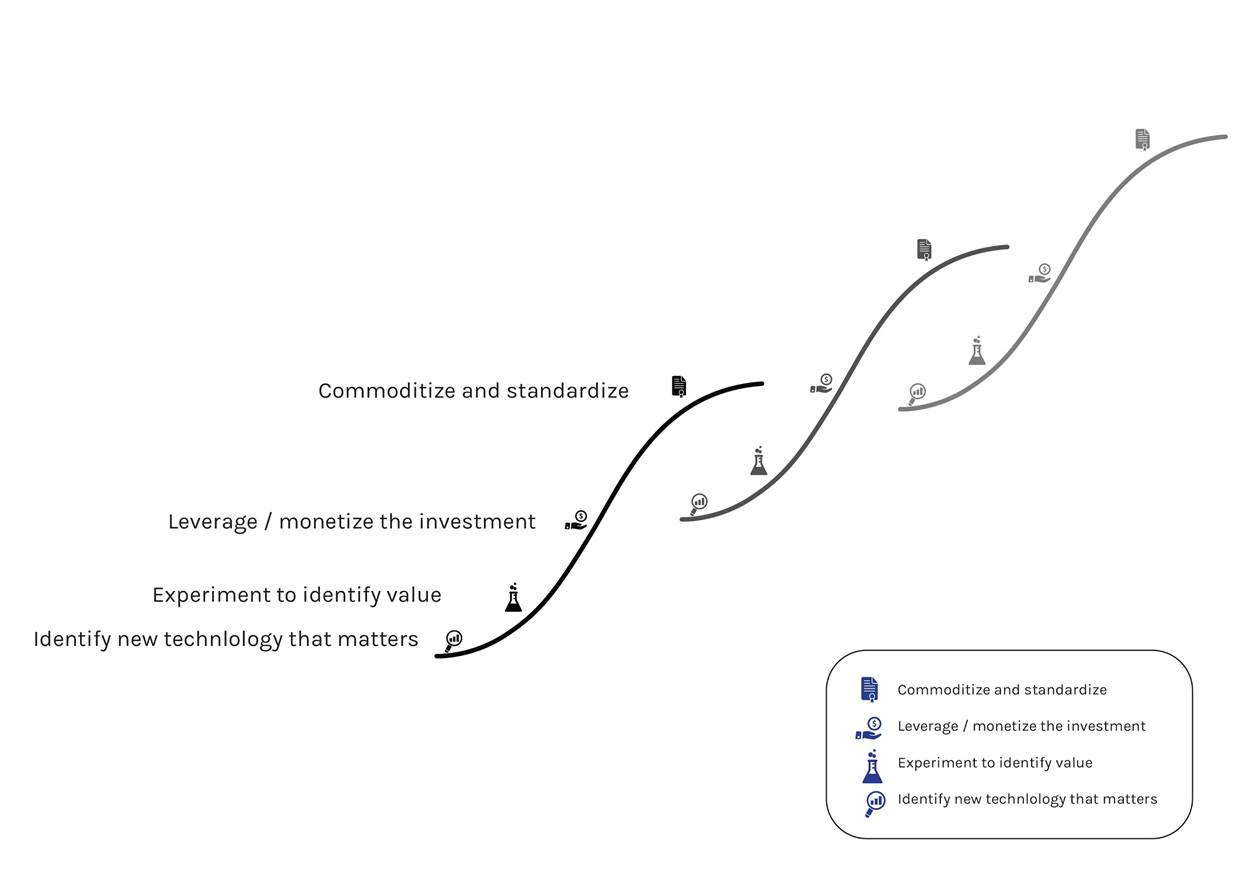
They do this by being adept at identifying new and emerging technologies that matter, implementing and leveraging these technologies in a way that adds value and then commoditising them to industry standard as that technology and underlying capabilities mature and spread.
Of course, all of this needs to be done in a way that ensures these new and commoditising capabilities are seamlessly integrated with previous investments and appropriately secure. No small task.
This cycle is illustrated in the diagram below.
Multiple moving parts
Because of the speed with which technology S-Curves move, you will notice that there are several cycles in motion at any one time. The digital strategist needs to effectively work these cycles simultaneously.
Identifying emerging technologies that differentiate them in the market (ignoring those that don’t), implementing and leveraging these technologies in a way that drives value for their organisation and customers and then commoditise their once distinctive capabilities (perhaps with the help of an IT Operations counterpart), as there is little justification in continuing to maintain expensive bespoke capabilities that your competitors can replicate through standard systems and processes. And they need to do this all at the same time.
In a digital world, competitive advantage is measured in a few years if you’re lucky and months if you’re not. That is, the time you have to turn an emerging technology enabled capability into cash, is short.
You cannot afford to invest on the assumption that the advantage you gain will be sustainable for a significant period; besides, not all technologies will follow the full S-Curve. Many will never get out of phase 1. This means that while investment is necessary to remain relevant, any one investment is risky. This drives the experimentation approach to investment early in the S-Curve.
The purpose of the experiments is to identify which innovations are likely to add significant value to your business and customers as early and as cheaply as possible. Those that work need to be implemented, leveraged and monetised as quickly as possible, because comoditisation is just around the corner.
When comoditisation does catch you, you need to transition your specific processes to an appropriate ‘industry standard’ approach. There is no longer a premium for what you are doing so you need to eliminate the overhead of complex customised solutions; besides, you will not have the time to continue to maintain them as by now you will likely be well into leveraging your next cycle.
The process never ends, new emerging opportunities will get quickly commoditised to be replaced by new emerging opportunities.
Well, that’s not strictly true. Digital, like all innovations, will have its own lifecycle and eventually digital’s power over business will win. When will this happen? When Moore’s Law stops, or slows to a crawl, and all new technology advancements are evenly distributed across all businesses.
When will this happen? Not soon, but really, your guess is as good as mine.
ABOUT OWEN McCALL//
Passionate about using technology to make a real difference to businesses, communities, families and individuals, Owen McCall has focused his career on understanding and answering this question: “How do you harness the power of IT to deliver value?”
An independent IT consultant, he is a former CIO of The Warehouse.
IT organisations tend to be fond of a mandate which states what IT does and what users can and cannot do. The expectation is that if we can simply clarify and enforce the rules, then shadow IT will go away and all, or at least a few, of the world’s problems will be solved.
However, there is a problem. Mandates have never worked when it comes to users and IT.
It is the mid-1980s and I am a freshly-minted graduate working at Deloitte. I have bought my first ever PC. A sewing machine-style luggable. I have always been a bit of geek and at the time this was the latest greatest machine of its type with twin floppies (if you’re a millennial and don’t know what a floppy is, search Google. For those that do know, this is so long ago that floppy drives truly were floppy).
I loved that machine. It was a game platform, a massive calculator through amazing spreadsheets, a word processor (and anyone who has tried to read my handwriting will know how important that is to me) and many other things besides. I could do so much with it, but, I was not allowed to use it at work.
Instead I had to use A3 size tabular paper and multiple coloured pens and pencils as notation aids and massive handheld ‘manual’ calculators. It was ridiculous. I could have been so much more productive if they had just let me use my PC.
But no, the powers that be had decided PCs had no place at work.
Despite the rules, I and several others slowly began to use our PCs anyway. They were helpful and improved our productivity even back then.
The introduction of the PC saw a massive rise in shadow IT for most organisations. While people like me found them useful IT teams routinely sought to shut them down and keep them out. Many IT teams proclaimed and enforced bans – right or wrong, we all know how that eventually played out.
First encounters of the mandate kind
While my little rebellion wasn’t the first instance of shadow IT ever recorded, or likely the worst, it was my first experience of IT mandates. It still demonstrates how futile it is to attempt banning that which people find useful.
Yet many IT teams today still seek mandates to determine what technology an organisation can use and to ban the rest. And too often the prevailing opinion is that if users dare step out of line, they should be chastised. They seem to want to treat the rest of the business as if they are naughty children who have broken the rules and need to be told off or better yet smacked.
We know in our industry that mandates don’t work. If people want and need something and IT can’t or won’t provide, they just go around IT. Shadow IT. That nasty underworld of backroom deals and shady characters who go around IT and ignore all our good work. We need to deal with those reprobates and return the organisation to the light. It is part of our fight against evil and let’s face it, there are some very good reasons for us to keep up this fight.
But maybe shadow IT is our fault. After all, deep down all these “shady characters” are trying to do is figure out how to get their job done in the best and easiest way and IT can’t or won’t help. Shadow IT happens because you have, or think you have, a mandate but fail to back that mandate up with great service.
Yes, mandates are important to keep the organisation safe and to enhance your prospects of delivering value, but every mandate needs to be backed up with an appropriate service proposition or people will try and work around it.
Solving the riddle
What can you do about it? Here’s one approach that seems to be getting results.
In one organisation, shadow IT is rampant. Business leaders are sourcing their own systems because the IT team can’t or won’t help (there simply isn’t enough capacity – people or money – to meet demand). In response, the IT team has set the business free to make its own decisions, positioning itself instead as a facilitator.
Some of the key aspects of the approach are:
- All significant IT investment decisions are formally made by an executive committee. The business leader needs to front this committee and convince them of the value of their proposal. The CIO is part of the decision-making process. While possible that the committee could make a technology decision that the CIO disagrees with, the dynamics of the process supports collaboration on solution definition. Sometimes IT leads, sometimes their peers across the business lead but no one wants to front up to their peers for a public battle, so these issues are nearly always addressed before the meeting.
- The organisation is progressively sorting out what is important and core to them and their success and what is non-core. Business activities, which are considered core, are much more likely to be supported by centralised organisation-wide solutions. For those areas which are not core, a more hands-off approach is taken.
- IT has established a dedicated SaaS enablement team which works with and supports the business to effectively implement a chosen SaaS tool. Their focus is to support the business with a focus on core technology issues of security, integration and getting work done in their culture. This team avoids enforcing mandates (leaving that to the executive committee) and simply try and be helpful. What they are finding however is that the more helpful they are the more influence they get in future decisions. A nice win -win outcome.
This organisation has some way to go. IT still gets worked around at times, but the more it lets go of mandates and focuses on providing great support and service, the more influence it gets.
What can you do to start your journey? Start by identifying all those areas where you have or wish you had a mandate and then ask yourself these questions:
- Does this mandate really matter? That is, is it core?
- In what areas are we okay with a little shadow IT and where might it be desirable?
- What service proposition do we have in place to support our people and organisation so they want to work with us?
ABOUT OWEN McCALL//
Passionate about using technology to make a real difference to businesses, communities, families and individuals, Owen McCall has focused his career on understanding and answering this question: “How do you harness the power of IT to deliver value?”
An independent IT consultant, he is a former CIO of The Warehouse.
I don’t know about you, but I have a series of moments which are burnt on my mind and I can recall them easily and always will. The birth of my children, the 1995 World Cup, the turn of the millennium with family at Waikoikoi. And September 1998 in Paris.
It was the Deloitte global new partners’ conference, for all those who had made partner that year from around the world. That’s the first reason it was memorable: it marked a major career milestone. The location also made it memorable. It was my first time in Europe, as I went to North America for my standard Kiwi twentysomething OE, but what really sticks in my mind from that conference is Pat Lacoonta’s speech at the gala dinner.
Unless you’re a long-term Deloitte partner or alum, you probably have no idea who Pat is. He was Deloitte’s global CEO and 1998 was his last year with the firm. He had announced his pending retirement and, as was perhaps befitting, his speech was a review of his life and career to date. It was a typical American “land of opportunity” immigrant story. He arrived in the US as a child with his parents, who had immigrated to the US, and had nothing but the “shirts on their backs”. His parents worked hard and he worked hard and while there were many ups and downs along the way, in the end it all worked out.
I am not typically into this type of reminiscing and have never before or since considered these self-biographical speeches memorable. What made this one different for me was a single phrase, which Pat used as the consistent thread through his speech, “It’s not where you begin, it’s where you end.”
It resonated. It talks to persistence, to keeping your focus on your goals, rolling with the punches of life and to learning. I could relate to not choosing where we begin, we simply start where we are today.
Too often we lament the unfairness of where we are, of our beginning point, and we sometimes get so stuck on this unfairness that we never really start to do much to change it.
But Pat reminded us that it’s not where you begin that matters, it’s where you end. You are where you are, so now what? You get to choose what happens next, you get to have a say on what happens now and, by having a say in what happens now (and now, and now …), you get to have a say in where you end up.
I try and keep this phrase front of mind as often as possible, but particularly when things are not going so well. It’s not where you begin, or what the world is throwing at you now that matters, what matters is your response to these things.
I used it when I had a significant client service issue with a client to help formulate a response. I used it when I got a call from the GM of supply chain and he informed me he had 500+ people standing around, and was wondering when the systems would be back up and his team could start working for the day (I knew nothing of an outage). I used it not long after the doctor told me I had type 2 diabetes (it took me a couple of days to get my head around this pronouncement, however).
As I go about my day-to-day business working with organisations to improve the performance and value delivered by IT teams I see many opportunities for my clients to use this phrase and thought pattern to great effect within their organisation.
That’s on the one hand. On the other, too many IT teams and users of IT services get caught up in the unfairness of their current situation. IT is too slow in its delivery, the systems are hard to use, or, how are we supposed to deliver effectively when priorities change all the time, when we are so under resourced, or whatever the complaint of the day is.
Sure, these complaints from both sides may be accurate, but they are stuck in “where you are today, where you are starting from”, rather than in creating and having a say in where you end up. They may be accurate and right, but it’s highly unlikely that they are helpful.
Rather than being stuck in the unfairness of today, IT teams are likely to be more successful if they focus on where they want to be and choosing an action or actions that they and their team can take that are likely to positively contribute to get you there.
Then, of course, you need to do those things and, having taken action, one thing is certain: you will get some sort of result. It may or may not be the result you want, but you will get a result.
Whether it is the result you want or not, stay focused on your desired end, review what happened and learn from it then choose your next actions. The more actions you take, the more opportunity you have to learn. The more you learn, the more likely you are to achieve what you want to.
ABOUT OWEN McCALL//
Passionate about using technology to make a real difference to businesses, communities, families and individuals, Owen McCall has focused his career on understanding and answering this question: “How do you harness the power of IT to deliver value?”
An independent IT consultant, he is a former CIO of The Warehouse.
I noticed that Gartner released its latest Hype Cycle for emerging technologies last week (see this Forbes article for a summary). I love the Gartner Hype Cycles and I loathe them all at the same time because to me they represent the best and worst in the IT industry all in the one graph.
I love them because they provide me with an excellent reference point on what is happening within the industry. Reading the relevant hype cycle is a great way to get a quick update on what is likely to be considered the hot technologies that are emerging in my area of interest.
You could spend your whole life doing this (and, indeed, some people do) or you can simply reference all their hard work.
As a CIO, no matter how interested I was in emerging technologies, the reality is there is far too much to do to spend much time on this pursuit. The hype cycles (and competitive offerings) provide a quick way to understand what is coming and to start thinking about the relevance of these technologies to your business.
What’s in a name…
I also love the name of the diagram: the Hype Cycle. This name is a stroke of genius because it so accurately captures the psychological journey that we make when something new comes into our lives. It’s a very human process. Gartner has applied it to technology, but it could apply to just about anything that we come into contact with. I see it in the way my children (and I) play with their toys: the best thing ever when it is new, most are soon discarded once the hype subsides.
I can also see it in the basic structure and progression of relationships. You know how it works. You meet, you flirt, court and all is wonderful as you rise to the peak of inflated expectations. You then begin to discover that the other person is perhaps not as perfect as your initial thoughts and projections suggested. Sure they still have many good qualities but they also have some really annoying habits.
Soon enough, you dip into the trough of disillusionment; many relationships (and many technologies) never make it out of this phase, but those that do have a new maturity, more realistic than the past although likely still wrapped in some aspects of positive delusion. That’s why they last.
Relationships, like technologies, can move through these phases really quickly (Pokemon Go was declared dead by some analysts merely weeks after launch) or perhaps it can take years (including marriage and children).
Love and hate collide
I love the brilliance of the hype cycle in capturing this process, but this is also one of the reasons why I hate it. By so brilliantly mapping the process and presenting us with valuable information, they actually help sustain and heighten the process. They bring new immature products and services to the attention of the corporate executive and boardroom; these companies then go, ‘how can we use them?’
This looks like a very legitimate question, particularly in these times of rapid change and unswerving focus on innovation, and potentially the only way to survive and thrive.
Unfortunately, I reckon for most companies, particularly large complex businesses, this is a very dangerous question indeed.
Why? Because even if they focus on the right technology (which is a gamble for most parts of the hype cycle) they are unlikely to have the skills and capabilities they need to effectively deploy it in a way that adds value.
To do that, you need two things.
The first of these is reasonably obvious. You need to have very good technology capability across your business, to be able to initiate, design, build, deploy and improve new unproven solutions.
This includes leadership that can envision a better future and invest in experiments with no certainty of return, a technology team that can effectively team to deliver the capability and a user community that can turn that capability into advantage.
Few organisations have these capabilities.
We still struggle to collaborate effectively on simple issues like how often we should release new functionality, how do we get the ERP (or name your favourite other system) to work for our users, or what software we should select and implement to help the sales, marketing or other team.
If we struggle to collaborate on these relatively simple issues, how are we going to succeed on deploying immature technology through experimental processes?
It’s not what you have, it’s how you use it
The second is perhaps less obvious. Delivering value from technology is less about the technology and more about the way you use it to fulfil your purpose. Or, if you prefer, to support you in strategic differentiation from the competition.
In the end value is not derived from the technology, it is derived from capitalising on a new way to meet customers’ needs, a new way to express purpose.
This brings me to my final frustration with the hype cycle: it stops too soon. It stops before the plateau of productivity.
I know the plateau is on the cycle; however, there are seldom any technologies there. I often wonder if this is because few technologies actually make it as far as the plateau – or does Gartner just lose interest? I suspect it is a bit of both.
The thing is, the plateau is where mainstream adoption begins. If I understand my hype cycle and my technology adoption lifecycles, then this means that about 85 percent of the market will adopt a technology either in the plateau (early mainstream adopters) or after that.
While I am a big advocate of investing in differentiating capabilities, most of the technologies we invest in are not actually differentiating. As a CIO, I am just as likely to be interested in identifying technologies that may help to uniquely deliver on the business purpose or differentiate from the competition. If the business can’t see this very specific link to differentiated capabilities, it shouldn’t invest in unproven technologies early in their development life cycle.
It’s better to wait until they mature and the value path has been established by others.
ABOUT OWEN McCALL//
Passionate about using technology to make a real difference to businesses, communities, families and individuals, Owen McCall has focused his career on understanding and answering this question: “How do you harness the power of IT to deliver value?”
An independent IT consultant, he is a former CIO of The Warehouse.
It has become very trendy to trumpet the importance of failure. Many authors, and commentators are encouraging us to fail. The rationale? The only way to make progress, to change things, to innovate is to do something, most likely to do something new. When you try something new there is a chance that it won’t work out the way you expect it too. That is, you will fail.
I get the need for progress. I get that progress means that you need to try new things. I get that new things entail risk that things may not work out the way you expect, but failure is an emotionally laden word. It doesn’t matter how much you tell me that failure is good, deep inside my guts tighten and my brain momentarily panics. I am deeply conditioned to avoid failure no matter what the underlying logic is to support failure as a positive. I don’t think I’m alone. I think most people are conditioned and react this way. While I am no physiologist or anthropologist my reading suggests that a fear of failure is one of those survival instincts that has allowed our species to flourish through difficult and dangerous times. If failure massively increases your chances of severe injury and death, then you have to think that it’s a pretty rational thing.
It’s not just genetics either. As children we are constantly reinforced that success is good and failure is bad. I consider myself and my wife to be a pretty positive parents, however if you count the number of times we have said “no”, “don’t”, “stop” or similar to our children to prevent them from doing something that might cause them a minor harm, I am sure I and everyone else would be shocked. We actively discourage our children from doing new things, from taking risk for fear that they will fail. It’s not bad parenting, it is our natural protective instincts being played out.
Then we go to school and sit exams. We pass or fail. We play sport or enter that talent quest. We win or lose. Yes we are loving and supportive, but everyone from a school new entrant through to the most mature adult knows that winning and success are good, losing and failure are bad. That’s why we keep score; so we know if we are winning or not.
Then you go to work and the cycle continues. Let’s face it, no one got “let go” for doing something extremely well but we all know people who have been “let go” or put into performance management when things don’t go so well. Failure is good. Yeah right! So let’s stop pretending.
There is an alternative that allows for progress without thinking in terms of success or failure. It’s the scientific method of experimentation. The scientific method has been credited with underpinning much of the progress that humans have made. It’s dispassionate. The results are impersonal and separate from the experimenter. As a result there is no success or failure, just learning; the hypothesis was wither confirmed or not.
As much as I have a negative emotional reaction to failure I love the idea of experimenting. It sparks my natural curiosity and while a good experiment takes some rigour, it just feels like it will be fun. So let’s stop talking about failure as being something desirable and start creating experiments, learning and adapting. If we take on experimenting as a way of thinking and acting there will be significant flow-on effects to how we go about delivering innovation and change. The table below provides one potential characterisation of the differences.
Traditional approach:
- Determine / set a goal to be achieved.
- Design an initiative to meet the goal (usually based on intuition and personal experience but limited data).
- Fund the initiative in full with the expectation that the goal will be achieved.
- Implement the initiative.
- Notice the results (often we forget this step!).
- Succeed or fail.
- If we fail, design a new initiative…. and fund in full.
Experimental approach:
- Determine / set a goal to be achieved.
- Design a hypothesis (doing x will lead to ….).
- Fund the experiment with the expectation that we will learn something from the experiment.
- Perform the experiment.
- Notice and analyse the results.
- If the hypothesis is not confirmed create (and fund) a new hypothesis.
- If the hypothesis is confirmed retest to validate and / or roll out.
- Fund the retest and or roll out.
For me the critical difference in the approaches is what we fund and when we fund it. The traditional project approach only ever funds initiatives that are designed to deliver specific benefits and results. Essentially the traditional approach provides us with one chance to succeed or fail – and as we know most of our projects fail.
The experimental programme approach funds two distinctive types of work. Firstly experiments, which by their nature cannot fail and are not designed to deliver benefits but to facilitate learning. Based upon what has been learned and the degree of confidence that you have in the outcomes of the experiment, you either fund another experiment or design an initiative to roll out what has been learned. As with the traditional method the resulting initiative or project is designed to deliver benefits, however the difference is that we now have a significant body of knowledge created through experiments that demonstrate that the initiative will deliver the benefits it is designed to deliver, thus substantially increasing our chances of success.
Businesses and IT in particular are getting better at experiments. Probably the most common form or experiments is A/B testing of designs, particularly customer facing designs.
This is a great way to validate assumptions and make progress and represents a good start, but I reckon there is a lot more scope for experimentation that can help us validate large organisational change initiatives and increase our chances of success there too. Yes we will need to think differently about change programmes but the potential benefits are huge as the ultimate success rates of our programme are likely to increase substantially.
So, what do you think? Does your organisation run experiments for change programmes?
 ABOUT OWEN McCALL//
Passionate about using technology to make a real difference to businesses, communities, families and individuals, Owen McCall has focused his career on understanding and answering this question: “How do you harness the power of IT to deliver value?”
An independent IT consultant, he is a former CIO of The Warehouse.
Think about it, is driving safe? Of course not. There you are hurtling down the open road at 100kph with another vehicle coming straight towards you at the same speed. The only thing between you and the oncoming car is a thin painted line. We know that if that thin painted line doesn’t do its job and the two cars collide the result is a big mess. Bodies aren’t designed to absorb that kind of impact.
The result is that over 300 people die from driving every year and thousands more are injured. A quick search on Wikipedia quotes World Health Organisation statistics of 1.25 million people dying on the world’s roads every year.
Yet we still drive. With these kinds of statistics why would you risk your life by driving? In the end there are two main reasons for most people. Firstly, the benefits of driving are huge. Modern driving means that you can easily travel 100km an hour. The non-driving equivalent of this is 5km if you walk, 30km if you’re really fit and can bike. If you go really old school and ride a horse then on average you will cover 50 or 60km in a day. The second reason is that we know if we take sensible precautions we can substantially decrease the risk of dying. When it comes to driving these sensible precautions are fairly well known. For example:
- Ensure your car is in good working order and ideally modern so it includes all the latest safety features
- Don’t drive while you are under the influence of alcohol or other drugs
- Don’t drive too fast, or perhaps more accurately drive appropriately for the conditions
- Ensure you are alert and do not drive when overly tired
- Adhere to the comprehensive set of rules that all drivers are expected to follow when driving (that’s why the thin painted line works).
On top of this we have a very comprehensive system in place to teach people to drive safely and a series of sanctions for people who are caught breaking the rules, including taking their driving privileges away from them.
Despite all this we know that an accident can happen any time. The risk is always there, but we still do it. I believe that this is the stance that organisations need to take around digital risk. We know it exists and we know that there is always a risk but if we put in place sensible precautions then we can substantially reduce the risk of operating in the digital world and set ourselves up to succeed. The only question is what are the digital equivalent sensible precautions that you need to implement to reduce your digital risk and have you implemented them?
| Sensible Digital Precaution | Rationale |
| Ensure all your systems are up to date with the latest patches and major releases | Often organisations look at the cost of system upgrades as being a waste of money. This position is understandable because most upgrades don’t deliver significant new benefits so it looks like you are being forced to spend for no real return. The reality is that these upgrades usually contain significant improvements in security as vendors seek to close security vulnerabilities and also address new emerging threats. If you don’t upgrade you leave yourself open to being exploited. |
| Build “security in depth” | Modern cars don’t rely on one safety feature. Modern cars have multiple safety features from seat belts, to crumple zones to air bags. It’s the same in modern system security. You need to deploy multiple ways to detect and deal with potential security breaches. We call this security in depth. |
| Build digital competency | For most organisations the greatest security weakness is your staff. They simply don’t know how to keep themselves and their organisation safe in the digital world and organisations don’t systematically invest in upskilling their team in the required skills. We don’t let people drive if they haven’t demonstrated their knowledge of the road rules or their basic competence in the practical skills in driving. We should take the same approach to digital competency. |
| Know how you are going to recover | As with driving, even if you do all of the above accidents still happen. You need to be prepared for when you do have a serious security breach because it will likely still happen. You prepare by understanding how you are going to recover from this breach and get your business back online. You do this through effective IT disaster recovery planning and regularly testing your recovery plans through a variety of scenarios. |
| Actively consider and understand your tolerance for cyber security and risk | Like all things in life reducing your cyber risk costs money. Also, the more secure you want to be the harder it is to innovate. Because innovation introduces the new and previously untried. By its very nature it is likely to expose a business to new and unanticipated risks. You need to invest enough time and gain enough understanding to be able to define what your particular appetite for cyber risk is and the appropriate set of controls and mitigations you need to put in place to effectively manage your risk profile. It is no longer good enough to do the ostrich and bury your head in the sand and hope it goes away. |
Do these things and you have set yourself up to be able to enjoy the benefits of digital in comparative safety and comfort.
ABOUT OWEN McCALL//
Passionate about using technology to make a real difference to businesses, communities, families and individuals, Owen McCall has focused his career on understanding and answering this question: “How do you harness the power of IT to deliver value?”
An independent IT consultant, he is a former CIO of The Warehouse.
Organisations are obsessed with projects. Every year management invests millions of dollars into them, presumably with the expectation that they will create value and support them to achieve their goals and visions. The problem is, projects seldom, if ever, actually deliver value or move organisations towards achieving their goals. And I’m not talking about the statistics on project failure. I’m talking about a different, more fundamental issue: projects are the wrong structure to deliver sustainable value.
Projects are not designed to deliver value, they are designed to build capability. The Project Management Institute for example defines a project as “a temporary endeavour undertaken to create a unique product, service or result”.
A project delivers capability, and value is delivered through the consistent use of that capability over time.
And this is a very human problem. Who hasn’t gone on a diet or started a fitness programme with a view to get fit, slim and “healthy”. We lose weight, we get fit, we complete that 10k road race, we look great for the big event. Then, the goal achieved, we slowly but surely slip back into our old ways. It was nice while it lasted but in the end nothing much has changed.
“My project had stopped, I had raised the flag in victory and slowly,
over time, things regressed.”
This issue has really been brought home to me over the last three years. The triggering event: my doctor told me I had Type 2 diabetes. So severe that in his view there was no chance of reversing the effects. At best it could be managed with medication but eventually diabetes or its side effects would get me. And as I learned being “gotten” by diabetes is pretty nasty. You can go blind and you are a prime candidate for gangrene that could leave you needing to have your limbs amputated are just a few choice options.
After a few weeks wallowing in self-pity I began to look at what could be done. I discovered that, despite what my doctor told me, there was actually quite a lot I could do. To cut a very long story short I made two key changes:
- I moved to a very low carbohydrate diet based largely on natural foods;
- and, as far as practically possible, I have parked the car and I walk everywhere.
Written like this it makes it look like a simple process, but it wasn’t. After nine months of research, personal experimentation and recording detailed information about myself everyday (blood sugar levels, distance walked, active minutes, calories, blood ketone) I was medication free and had no signs, symptoms or health markers that indicated I was diabetic. As you can imagine this was a huge deal for me, but the point of the story is this: Having succeeded guess what happened? Slowly, over time, my behaviours began to reverse. I stopped recording everything I ate, I began to sneak different foods into my diet, to walk less… and the symptoms and health markers of diabetes started to come back.
My project had stopped, I had raised the flag in victory and slowly, over time, things regressed. What I have learned is that if I want to stay diabetes free I need to morph my diabetes control project into a new lifestyle (and I have).
And that’s the point: if you want to change things in the long term you need to change your project into a new way of doing things. It is the new way of doing things that delivers the value, not the project. This is true for all human endeavour including delivering value through IT.
“It is capabilities in use that deliver value.”
If you want to deliver value through IT you need to change your thinking from delivering initiative after initiative to focusing on a long-term commitment to building technology fitness across your organisation. You will still do projects but you will not deliver value to your organisation that way, no matter how large or transformational you think they are. It is capabilities in use that deliver value.
Morphing your projects to become ‘daily life’ is a critical step in the value generation process that most organisations miss. Too many organisations and senior executive teams don’t focus on capability in use. It’s almost as if that day-to-day hard work is beneath them. Instead, they go off and try and find the next strategic initiative, the next big thing that will save them and make them famous. The problem is it doesn’t work. You might get some short-term results but not in the medium to long term and that’s where you make a real difference for your business, your customers, and for yourself.
ABOUT OWEN McCALL//
Passionate about using technology to make a real difference to businesses, communities, families and individuals, Owen McCall has focused his career on understanding and answering this question: “How do you harness the power of IT to deliver value?”
An independent IT consultant, he is a former CIO of The Warehouse.
It is a very exciting time for her and a somewhat nervous time for me and her mother. The day after she passed I took her out for her first ever drive. I decided that having her actually drive on the road with other cars was a step too far for the first time, so I drove us to the North Shore Events Centre. There were no events on this day so what we had was a large empty parking lot set out in three connected sections that she could drive around with no real risk of hitting anything.
The lesson went well and as I drove home my mind began to drift towards work. I have been thinking a lot lately about the idea of digital competence. As I have said before I reckon that if you want to be a digital leader then one of the prerequisites is that your team needs to be digitally competent and, as I have said in previous blogs, organisations are not consistently investing in the digital competence of their team.
It was about then that a weird thought struck me. What would happen if we taught people to drive the way we teach them to use technology? It wasn’t a pleasant thought. All I could foresee was accidents, deaths and danger. So I flipped the thought. What if we taught digital competence the way we teach people to drive. That seems to have some potential. In New Zealand it takes about two and a half years and four stages to get your full driver’s licence. I wondered what if we applied this to building digital competence. It could look something like this:
| Driving Stage one of learning to drive is learning the road code. It doesn’t involve a car at all, rather the focus is learning the rules of the road. Learning the rules is vital to keep yourself and all other drivers safe. Having successfully learnt the road code you then sit and (hopefully pass) a test and earn your learner’s licence and your ‘L’ plates. |
Digital An equivalent phase in digital competence could be learning about digital. It might include how to keep yourself safe online (eg virus protection, strong passwords, the need for patching and how to recognise suspicious activity) and some basics about how digital works end-to-end (user device, networks, how to connect) applications etc. |
| Stage two is where you begin to learn the practical skills of driving. Your learning is guided under the supervision of a fully qualified driver. You are not permitted to drive by yourself and you also need to display those ‘L’ plates so those around you know that you are learning and can provide you with a bit more latitude. At the end of stage 2 your practical driving skills are tested and if you pass this practical driving test you receive your restricted licence and move to the next stage. | The digital equivalent would be learning how to actually use your digital devices and applications to get work done. As with driving, this phase could be done under the supervision of a competent user who will guide and mentor you in best practices and in how to turn the theory you learnt in phase one into practical use. |
| Under a restricted licence you can drive solo but only under specific circumstances designed to keep drivers away from the most dangerous situations. These include driving at night and with friends who can be distracting and encourage “stupid” activities.A restricted licence lets you get most of the benefits of being a licensed driver and allows you to continue to build your skills while ensuring you remain relatively safe.A restricted licence typically lasts two years however you can shorten this by successfully completing advanced study aka a defensive driving course. | The next phase of digital competence is more about learning to innovate rather than the driving equivalent of remaining safe. Having learnt the basic skills required to get work done digitally the next phase is about using your digital tools to solve and complete ever-increasingly complex situations and to learn how to identify opportunities to innovate and create new tools. Innovation may include devising better ways to complete tasks, improving decision making by identifying new sources or presentation of data or by devising new ways to engage with customers, your team or other key stakeholders.As with driving, maybe this phase could be shortened by committing to learning advanced skills in digital innovation. |
At the end of the two-year period you become a fully licensed driver and fully digitally competent. For most this will be the end of the process. For some however, they will wish to pursue additional skills such as being a paid driver whether that is trucks, buses or taxis. If so, then there are additional steps required in the process to become licensed for these activities.
Maybe my analogy isn’t perfect, but there is no doubt that a more planned approach to developing digital competence, similar to that which we take to licence drivers, is warranted if you wish to develop your organisation into a digital leader. In the meantime, I’d be interested to know what your organisation is doing to support the development of digital competence – unless I have not survived my next driving lesson with my daughter, that is!
ABOUT OWEN McCALL//
Passionate about using technology to make a real difference to businesses, communities, families and individuals, Owen McCall has focused his career on understanding and answering this question: “How do you harness the power of IT to deliver value?”
An independent IT consultant, he is a former CIO of The Warehouse.
AU: 1800 462 388 · +61 401 189 448