
TAFE NSW has launched a new program to tackle the issue of lack of business-ready tech skills – by upping educator skills. The new Industry Accelerator program will place teachers inside tech companies as part of an effort to keep vocational training aligned with rapidly evolving industry requirements.
“The program is the first major step in an ambitious program designed to strengthen connection between education and industry.”
The Industry Accelerator – Teachers to Industry Program will see educators undertake professional development and industry immersion with organisations including Adobe, Macquarie Technology Group and Omron Automation and Robotics Australia. It’s designed to give teachers hands on experience and direct exposure to current technologies, workplace practices and employer expectations, before returning those insights to the classroom.
The launch follows a successful pilot involving 34 advanced manufacturing teachers, which drove the program to progress to full implementation last week with an initial cohort of 50 digital and finance teachers beginning their initial professional development phase before beginning industry placements.
TAFE NSW says participating teachers will focus on priority skills areas and then share learnings across the wider organisation to broaden the program’s impact.
The move comes amid ongoing concern across Australia and New Zealand about the availability of digital skills.
In New Zealand, technology industry body TUANZ recently issued another call for ‘urgent, coordinated investment in home-grown digital capability’, including encouraging diverse pathways of training, expanding industry-led reskilling programs with tax credits or subsidies, and mandating technology upskilling in the core curriculum.
While employers are continuing to invest in AI, cybersecurity, automation and data-driven technologies, industry groups on both sides of the Tasman have continued to warn that demand for digital capability is outstripping supply. At the same time, employers on both sides of the Tasman have long complained that graduates often arrive with qualifications but lack exposure to the tools, platforms and technologies being deployed in business environments, with the technical skills learned in education settings often not matching those required in the real world.
In announcing the initiative, TAFE NSW said the program would help educators remain at the forefront of industry practice by providing hands-on experience with ‘leading employers across NSW like Adobe, Macquarie Technology Group and Omron’. The aim is to strengthen expertise in priority skills areas and improve the relevance of training delivered to students, ensuring it better reflects workplace expectations.
The organisation says industry partnerships will play a critical role in ensuring training reflects current workplace requirements and future workforce needs, and representatives from Microsoft, Google, SAS, Adobe, Macquarie Technology Group, Palo Alto Networks and Omron on hand for last week’s launch at the Institute of Applied Technology, Digital at TAFE NSW Meadowbank.
There is, of course, a difference between learning how modern organisations use technology and learning how tech companies would like organisations to use technology. TAFE NSW has framed the program around industry practice and workplace readiness, but it remains to be seen whether educators return with deeper insight into employer needs, vendor ecosystems or a healthy dose of both.
Fiona Watts, TAFE NSW senior manager education standards, says the program is the first major step in an ambitious program designed to strengthen the connection between education and industry while providing direct exposure to emerging technologies and workforce requirements.
Watts, who is leading the initiative, says the program is about creating genuine partnerships to help educators understand where industry is heading so they can prepare learners for careers that may not even exist today.
The new scheme forms part of a broader push by TAFE NSW to strengthen tech capabilities across its training network. Other recent initiatives include the launch of microskills programs covering AI, cybersecurity and data centres, and specialists training facilities and centres of excellence focused on emerging technologies. The Meadowbank facility, into which the Albanese and Minns Labour Governments have invested $11 million, is one on those new centres of excellence and is expected to train more than 50,000 Australians annually, upskilling and reskilling students and workers in cybersecurity, AI, big data, cloud and software.
The launch also follows the New South Wales Government’s announcement of a A$2.7 billion investment in TAFE NSW, including funding for network upgrades, classroom technology modernisation and new devices for staff and students.
How is your employee AIQ? That’s AI quotient and, according to Forrester, it’s probably nothing to brag about with new research showing that while AI tools are rolling out at speed across enterprises, workforce readiness is barely moving.
Put another way, organisations are buying the AI sports car, but most employees still don’t have a driver’s licence.
“Organisations that treat AI literacy as a strategic priority, not a box-ticking exercise, will unlock meaningful productivity gains and long-term competitive advantage.”
AIQ measures the readiness of individuals, teams and organisations to adapt to, collaborate with, trust and generate business results from genAI and other forms of the technology. The Forrester report AIQ 2.0: Employees (Still) Aren’t Ready to Succeed with Workforce AI, finds that only 16 percent of employees achieved a high AIQ in 2025, up marginally from the 12 percent seen in 2024. That’s despite widespread deployment of generative AI tools such as Microsoft 365 Copilot, Google Workspace and enterprise copilots now embedded into daily workflows.
The disconnect matters. JP Gownder, Forrester VP, principal analyst, says the lack of AIQ is becoming a clear bottleneck to productivity and ROI. Employees with low AIQ are slower to adopt AI tools or use them incorrectly, increasing errors, rework and frustration. In many cases, the time and effort required to use AI outweighs the value generated, preventing organisations from reaching the productivity ‘crossover point’ where AI meaningfully improves work outcomes.
Forrester’s AIQ framework looks at four dimensions of employee readiness: Understanding AI, skills and training, confidence and motivation, and ethics, risk and privacy awareness.
While 68 percent of organisations report using generative AI in production applications, only a small minority of employees show a strong ability to work effectively with the tools, with AI skills ‘stagnating’ despite the widespread deployment.
“This slow progress indicates that enterprise AI rollouts are outpacing investments in employee capability, creating a readiness gap that limits productivity gains and increases operational risk,” the research firm says.
Training gaps a key constraint
Training is a major weak spot. Just over half of organisations provide AI training to non-technical staff and fewer than a quarter offer prompt engineering training, which Forrester dubs a ‘foundational skill’ for effectively using tools like Microsoft 365 Copilot and Google Workspace.
The report dubs a ‘mere’ four-point gain in the percentage of individual contributes who said they received formal training as a ‘shocking lack of progress’. “It’s clear that employers haven’t stepped up to enable their employees through learning initiatives.”
It notes that GenAI tools are probabilistic, rather than the deterministic computing we’re used to. Where with deterministic tools the same input produces the same output each time, following fixed rules and logic, with GenAI’s probalistic outcomes ‘we don’t know exactly what they’re going to say and do’, Forrester says. That changes how employees must work with technology, requiring them to understand that AI outputs are suggestions, rather than definitive answers and making the need to know when to question the output of AI ‘crucial’.
There’s also the human factor. Many employees still worry AI will replace their jobs, even though Forrester’s forecasts show limited job displacement to date. Poor communication and vague messaging about AI’s role are fuelling anxiety, reducing trust and quietly sabotaging adoption efforts.
Gaps in employee confidence and motivation are also highlighted. Only 37 percent of employees report feeling confident in adapting to AI-driven work and fewer than half are motivated to build AI-related skills.
Ethical readiness is another area of concern with just 44 percent of employees feeling confident using AI responsibly and ethically. Forrester warns these gaps increase organisational risk, particularly as AI is increasingly used in customer-facing, decision-making and regulated environments.
“Employers aren’t giving their people the skills, understanding or ethical grounding they need to succeed with AI,” Gownder says. “Our research shows most organisations are rolling out AI tools without investing in employees’ ability to use them effectively.”
Here’s how to close the AIQ gap
The good news is the research is equally clear on what works. High-performing organisations treat AI literacy as a capability to be built over time, not a one-off training exercise.
“To close the gap, businesses must move beyond surface-level training and build continuous, hands on learning that demystifies AI, addresses employee concerns and develops real capability,” Gownder says. “This isn’t about replacing workers – it’s about enabling them to work smarter with AI.”
Formal learning plays a surprisingly small role in raising AIQ, with linear training quickly forgotten, Forrester says. Organisations making progress are investing in continuous learning models that combine formal instruction with practical, hands-on experience. This allows employees to apply AI skills directly within day-to-day work and build capability over time. “Better is a weekly email with tips, videos and best practices form inside your organisation and ideally inside your division.”
Social learning – with weekly office hours with a subject matter expert – are also key. Approaches such as AI champions programmes, shared experimentation and peer support networks have been shown to be more effective than traditional training alone. These models help reinforce learning and support sustained adoption across teams. Middle managers need to signal with their attendance the behaviour they want to see from direct reports. Online discussion forums offering real-time help and testimonial videos of successes and failures from within your organisation have more legitimacy, Forrester says, than bland, online training.
Third, organisations need to ensure training reaches non-technical employees, who make up the majority of the workforce using generative AI tools. Practical training in areas such as prompt development and use-case application is critical to improving baseline AI capability.
Forrester also highlights the need to address employee concerns and build confidence. Clear communication about how AI will be used, what it will and will not automate, and where human judgement remains essential can reduce anxiety and support adoption.
Finally, the report stresses that ethical, risk and privacy considerations must be integrated into workforce AI education. Employees need guidance on responsible use, particularly as AI systems are embedded into sensitive and regulated workflows.
Forrester’s conclusion is clear: Technology deployment, as is so often the case, is not enough on its own. Without corresponding investment in employee readiness, organisations will struggle to realise the full benefits of workforce AI.
“The organisations that treat AI literacy as a strategic priority, not a box-ticking exercise, will be the ones that unlock meaningful productivity gains and long-term competitive advantage,” Gownder says.
Z Energy has turned to loyalty SaaS and AI tech provider Eagle Eye to drive its new loyalty program and capture new opportunities from its EV charging and expanded grocery ranges.
The company says Z Rewards was designed ‘to combine simplicity with generosity’ offering customers points for almost all their spend at Z, including purchases on food and coffee, EV charging and fuel.
“We are seeing rapid innovation in fuel and convenience loyalty, as retailers adapt to shifting consumer expectations and look to capture new opportunities.”
The program, which launched in March, is built on Eagle Eye’s loyalty and promotions platform which enables real-time rewards and recognition and is also the technology behind Woolworths Everyday Rewards program and the Warehouse’s MarketClub. Globally customers for the UK-based company include ASDA, Tesco, Carrefour, Gordon Ramsay Restaurants, Greggs and Vans, with more than 500 million loyalty member wallets.
Jonathan Reeve, Eagle Eye APAC vice president, says the company is seeing rapid innovation globally in fuel and convenience loyalty, as retailers adapt to shifting consumer expectations and look to capture new opportunities, whether through EV charging, expanded grocery ranges of value-added services.
The cloud-based platform claims to provide the most flexible and scalable loyalty and promotions capability in the world.
Bronwyn Barberel, Z Energy head of loyalty, says thousands of new customers have downloaded and used the Z app to access the rewards program since its introduction.
“Z Energy launched out new loyalty program, Z Rewards, as a way to better recognise and reward loyal customers for more of their spend at Z, beyond fuel,” Braberel says.
The program includes everyday fuel discounts, special offers and a referral scheme allowing members to get additional points for referring friends. Points can be redeemed for a range of ‘treats’.
Andy Baird, Z Energy general manager for customer, says incorporating more than just fuel into the loyalty program was critical.
“The evolution of the Z service station means along with providing fuel for customers, we are continuing to grow our network of EV charging stations at selected Z sites, and expand our grocery and convenience offers in-store,” he says.
“It’s important, therefore, that our loyalty offer evolves with us. Z Rewards does just that – offering customers points for almost all of their spend at Z, from fuel to food and coffee, through to EV charging.”
Reeves says the Z Rewards program stands out for its ability to reward customers however they shop and whatever fuel they chose, its ‘clever’ sue of popular treats as incentives and its differentiated approach to rewarding fuel versus grocery purchases. (The program awards one point for every dollar spent on fuel and two points for every dollar spent in-store or on EV chaging.)
Static webforms and PDF fillable forms are on their way out, and smart forms are taking over. But many businesses still haven’t got the memo. It’s about as smart as sticking with dumbphones because ‘that’s the way we’ve always done things around here’.
“Too many people are still not in-the-know about smart forms.”
Let’s take a look at what’s going on, why, and the next generation in data collection.
The Old World
When I was a little kid, I thought it must be terribly tough being a grown up. I would see my dad hunched over the kitchen table, all red-faced and crotchety, shuffling papers and huffing.
There were three things he hated most: Paying bills, tax time and filling out forms.
Things are much easier now 50 years later with streamlined bill payment and tax management, but somehow forms are still basically the same as they were back then!
Admittedly, PDF fillable forms and webforms offer some improvement with a more digital interaction, but they are still basically the same thing, just digital. Not particularly smart.
I don’t get as frustrated with forms as my dad, but it does feel ridiculous repeatedly filling out the same information already known to the business, such as my address details. Could they not be more ‘grown up’ as a business and provide a more mature experience?
Static webforms and PDF forms provide poor customer experiences that lead to form abandonment. Customers are often required to self-navigate choose-your-own-adventure forms. And with the likelihood of forms being completed incorrectly, they trigger customer service follow-ups about 50-70 percent of the time.
The New World
Smart forms arose from reimagining the data collection process.
What if you could make the process much easier and more natural, like a human conversation or interview?
What if you could create a dynamic journey that adapts according to existing information and answers provided?
What if you could connect to other services (like MyGov, Medicare, VicRoads, ID services, etc) to collect or verify data, so the customer doesn’t need to?
What if the data collection process were as smooth and simple for the customer as technologically possible?
Unsurprisingly, it turns out to yield far superior results.
Here are the results from case studies with Westpac, ANZ Bank, ATO, Telstra, Sydney Water, Lloyds Banking, ADF, NAB, Suncorp, and Origin Energy, among others, when they switched from PDF to smart forms:
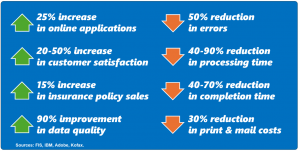
Despite such clear and unambiguous outcomes, about 50 percent of financial businesses are still hanging their hats on PDF forms. Too many people are still not in-the-know about smart forms, even though they first emerged 20 years ago. But once you cross over, there is no looking back. It’s a new life with a new level of power and possibility at your fingertips.
Key Differences, Benefits, and Use Cases
You can capture the key differentiators and benefits in this snapshot overview:
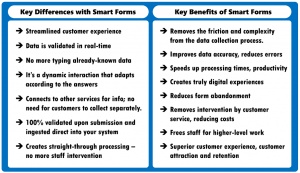
When considering where and when to use this kind of technology, the key target areas for improvement in any business are downloadable forms that need to be printed and signed, PDF fillable forms, static (non-dynamic) webforms and mission-critical business processes, anything ripe for automation and straight-through processing (such as onboarding, servicing, renewals).
But why should you be talking to me first, rather than any other smart forms provider?
I’m glad you asked.
We have the next-gen market disruptor in smart forms technology. It is a leap ahead of all other solutions with unique, patented capabilities.
Among our key main differentiators are:
- Patented NanoSites technology which completely reimagines digital data collection. For example your people can create forms on-the-fly and send them to customers via SMS or email with QR codes prepopulated with data so the customer only needs to click one button to close or accept that call to action. It’s PCI compliant as well.
- Low code, no code and can be deployed in hours/days.
- The technology is built on an IDE. You can flexibly build apps with it, tailored to suit.
- Elegant drag-and-drop workflow and journey builder for easier development so users are more productive.
- As much or as little as you need. It can extend and enhance existing investments or completely retire significant amounts of digital debt
- Complex technological hurdles resolved – uniquely achieved by our team for this solution
- Great feedback. Described as “exceeded our initial expectations”, “presents significant potential,” “offers widespread benefits,” and “could prove extremely valuable” by a Business Analyst we recently showed it to.
It’s only a matter of time before everyone has seen the light and only laggards are left to play catchup. It’s like when my dad was so resistant to switching his dumbphone for a smartphone. It took ages getting him to budge. But now he’s on it, he’s delighted! When you move to smart forms, you will be too.
There’s plenty of money left on the table for savvy businesses to pick up and stay at the forefront, reaping the benefits.
 Russ Townsend is Senior Solutions Executive, A/NZ, for Cincom Systems, helping A/NZ organisations with high volume customer communications needs to improve their communication performance.
If you would like to contact Russ, please get in touch here.
rtownsend@cincom.com or https://www.linkedin.com/in/russtownsend/.
Nearly half of Australian and New Zealand mid-market businesses say their teams are wasting valuable time inputting data into different, siloed, IT systems, diverting resources away from activities that could be bringing in more business or upskilling teams.
In an example of how more is not necessarily always better, MYOB’s latest mid-market report shows New Zealand and Australian mid-market enterprises are facing a digital disconnect as they struggle with siloed, underutilised, outmoded and duplicated systems – and the productivity and cost detriments of them.
“They don’t have large IT departments to stitch together solutions.”
The survey of more than 1,000 mid-market decision makers was conducted in October-November and shows local companies are relying on an average of five business management tools or applications – many of which (three in Australia, four in New Zealand on average) were added in the past 12 months.
While the businesses say the new digital offerings they’ve implemented in the past 12 months have brought benefits (more on that soon), they’re also reporting heavy negative impacts from ineffective digital business management solutions.
While having their teams waste time inputting data into different systems lead the charge for both Australia (48 percent) and New Zealand (46 percent), it wasn’t the only cost. Forty-three percent of Australia mid-sized businesses – defined by MYOB as being 20 to 500 employees – and 46 percent of Kiwi businesses, say their teams are having to regularly check between systems to ensure data is correct and aligns, while 41 percent of Australian and 38 percent of Kiwi businesses are sometimes or often having to edit data transferred between systems.
Unsurprisingly, the decision-makers surveyed would much prefer their teams to be targeting new customers/audiences, focusing on strategy and business planning or training and upskilling existing team members – all tasks respondents say teams are being pulled away from by the requirement for the manual tasks demanded by disconnected systems.
“When it comes to changing or improving their digital solutions, mid-market businesses don’t have the same luxuries as larger corporates with large IT departments to stitch together solutions, or access to additional budget to cover complex integration requirements,” Kim Clarke, MYOB general manager for enterprise, says.
“Instead, many are cottoning onto the fact that more doesn’t mean better and are now after future-fit platforms that remove the challenges of disconnected systems, like lower productivity and higher security risks.
“They also know they risk falling behind their peers on every level unless these challenges are resolved.”
Indeed, when asked what was preventing them from improving their current solutions, 46 percent of Kiwi businesses and 36 percent of Australian, said it was a lack of technical skills to understand the specific improvements needed.
For Australian businesses it was, however, the effort required to change the ways of working that was the biggest barrier to changing or updating systems at 43 percent (44 percent for New Zealand). The high cost of technology was also a key factor for Australian respondents (32 percent), while the time required for more employee training (42 percent) was holding New Zealand businesses back.
It’s not all bad news though.
For those who have added to or changed their digital solutions over the past 12 months, the report shows the value of the benefits when implemented strategically, are significant, with 48 percent of Australian businesses and 45 percent of New Zealand businesses saying their teams are more efficient and productive.
In Australia the new systems are enabling mid-market businesses to service a larger/more diverse range of customers (39 percent), make more informed decisions (34 percent), providing more time to focus on business strategy and growth (32 percent) and enabling them to be more competitive in target markets (30 percent).
In New Zealand, it’s an increased focus on business strategy and growth (44 percent) that is a key benefit, behind the increased efficiency and productivity, followed by being more competitive in target markets (43 percent), enabling the servicing of a larger/more diverse range of customers (40 percent) and more informed decision making (30 percent).
“Having the right tools to make informed business decisions quickly and confidently is essential to business success in today’s market, and access to real-time data and information is a critical component – particularly for businesses operating in sectors impacted by change across international economies,” Clarke says.
MYOB research in December 2022 showed mid-market businesses across both countries were feeling buoyant with many reporting ‘better than expected’ results, and profitability increases in the 2022 calendar after the lows of 2021. For many a move to remote or hybrid working had resulted in a boost in productivity.
Looking to the future, the latest mid-market snapshot shows business leaders and decision makers are eyeing up big data as the technology likely to most significantly change their business in the next five years (39 percent for Australia, 44 percent for New Zealand).
Kiwi businesses leaders are also expecting digital sales platforms (44 percent), automation and robotics (37 percent), cloud computing (31 percent) and AI (30 percent) to significantly change their business in the next five years.
In Australia, it’s cloud computing (37 percent) and improvements in connectivity (35 percent) that lead the charge after big data, with automation and robotics (32 percent) and digital sales platforms (27 percent) rounding out the top five.
Virtual events, online meetings, webcasts or webinars – call them what you will – are an effective and efficient alternative to in-person events.
They offer a platform to stay connected, build community or engage with clients or prospects, just as you would do with a physical event.
But just because the technology is easily accessible and the bar for attendance is low, doesn’t mean success is a given. With in-person options severely constrained under Covid-19 restrictions, marketers are scrambling to be heard amongst a din of competing online events across the world.
“There are some unique challenges that those new to the medium need to adapt plans around.”
To be successful, many of the same challenges that exist in creating engaging events offline also apply in the online realm. But there are some unique challenges that those new to the medium need to adapt plans around.
The Technology
By now, we’ve probably all engaged in some form of online work or social video meeting.
Through Skype, Teams, Facebook Messenger, Zoom, or a multitude of others, we’ve become familiar with connecting with friends and colleagues remotely.
We’ve probably also experienced the downsides. Background noise, connection or streaming issues, interruptions or a dominant attendee can all detract from the experience.
But for costs that range from free to tens of dollars a month, you can put up with it when bantering amongst friends and colleagues.
However, for a professional B2B or all-of-staff presentation you need a more controlled platform. This is when online meeting tools fall short – you need a webinar.
Webinar events are typically connecting people who do not know one another. They are attending out of a personal interest or to learn more about a topic. Invitations are needed to advertise the event and convert interest into registrations. Registered attendees need to be sent reminders and calendar updates, and their details need to be retained for follow up after the event.
To handle all that, you need a proper webinar tool, and that involves either taking up a paid subscription or engaging a partner.
If your organisation does not have a webinar platform, a Google search will quickly confirm that there are multiple products, features and pricing plans available.
Zoom (the webinar version), WebEx and GoToWebinar are the most commonly used in this part of the world, with Bluejeans also emerging. The products and prices are not all equal, so take the time to set up trial licenses and give the product a proper run through prior to purchase to make sure it meets your needs.
Look for features like customised registration pages, automated reminders, waiting rooms, multi-speaker views, recording, Q&A, live polls, integrated exit surveys etc.
Costs for a complete webinar platform range from around $50 to $500 a month, depending on features and maximum audience size.
Virtual Conferencing
If you are looking to create a more engaging experience, potentially with paid ticketing, you can move further upmarket into virtual conferencing systems. These are split into two categories:
- Video streaming – which involves broadcasting live ‘speaker-on-stage’ events to remote attendees. Livestream and Brightcove are the leaders in this category, integrating industry-standard camera and audio feeds into a production console and broadcast quality streaming service.
- Virtual conferencing – these seek to emulate the trade show experience for attendees, providing facilities such as break-out rooms, simultaneous presentations, live Q&A with speakers, casual chat between attendees etc. On24 and vFairs are examples of such platforms.
Costs for both these categories run into the thousands per event – typically $5,000-$10,000, or may be priced at the upper end of that range on an annual subscription for a capped number of events per year.
The environment requires significant configuration to set up so expect to also engage specialist services to assist with this aspect also.
VR/AR is emerging in this category (think salesmen as avatars roaming the virtual exhibition hall) but is more gimmicky than useful and a distraction away from the content attendees are wanting to see.
Hosted Platforms
You can also engage a partner to run webinars, using their platform of choice.
Under this scenario, you effectively outsource event management (including the platform, event collateral, promotion and all administrivia) to a partner.
Some publishers, event managers and even industry associations are offering hosted webinars with paid sponsorship options. Typically, they choose the theme and speakers and try to attract sponsors, so as a sponsor it is a matter of finding the right theme that fits your objectives and will attract the right audience.
iStart’s ‘Lunch Box’ webinars are another option. Our point of difference is that we usually work with a single sponsor and tailor an event to meet the sponsor’s specific objectives. We also come with our own database of prospects, promoting events to our subscribers who are Australia and New Zealand’s business and IT decisionmakers.
Tips for a Successful Event
- You get the audience your content deserves. Take the high road with educational, high value content and quality speakers your target audience can relate to. People will not register for a sales pitch.
- Independence delivers credibility. Companies who promote their own webinars, particularly with staff as presenters, are tarred with the perception that the event will be a sales pitch. Sadly, perception is very often reality.
- Be interesting. Would you attend your webinar? Be brave, be creative and challenge yourself with that question. Being intelligent and professional doesn’t mean being boring. Have some fun, leverage your interesting clients or wider sports or other sponsorships. But please, don’t be boring.
- Don’t script it. Speakers or panellists should be natural and confident with their content. If they can’t work without a script they’re probably not the right person. And if you need to be prescriptive, you’re on the wrong track with #3 above.
- Keep it punchy. The downside of virtual attendance is that your audience is probably sitting at their desk or at home where distractions are but a click away. Energy and interaction are key tools that can capture and maintain engagement. An expert talking in monologue through a slide deck for an hour is a recipe for failure. A panel discussion exchanging shared perspectives is usually more engaging for the audience.
Good Luck!

iStart has been hosting webinar events since 2010, in that time introducing tech brands to over 14,000 business and IT decisionmakers from across A/NZ.
Past sponsors include NetSuite, SAP, Microsoft, FinancialForce and Infor as well as local partners like Realtech, Inecom and Fusion5, with many returning to host multiple events.
We provide a rare mix of news/editorial nous, an extensive network across the technology and business sectors, and a fully curated subscriber list.
If you want your next digital event to be a success, get in touch.
E: lunchbox@istart.co.nz
NZ Freephone: 0800 928 268
AU Freephone: 1800 462 388
…
NZ Tech exists to connect, promote and advance the New Zealand tech sector and, in a recent mail-out to members the association said that it has changed greatly during the past year. It put these changes down to its diverse board make-up. This is the result of a Board Diversity Policy which came in to effect over a year ago and which saw the association actively identify skills and experience needed to help accelerate its strategies and ensure diverse thinking.
NZTech has a Governance Sub Board which reviews and assesses Board composition and recommends the skills and experience that might be best added to achieve a diverse and balanced Board. The Sub Board also oversees the conduct of the annual review of Board effectiveness.
In reviewing Board composition, the Sub Board considers: “the benefits of all aspects of diversity including, but not limited to, those described above, in order to maintain an appropriate balance of skills, experience and background on the Board.”
NZTech is welcoming nominations until 5pm tomorrow and says its main strategy focus for the year ahead is to further promote the tech sector in New Zealand.
This year it has vacancies for the following positions:
- Major Corporate (1 position)
- Corporate – Other (1 position)
- Business (1 position)
- Government/Education (1 position)
NZTech says that while the board candidate must be a from an NZTech member organisation, they do not need to be from the same membership tier that they wish to represent on the Board, provided that they are nominated by at least one Member of that tier. The details of what’s required and who is entitled to be elected are set out on the nomination form.
If you wish to nominate someone for a position on the Board, the nomination must be forwarded to Roxanne Mulvaney.

Over the last year IDC’s research manager for IT services Adam Dodds based in New Zealand has charted the changing boardroom and executive conversation concerning technology procurement. And it is a conversation that has changed significantly as we move to digital-first business and cloud computing changes the procurement framework. Below are the questions that are now being asked in the more progressive boardrooms:
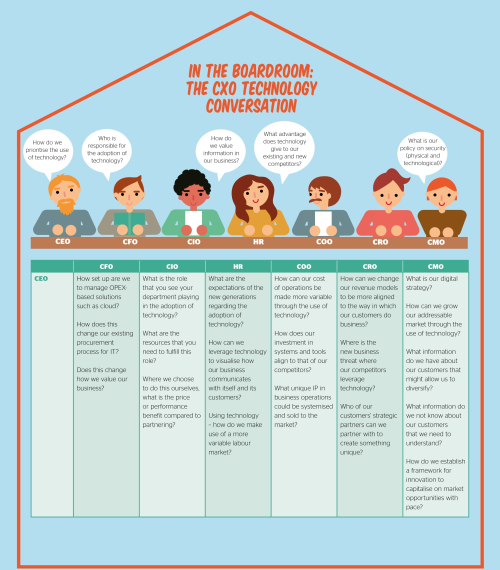
Source: IDC studies including the NZ Ecosystem Study 2014; CIO roundtables; mobility, cloud and IT services surveys during the 2014 period; and the C-suite Survey 2014 which focused on CXOs…
“New Zealand is a rock star in the world of Ricoh,” says Mike Pollok, managing director for Ricoh New Zealand. “We are well beyond thinking about product along the lines that Ricoh has traditionally. We really focus on the customer’s needs – the hardware and software offerings, and more recently commoditised IT Services, come second.
“After four years of having the consulting division in place, our sales team is now going into businesses with a very good listening ear, they approach things with a ‘how can we work with you to fix these problems’ attitude, rather than ‘do you want to buy this machine?’ as has sometimes been the case in the past,” says Pollok.
“Automating processes, storing data and documents in the cloud, failsafe IT systems…these things all add up to providing resilience and sustainability to our customers, and we think that’s really important.”
Mike Pollok, Managing Director, Ricoh New Zealand
Marketing manager Murray Clark says it has often been a case of educating the market about what Ricoh stands for. “We have made an effort in recent times to explain the wider capability that the business now brings to clients. The cheeky campaigns around the ‘I didn’t know Ricoh did that’ line have started to change how the company is viewed, as has the ‘we run the things that run your company’ radio campaign for IT Services,” Clark explains.
“New Zealand is a small market and we pick up things really quickly, we can trial things easily and find out what works. The Ricoh Solutions arm has been one example that has delivered significant growth to the business and been a poster child for Ricoh worldwide. Our relationship with Laserfiche (the document management and workflow solution provider) is another example – Ricoh NZ won an international award from Laserfiche two years in a row,” he adds.
The new office environment will ultimately demonstrate Ricoh’s diverse capabilities by showcasing how they have been embedded into Ricoh’s own processes. “We want to say ‘let us show you how we use it’ and open up our internal processes,” says Pollok.
“These concepts are a vision. We need to change our own processes to bring them up to a level that can be showcased, so we have a way to go ourselves,” says Pollok. “What we are doing with the office has created focus and momentum on completing our internal change initiatives.”
Pollok says the new premises are being designed with Ricoh’s very high standards regarding work efficiency and sustainability in mind. “We now have over five years of extensive metrics on sustainability, and by that we mean true sustainability – actually measuring the environmental impact of everything that we do, so that we can deliver better results,” he says. According to Pollok, there is only one other organisation that has a similar level of metrics – Toyota. “The sustainability initiative came from head office, but Ricoh NZ, being the nimble Kiwi firm that it is, has done it better and done it quicker. A central vision for Ricoh globally is ‘imagine change’ and we have really embraced that here.”
In one sense, the fallout from the Christchurch earthquakes has helped redefine the meaning of sustainability for New Zealand’s business community, advancing it from narrowly focused environmental initiatives to a more holistic sense of business sustainability. There is a strong interest in creating resilient business processes, and that translates into sustainable business. Pollok elaborates: “That sense of being in for the long haul is central to the Japanese heritage behind Ricoh as a company, and is core to the sustainability focus we have in everything we do,” he said. “Automating processes, storing data and documents in the cloud, failsafe IT systems…these things all add up to providing resilience and sustainability to our customers, and we think that’s really important.”
Pollok reinforces the message of continuous improvement by quoting Ricoh CEO Kiyoshi Ichimura: “There was a quote from Ichimura that was used at the global sales conference a couple of years back which has stuck with me. His words were, ‘The reputation you earned in the market two years ago may not be what the company is now,’ which to me really embodies our challenge as a company. By showcasing ourselves – opening our internal workings in quite a public way – we will deliberately be demonstrating our journey and our vision for the future.”
Clark explains that the ‘One Ricoh’ global initiative has created momentum for New Zealand’s head office project. “One Ricoh, for us, has coalesced in this idea of a single office demonstrating everything that we do and stand for.
“The new tenancy has come about because of our growth. We ran out of space in Stanley Street and have been forced to spread our divisions across several sites, which is not ideal, so to consolidate onto one site will bring together the business both physically and literally.”
The new site is under wraps, so to speak, with the refurbishment project under way inside a large construction wrap at 200 Victoria Street West in Auckland’s CBD fringe, but it will accommodate 220-plus staff across three floors, one of which will be the showcase open for clients and prospects to browse through various live business processes using Ricoh’s solutions.
Looking at the plans, the new digs will make quite a statement in the Victoria Street landscape.
AU: 1800 462 388 · +61 401 189 448