
“We planned our journey to the cloud in phases. The phased, incremental approach mitigated risk, making it easier to manage business change. We defined and proved out the solution, built skills and expertise, provided feedback to development about the user experience, and incrementally added new functionality.”
That’s according to Corey West, corporate controller and chief accounting officer, for Oracle. He’s quoted in a new whitepaper by the company called ‘Best practices for ERP cloud migrations – a CFO guidebook’. And he’s singing from the choir, after going through the process internally at Oracle.
“ERP cloud can help you achieve measurable business value, but realising this value isn’t a given, and safe passage to the cloud is not guaranteed.”
The vendor contends that while customer and talent-facing functions tend to get the most attention when it comes to migrating to the cloud, business leaders are remiss if they discount the benefits of moving their core systems. “In fact, digitising core operations can have a greater impact on operations efficiency and cost-reductions than anywhere else,” it says, quoting the results of a McKinsey & Company survey.
Where once cloud ERP was pooh-poohed as being too risky, it is becoming more accepted by CFOs but, Oracle warns, good results are not a sure thing.
“ERP cloud can help you achieve measurable business value, but realising this value isn’t a given, and safe passage to the cloud is not guaranteed,” the company says. “It’s important to understand how cloud implementations are different from traditional, on-premise projects.”
Many companies think of the cloud in terms of cost savings alone, and don’t often take the time to map their unique processes to the value they can gain from a move to ERP cloud. As a result, many don’t get the business value they had hoped from their cloud deployments.
That is the first of three best practice lessons that the whitepaper outlines. The top tips are peppered with nuggets on Oracle’s own learnings after implementing its cloud ERP solution as well as comments from successful client implementations.

To read the full whitepaper, download it here (no registration required).
…
As the Oracle Insight team engages with fast-growing small and midsize businesses, we invariably hear this feedback: Our needs have outgrown the design and configuration of our current finance system.
Most often, their off-the-shelf enterprise resource planning (ERP) systems don’t scale, are difficult to reconfigure, and can’t address the changes to their business structure or regulatory environment. Moving from an on-premises ERP system to a cloud one typically makes sense for two reasons:
- The cloud system can add new functionality, such as data analytics, dashboards, invoice scanning, collaboration tools, and automatic uploads of preferred supplier lists.
- It can lower costs, freeing budget for other business priorities.
Following are examples of companies that employed smart strategies in moving to cloud ERP.
 Do the most impactful first
A company we recently worked with needed to upgrade its on-premises ERP system to comply with changing reporting regulations. Three years ago, the company spent close to half a million dollars on a technical upgrade that didn’t deliver any additional functionality. The new initiative took a similar approach: Review the system capabilities for three months, do the technical implementation over the next six months, and then take two months to consider additional business requirements. Close to 30 change initiatives—some of which had been on the list for more than two years—were competing for an annual budget of about $100,000.
By taking the cloud route, the company was able to use only half of the originally earmarked implementation budget, while quickly delivering new features.
Halfway through the first phase of the project, a new chief financial officer arrived and stopped the project. She conducted a three-week finance process review that revealed the need to improve the productivity of the accounts payable team and get better visibility into its spending. It was determined that the company needed to introduce new capabilities, such as automatic invoice processing to eliminate manual retyping and e-mailing invoices, and easy-to-use dashboards to track spending.
Introducing these new capabilities into the previous system would have almost doubled the costs of the technical upgrade. The finance process review determined that the leading cloud ERP vendors could provide the additional capabilities in a phased approach geared toward delivering high-impact functionalities fast.
By taking the cloud route, the company was able to use only half of the originally earmarked implementation budget, while quickly delivering new features.
Use self-service capabilities
Another company we worked with struggled to get information out of its transactional ERP system in a timely manner. The company relied on an external managed service provider to create and amend reports, which took three full-time staffers.
While deciding to implement a cloud-based ERP system, the company revisited its existing reports and found that about 80% of them were used by fewer than three people at any given time. With the cloud service, the company chose to replicate only 20 critical reports out of 150, while managers who requested other reports could often use the self-service report tool.
The initial plan to replicate all existing reports was expected to take eight weeks, whereas the revised plan took only three weeks. In addition, the company is reallocating some of the budget for those three external support staffers to train an internal business analyst who can deliver the needed reports.
Centralise your ERP control
In our third example, a company had started moving its legacy ERP system to a private cloud hosting service provider, and supplemented it with procurement features from a different cloud ERP vendor. It had four different contracts for this arrangement: One to provide cloud storage and infrastructure hosting for the legacy system, another to provide managed services technical support, a third with the procurement ERP vendor, and a fourth with a systems integrator to provide overall system management.
The four contracts were each owned by a different company department, and it wasn’t clear how responsibility was distributed among the external service providers, the internal IT department, and the finance organization. Also, the external support staffers spent close to half of their time extracting slightly different cuts of data for reports for different users.
The company decided to unify the contracts under a single cloud ERP provider. The goal was to create a single point of oversight, significantly reduce the cost of the in-house support, and cut the external service support costs completely.
Internalise the process
The last example is a company that reduced the cost of moving to cloud ERP by minimizing the need for external change managers. It did this by ensuring that all members of the finance executive team dedicated one day a week to the project for its duration, each taking ownership of a specific stream. The head of finance operations spent 80% of his time leading the implementation.
The only way the company could succeed was by committing to not introduce any variations to the processes across its operations in the US, Europe, and Asia. Not only did this approach save the company the cost of engaging external change managers, but it also demonstrated the senior executives’ commitment to the cloud project.
 ABOUT OGEN BOROZANOV//
Ognen Borozanov is Senior Director, Industry Strategy & Insight at Oracle.
As the managers of risk, planning, and investments in a business, chief financial officers (CFO) have had two main responsibilities: manage the departmental financial function and advise the company’s other business leaders on reducing costs and increasing efficiency.
Today, CFOs can use digital technologies—big data, mobility, social media, cloud computing—to drive growth and value both within the finance function and the rest of the business.
The Move to Cloud ERP
Within the finance function, companies of all sizes are transitioning their ERP systems to the cloud. In a May 2014 Forrester Research survey, 24 percent of respondents from midsize and large enterprises said they planned to replace their ERP systems within two years; 41 percent said they planned to move to a hybrid solution within two years.
CFOs stand to gain a number of benefits from moving teir ERP systems to the cloud. The most important is that they gain a robust, modern system at a lower total cost, producing better economic value. In other words, that fits in with a CFO’s #1 priority. With the cloud, not only do CFOs save on the capital expenditures of on-premises software, but they also save on the people costs of maintaining that infrastructure.
Cloud ERP systems also offer finance organisations constant innovation, via regular, automatic upgrades that deliver the newest capabilities. And then there’s the flexibility: With on-premises software, it was difficult to grow or downsize your IT infrastructure based on business changes. Now, you can just increase or reduce the number of users on your contract. The finance function effectively becomes more agile and adaptable to change.
A Strategic Leadership Role
As different functions in a company move to the cloud, CFOs can also help other departments make better decisions. Marketing departments, for instance, are spending increased budgets on modern software that leverages data from social media. The CFO can provide valuable perspectives: Should the chief marketing officer be investing more in certain areas than others? What’s the return on investment?
Successful CFOs are also modernising their departments while partnering with the CEO and line-of-business leaders to find new growth opportunities.
These technology decisions will affect not just the CMO, but also the CFO—resulting in an outside-in effect. Moving to the cloud is about enabling the flow of information, and CFOs have a vested interest in making data available across the enterprise.
That marketing software will tie into other systems, including finance, so CFOs need to make sure they are getting a 360-degree view of the customer across all lines of business—from sales to service. The better information they have about customers as well as the company’s operations, the better they can do their job and serve the business.
A Roadmap is Key
The key to doing all of this successfully is a roadmap. Most companies aren’t upgrading all of their systems to the cloud immediately; they are addressing one function at a time. This has the potential to introduce all sorts of integration complexity, interfering with that complete view of the organisation that’s vital for a successful move to the cloud. So it is vital to have a multiyear plan for making the transition, while building the right cloud architecture. It’s just as important to stick to that plan.
With the cloud, CFOs have the opportunity to stimulate growth throughout the organisation while managing costs. By being strategic partners with the rest of the business, they can play a key role in driving the success of their organisation.
- Jeffrey O. Henley is executive vice chairman of Oracle. He was previously Oracle’s chief financial officer.
Quantum leaps in the volume, speed and quality of digital information that redefine business now converge in finance departments. Once tasked with keeping score, chief financial officers (CFOs) and finance teams are now leveraging data insights to change the game for their companies in The Digital Age. They take ownership of business models that identify, monitor and govern financial risks and rewards.
Increasingly, companies seek more than traditional skills in finance. Millennials who move up the ranks are expected to learn how data analysis advances objectives in sales, marketing, strategic partnerships, price negotiations and investor relations.
But to develop talent you must first attract it. Finance departments engage and nurture the right kind of talent by demonstrating commitment to growth and change rooted in digital transformation. Young professionals want to work for companies where their expertise can make a material difference inside and outside finance departments. If they feel isolated from data-driven trends sweeping through more agile companies, they may quit—or worse, quit and stay, but not do the job. Flexibility, collaboration and continuous learning win young hearts and minds more than ascent up traditional ladders.
Arming companies with finance talent ready for digital challenges requires planning and adjustment. Success hinges on multiple factors, both local and global. To get a picture of change on the ground, WSJ. Custom Studios, in collaboration with Oracle, asked CFOs at top global companies about building finance teams which have the right stuff. Their answers depict the new rules for the digital age:
1. Recruit—and pay for— different kinds of talent
2. Fill the gaps by grooming talent in-house
3. Ask the right questions
4. Share data or it has no value
5. Use technology and data insights to be a better business partner
6. Use digital technologies to attract and retain the best and the brightest
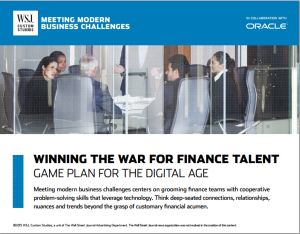
To find out more about the game plan for the digital age, please download the free whitepaper: Winning the war for finance talent
The adoption of enterprise resource planning (ERP) applications running in the public cloud has increased significantly in recent years. Research from Forbes and ZDNET predicts an increasing adoption of ERP public cloud applications in the next five to 10 years, leading to disruption of the traditional deployment of ERP applications. When looking at the full spectrum of ERP, ranging from customer relationship management (CRM) and human capital management (HCM) to finance and supply chain management, we see that organisations usually start to adopt cloud applications to add value to distinctive business processes such as talent recruiting and management or sales automation. What are the key drivers supporting these decisions, and what are businesses achieving by adopting ERP in the cloud?
Faster time to value: Cloud applications enable the business to implement new functionality immediately and at a lower cost than with traditional on-premise implementations. With cloud applications, IT is focused on integration and security, and the cloud services vendor can be leveraged for these tasks. On-premise implementations require significantly more IT effort, and a lot of energy is focused on maintaining the consistency of the existing, often complex, IT environment. This complexity can prevent new functionality from being rolled out and usually results in higher IT cost and longer implementation time and effort for the business.
Increased innovation: With cloud applications, the functionality is deployed in a standardized manner. This means that all customers run the same software. As customisations are not allowed, new innovations can be rolled out much faster and the experience from the user group can be shared. Further, in most cases, cloud applications have standard innovations such as analytics, collaboration tools, and mobile support readily available.
Scalability with growth: ERP cloud applications enable business leaders to act immediately if they need to scale. Typically, after a pilot period, they can evaluate success and decide in what manner and at which pace the functionality can be rolled out in the business.
ERP cloud solutions have matured rapidly in recent years. Today, even core transactional processes in finance and procurement can be supported in a way that is suitable for most organisations. This leads to greater value and opens new business opportunities as described in the following cases based on real-live customer engagements.
Globalisation strategy
A professional service organisation had grown significantly in over 20 countries. Each country had implemented an on-premise finance solution tailored to country-specific needs. This resulted in a significant lack of transparency and insight into profitability and cost across the business. This bottleneck started to affect the ability for finance to support the business. ERP in the cloud enabled a new business opportunity. It avoided a high cost IT re-implementation and enabled an easier way for the organisation to redesign existing finance processes and procedures. As a result, this organisation started to move to a global, uniform, and scalable system. Other benefits enabled include improved collaboration between finance resources in different countries and consistent management information in various dimensions (country, resource, service line) available instantly when needed.
Business expansion
A medium-sized organisation on an acquisition strategy had inherited many ERP applications with bespoke business processes. The existing ERP systems could not scale to support the business, and processes became increasingly fragmented. If this situation were to continue, there was a risk that the number of back-office and IT staff members needed would increase significantly as the organisation continued to grow. Moving to ERP cloud applications enables this organisation to have a common platform for existing and future businesses designed to support best practice processes. With this platform, IT and back-office costs were mitigated while new functionality requirements could be introduced easily.
Managing an aging ERP environment
A medium-sized public sector organisation had adopted several ERP applications over the last ten to 15 years. This environment became increasingly customized. The result was that the cost of maintaining this environment had increased over the years and upgrades were mostly executed out of technical need and not functionality driven. Given the size of the organisation and its functionality requirements, the cost of ERP in the cloud was lower than maintaining the existing applications. In addition, the cloud functionality was richer.
These use cases indicate that ERP cloud solutions have matured to the point where they are a smart strategic alternative for many organisations—especially for those whose ERP system is focused around CRM, HCM, and finance management. In other cases, the traditional ERP suite can be replaced by a hybrid ERP environment consisting of a well-secured and integrated combination of public cloud for generic ERP capabilities and private cloud for business-specific ERP capabilities.
Chris Downie is Senior Director Applications Sales Consulting at Oracle
ARTICLE SUPPLIED BY//
Oracle
W: https://cloud.oracle.com/erp-cloud
Australia
T: 1300 362 801
New Zealand
T: 0508 555 230
If you are a growing midsize organisation, chances are you have outgrown your entry-level accounting system. More and more companies are turning to cloud ERP systems to modernise and lay the foundation for future growth. The advantages of an ERP solution delivered ‘as a service’ include an intuitive user experience, modern functionality and the ability to conduct business anywhere via mobile devices. Cloud ERP also offers more favourable economics with subscription-based licensing and minimal need for IT support. And, reduced implementation times offer you faster time-to-value.
However, careful management of the implementation project is necessary to ensure current and ongoing success. Essential criteria to consider include data migration from existing systems, taking advantage of best practices, and using the modern capabilities built into the new cloud applications.
There are five major steps involved in a cloud ERP implementation which will ensure success in the short and longer terms. They are:
- Build a plan
- System design
- Data conversion
- Systems integration
- User adoption and training
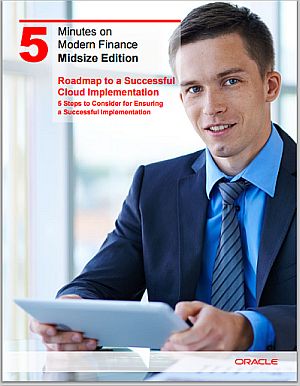
To find out more download our free whitepaper – Five minutes on modern finance midsize edition.
…
AU: 1800 462 388 · +61 401 189 448