






Published on the 05/03/2026 | Written by Heather Wright
Integrated data and automation reshape business…
For Nick Lachimea, there’s a simple principle driving Apex Steel’s technology strategy: Every digital investment must strengthen service, accuracy and responsiveness.
Lachimea, chief corporate officer for the Australian manufacturer and distributor of steel products, is clear that technology is a fundamental requirement for his industry – not only to enable operational efficiencies, but to remain competitive.
“Over the next three to five years, the biggest differentiator will be deeper system integration with key customers and suppliers.”
“In the steel industry, differentiation comes from service, not the product,” he says.
“Over the next three to five years, the biggest differentiator will be deeper system integration with key customers and suppliers,” he told iStart. “Seamless data sharing will reduce friction, minimise errors and improve speed to market.”
Reduced manual keying errors and processing delays will also be key.
“Businesses that eliminate those inefficiencies will have a clear service and cost advantage,” Lachimea says.
The focus on eliminating friction has shaped a broad digital roadmap for Apex, which has adopted a progressive modular approach, upgrading its warehouse management systems (WMS), integrating with SAP Business One, introducing analytics to guide planning and deploying Zebra technologies to modernise frontline workflows.
While a deployment of Zebra ultra-rugged mobile computers, printers and barcode scanners might be a highly visible step which has garnered the company attention, Lachimea says the foundations sit much deeper.
“Our ERP and WMS platforms form the backbone of our operations, supported by analytics and planning tools that drive informed decision making across procurement, production and customer service.”
The objective is not simply to capture more data, but to ensure operational performance is visible. “This allows us to respond faster to customers and maintain tight control over stock, production scheduling and delivery performance.”
The company previously relied on a legacy paper-based system, which led to inaccurate stock counts and fulfilment delays and hampered the company’s long-standing stated goal of setting itself apart through customer service.
The modernisation has included a combination of mobile computing, barcode scanning and industrial printing, alongside the Warehouse Management System upgrade designed to connect seamlessly to Apex’s SAP Business One system.
Lachimea says the new workflow has dramatically reduced order-receiving time.
“Receiving orders could take up to an hour. With Zebra’s MC9 series mobile computers, it now takes 10 minutes, making our team six times faster.”
Orders are now received digitally, entered directly into Apex’s systems, and automatically nested with similar jobs to improve production efficiency.
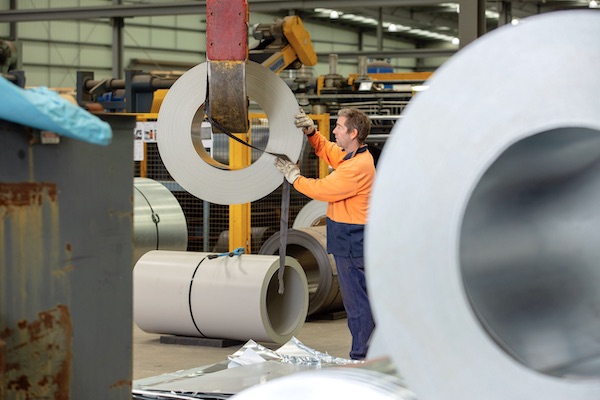
The new workflow provides a single source of truth for inventory. On the shop floor, barcode scanners validate every steel coil’s colour and gauge before cutting, preventing material waste and expensive rework. Industrial printers automate the final labelling stage, ensuring every finished pack is correctly identified to prevent shipping errors.
The improvement in inventory visibility has produced a measurable service impact. “We can tell a customer immediately if we have an item in stock and commit to next-day delivery with 99 percent confidence.”
The digitisation effort has also changed how operational information flows through the business with Zebra’s solutions working with the WMS to enable real-time visibility of stock, improved accuracy and instant data sharing across the business.
“This has empowered planning and purchasing decisions by moving from historic forecast-reliant processes to data driven decisions. It also enables more frequent stock validation and faster investigation of unusual variances.”
From a customer perspective, the biggest opportunity is confidence. “We can confirm availability more readily and provide more accurate delivery timelines, enhancing overall customer experience.”
Tech as a workforce strategy
The technology is also a workforce strategy. Lachimea emphasises automation is a support for Apex’s team, rather than a replacement. Reducing administration and paperwork enables team members to focus on activities such as customer engagement, supplier collaboration and problem solving, all areas he identifies as critical to service outcomes. “We see digitalisation as enabling our expertise to be applied where it matters most, in delivering service.”
Every transformation project comes with cultural and procedural challenges, and Apex’s has been no exception. “Any system rollout requires buy-in from everyone,” Lachimea says. Not all benefits are immediately visible at the frontline and adjusting established habits takes time. However, once improvements become clear ‘adoption accelerated quickly’.
The lesson, he says, is that process discipline and training are just as important as the technology itself.
Beyond the frontline digitisation, Apex is taking a pragmatic approach to the architecture supporting its operations. “We operate within a hybrid architecture,” Lachimea explains. Legacy systems remain in place that continue to perform well, but they are being progressively upgraded and integrated into a more connected, cloud-enabled environment.
“Our focus is on modular and scalable systems that can evolve with the business rather than wholesale replacement for its own sake.”
Looking ahead
Lachimea says the next wave of automation will focus on accounts payable and accounts receivable automation, including digitising supplier invoice processing, matching delivery dockets to invoices, automating reconciliations and streamlining collections and payments.
Looking further ahead the company is exploring real-time sensors, along with expanded reporting capability and further automation opportunities.
“A major focus is equipping our customer service team with enhanced visibility tools so they can proactively support customers,” he says, adding that technology investments will continue to be guided by improving service outcomes.
“Our commitment to service and reliability has not changed, but the way we deliver it continues to evolve. By integrating modern software and hardware platforms, we reduce manual touchpoints, improve data accuracy and ensure we meet and exceed our customers’ expectations for quality and reliability.”