






Published on the 01/04/2026 | Written by Heather Wright
Virtual modelling proves real power in major builds…
A ‘world-first’ deployment of digital twin technology on New Zealand’s $290 million Te Rua National Archives project has highlighted how early-stage virtual modelling could prevent millions of dollars in cost overruns and slash operational emissions across the country’s $275 billion infrastructure programme.
Australian ASX-listed real estate assets manager Dexus, which was the project developer says it adopted an ‘end-to-end’ digital strategy for the project, including creating a full digital twin pre-construction to enable real-time decision-making, stakeholder engagement and seamless transition into facilities management, with the model now being used to manage the buildings operations.
“The scale of the model and the accuracy behind it are unlike anything we have worked with in New Zealand.”
The twin eliminated design clashes before construction began and held contingency to just five percent – half the industry norm of up to 10 percent.
The digital twin is now operating as a live facilities management system for the building, which opened last week, and Dexus says the technology has helped cut the building’s operational carbon by 80 percent.
Te Rua’s results demonstrate the impact of embedding a fully coordinated digital environment before ground is broken. Dexus says if digital twin technology is introduced from the design stage of large scale projects to identify and address flaws across the infrastructure pipeline to the levels achieved on Te Rua, New Zealand could potentially avoid millions of dollars in construction cost overruns.
The archive, which is one of the most technically demanding buildings constructed in New Zealand, required millimetre-level accuracy to meet strict environmental and seismic performance standards. Designed to remain operational after a one in 1,800-year earthquake, it must maintain temperature and humidity within one degree tolerance for at least 48 hours in a power failure to protect government records and taonga held under UNESCO Memory of the World obligations.
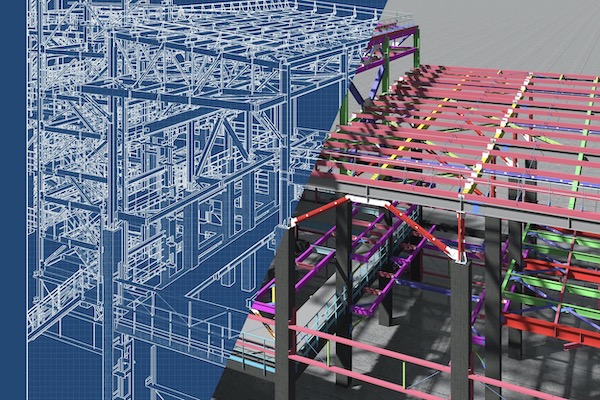
The digital twin created a 3D virtual environment that allowed architects, engineers and contractors to detect and resolve design conflicts before they appeared on site – a common source of costly delays and rework in complex builds. The archive’s model was ‘clash-free’ at tender stage, an accuracy level Dexus says was not previously seen in complex civic construction in New Zealand.
Contractors used on-site stations connected to the live design so they could install services with millimetre accuracy, and augmented reality was deployed for quality assurance during installation, allowing the design team to validate work in real time.
Once the building was operational, Te Rua’s digital twin transitioned into a live facilities management platform. It now monitors more than 20,000 assets, tracking temperature, humidity, energy use and structural movement in real time. The system has already contributed to an 80 percent reduction in operational carbon emissions – equivalent to around 1,330 tones – by optimising environmental systems and enabling proactive fault detection.
Risk-mitigation engines
Phill Stanley, Dexus portfolio manager, says the results have direct implications for hospitals, data centres, water infrastructure and high-density civic buildings that require strict environmental stability and uninterrupted operations.
He believes with the integration of AI, the methodology could be adapted for use in New Zealand’s planned multibillion dollar healthcare infrastructure programme to produce clinically safer environments for patients.
With major projects gearing up in New Zealand’s hospital sector, including a new Dunedin Hospital, the redevelopment of Nelson Hospital, the expansion of Wellington’s Emergency Department and major upgrades to Auckland’s hospital network, Stanley believes digital twins could be a winning formula – effectively a hospital risk-mitigation engine.
“These facilities rely on uninterrupted power, complex mechanical systems and precise climate control and even minor faults can create clinical risk,” he says. “Digital twins could help control costs, reduce construction delays and ensure clinical spaces meet strict operational and environmental requirements from the day they open.”
He says while New Zealand has previously been slower to adopt digital design, the gap now represents a chance to reset industry practice and prevent the design clashes that traditionally surface only once construction is underway.
“You cannot retrofit this level of coordination. You have to make the decision right at the start or you lose the opportunity. Once you commit early, everything else becomes more predictable.”
While no two infrastructure projects are identical, Stanley says achieving the financial results seen on a project of Te Rua’s complexity demonstrates substantial, repeatable savings potential across the broader infrastructure pipeline.
“This… shows what is possible when everything is coordinated from day one. The scale of the model and the accuracy behind it are unlike anything we have worked with in New Zealand. For us, it gave a level of design certainty you just do not get on projects of this complexity.”
Australian adoption
The benefits aren’t confined to Wellington. Australian projects—facing their own pressures from rising costs, labour shortages and a packed infrastructure pipeline—are turning to digital twins for similar reasons. According to Deloitte and Autodesk’s State of Digital Adoption in the Construction Industry 2025 report, digital tools are becoming a central too in how Australian firms manage complexity, reduce delays and improve visibility across major builds. The report highlights that digital twins are now among the key technologies transforming delivery workflows across six Asia Pacific markets, including Australia.
On construction sites, digital twin integration has moved from pilot to practice. Builders are pairing models with photogrammetry, laser scanning and IoT data to maintain continuous, real-time alignment between the physical site and its digital counterpart. Teams then use the live models to rehearse material deliveries, test staging sequences and identify planning errors early, reducing rework risk and improving the likelihood of on-programme completion.
During construction, the models act as coordination hubs. Australian projects using live digital twins report earlier detection of discrepancies, cleaner as-built validation and faster decision cycles thanks to remote walkthroughs that allow certifiers, trades and clients to review issues together. The approach helps cut reactive repair costs by flagging anomalies – such as rising transformer temperatures or spikes in water demand – before they turn into expensive failures.
Beyond immediate project control, digital twins are underpinning longer-term asset management.
In Australia’s bridge network, the University of Melbourne’s Centre for Spatial Data Infrastructures and Land Administration (CSDILA) is developing a digital twin platform for structural health monitoring. The system integrates real-time IoT data, geometric models and physics-based simulations to track structural behaviour across critical sites, including heritage rail bridges owned by the Australian Rail Track Corporation. These models support predictive maintenance and provide detailed insights into safety and performance, offering a scalable approach for infrastructure networks nationwide.
Meanwhile, digital twin project management is gaining popularity across Australia’s expanding infrastructure portfolio. Major initiatives, from Snowy Hydro 2.0 to Western Sydney International (Nancy-Bird Walton) Airport, are turning to digital twins for real-time monitoring, lifecycle analysis and predictive forecasting. As project owners balance the pressures of complexity, cost and stakeholder expectations, digital twins offer the transparency and control needed to mitigate delays and keep delivery aligned with programme targets.
For both countries, the implications are substantial. In New Zealand, where a $275 billion infrastructure pipeline is underway, the potential savings from avoiding design clashes and optimising performance could be measured in the hundreds of millions. Te Rua may be the most prominent example to date, but its methods – early coordination, real-time validation and data-driven asset management – are directly applicable to hospitals, civic facilities, water assets and data centres.
While the technology won’t prevent every challenge, it does offer something the construction industry rarely enjoys: Predictability. By exposing issues long before they hit the site – and flagging operational risks before they trigger failures – digital twins give builders and asset owners the chance to act early instead of react late.